Showing posts with label box wine. Show all posts

Tuesday, August 29, 2017

Canned Rosé – A Naked Vine Examination

The contenders...
A couple of our neighbors recently invited The Sweet Partner in Crime and I out on their boat for some fun in the sun out on the Mighty Ohio. I brought along some beer for myself, but the SPinC prefers rosé for her day drinking.

Bottles of wine pose their own unique portability issues, so on my load-up trip to Big Wine Store, I ambled by the “bulk” section to see if there were suitable containers. That’s when I discovered that the powers-that-be have gifted us with rosé…in easy-to-boat-with aluminum cans.

I’ve covered the idea of wine-in-a-can in this space before. My initial experience with Underwood Pinot Noir led me to purchase a couple of cans of their rosé for our trip. But I noticed that there were several other companies joining the canned wine – and specifically canned rosé – movement. And judging from the state of the shelves, it seems like these are becoming more popular options.

As a note, there’s nothing inherently wrong with a can as a storage system for wine…at least for wine that’s designed to be drunk in a casual manner. Wine cans are lined, like beer cans are, to avoid direct contact with aluminum and juice. That said, I’d suggest pouring the wine into a cup or glass. Drinking wine (or beer, for that matter) straight from a can eliminates much of the flavor, because there’s no olfactory component other than “can lid.” While this “no smell” effect might be useful for your summertime case of PBR or Beast Light, it defeats the purpose for wine or craft beers. Pour, dammit!

A few thoughts on these metal-clad pinks, starting with good ol’ Underwood:

Underwood 2016 Rosé Wine – When I first wrote about Union Wine Company’s Underwood wine in a can, they were still rolling out their pinot grigio to go alongside their pinot noir. But we’re here to talk about the rosé. Their can clocks in at 12% ABV and is produced from a proprietary blend of Pinot Gris, Pinot Noir, Riesling, Muscat, Chardonnay, and Syrah. The tasting notes printed on the can read “Strawberry. Watermelon. Peach.” – which is pretty much exactly what you’ll get. There’s a fair amount of body to this wine, which is straightforwardly fruity all the way through. It’s easy enough to drink without thinking and made for a perfectly suitable quaff while we were out on the water.

Underwood now produces five different canned wines – the three I’ve previously mentioned, along with two carbonated wines: “Bubbles” and “Rosé Bubbles.” They’ve also rolled out a “Riesling Radler” – a carbonated wine cooler made from of Riesling and grapefruit juice that sits at around 6% ABV, the same range as an IPA.

Essentially Geared Wine Company (NV) Rosé Wine – “Seek the Everyday Uncommon” is Essentially Geared’s slogan. The website clearly caters to folks who are outdoorsy, on the go folks, and the can design was the most interesting, in my opinion, of the wines we tried here. It’s made from 100% Pinot Noir from Napa and suggests pairing with “Pizza by the slice, barbecue brisket, and falafel” – which sounds like an interesting evening’s menu.

Unfortunately, the wine itself wasn’t as interesting. In the words of the Sweet Partner in Crime, the experience of this wine was “Pink. Wet. Gone.” Honestly, it didn’t feel all that much like drinking wine. There was an initial burst of watermelon and strawberry to let you know “Hey! You’re drinking rosé,” then a little alcohol and “wine-ish” taste, and not much of a finish. The note on the can said, “Think: Pink Starburst and 80’s Punk Rock,” but I didn’t get a lot of Clash, Misfits, or Buzzcocks here.

Essentially Geared also produces a California Chardonnay and a California Red made from Merlot, Zinfandel, and Cabernet Sauvignon.

Alloy Wine Works 2016 Central Coast “Everyday Rosé” – Another California entry, but in a larger format. Most canned wine that I’ve seen comes in a 375ml can – so the equivalent of a half-bottle. Alloy’s rosé (a product of Field Recordings winery) comes in a 500ml can, so think of a tallboy next to a standard beer can.

There’s a French rosé called La Vielle Ferme which I’ve reviewed here many times. It’s basically my “house” rosé – a simple, relatively light, minerally-but-fruity pink bottle of goodness. I expected more of a California thump from a wine in a big can, but I was pleasantly surprised to find a lighter-styled, very French, pinkness therein. Their tasting note is “Tastes like: strawberry, grapefruit, mint and guava, Sour Patch Kids, and rose petals.” I don’t think it’s quite that complex, but it does have strawberry and citrus with a refreshing minerality on the finish that I liked quite a bit. It was quite reminiscent of good ol’ LVF, and I certainly recommend it among the three here – for value and for flavor.

Alloy also produces a Pinot Noir, Chardonnay, a red blend they call “Fiction,” and a dry-hopped sparkling chardonnay made from ale yeast called “Weissland.”

All of the above wines run around $5-7 per can. Costing that out for bottle price comparisons, that equates about $10-15 a bottle, depending on the can size.

While these are marketed as “everyday” wines – I likely wouldn’t stock my fridge with them on a regular basis. However, a bottle of wine runs about 2-3 lbs, while two cans are about a pound and a half, and are much less likely to shatter if you happen to drop your backpack. As long as you’re not looking for high-end juice, these will be just fine for you in the wild.


Tuesday, December 02, 2014

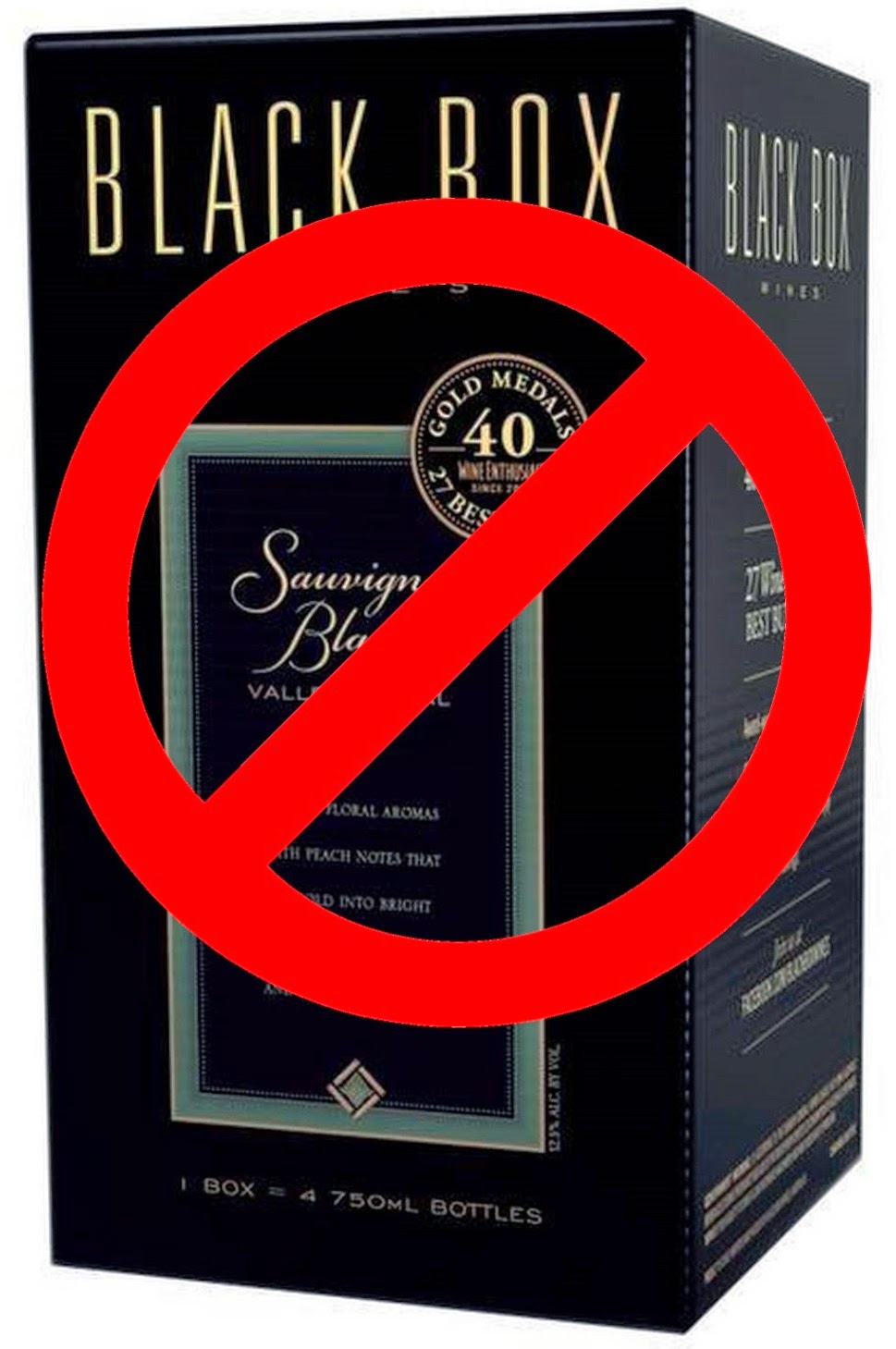
Bye Bye, Black Box

By this point in our online relationship, none of you should be surprised that I keep box wine around the house. As I've said before, I don’t keep it because it’s necessarily great wine. I keep it because I don’t always want to open up great wine. There are plenty of decent ones out there for when you just feel like being an unthinking sipper.

So long, Farewell, Auf Wiedersehen, Goodbye.
With a sense of regret, however, I must report that I'm swearing off the Naked Vine's unofficial-but-most-often-in-the-fridge "house wine," Black Box Sauvignon Blanc.

I'm not saying farewell because the wine's bad. Honestly, it's as good a box white as I've come across in my various samplings and sloshings. No...the problem, honestly, is a mechanical one.

Almost all box wines come with some sort of spigot at the bottom -- all the better to actually pour the wine. A few months back, I got a box of the Blanc just as I'd done on numerous occasions, chilled it, opened it up, poured a glass, and popped the box back in the fridge, thinking nothing of it.

I came back about an hour later to a big ol' mess.

The spigot didn't seal properly, and wine had leaked all over the top shelf of the fridge. Cursing a bit, I cleaned up the mess, laid the box on its back, and figured it was a one-off problem.

Until I got the next box. And the next box. That's three in a row. All leaky. All messy. All making the Sweet Partner in Crime and I very unhappy.

I went away from Black Box for awhile. Tried a couple of other boxes. Figured there might just have been a bad batch floating around. Since the Black Box Sauvignon is a fairly popular wine around these parts, I figured that the law of averages was in my favor. So, right before the Thanksgiving holiday, I decided to shoot the dice and pick up another box. The box got opened at some point during our Big Feed prep. Again, the box sat innocuously on the top shelf, and I didn't think anything of it...

...until the day after our family meal. Yes, another leaky box, and this one had some gumption. I'd estimate that probably a third of the box -- yes, that's a full liter of wine -- leaked into the fridge. Cleanup, as you might guess, was unpleasant with a fridge full of leftovers, stray vegetables, bottles of things, and various other sundries.

If Black Box decides to redesign their spigot or find a new spout manufacturer, I could be enticed to return to the fold. For now, though -- I'm on the hunt for another good box of sluggable white. Any of you out there in Vine-land have suggestions?


Monday, August 04, 2014

Who ya got? -- Pinot Noir Smackdown! Bota Box vs. Black Box.

You drink box wine. I know you do. We’re all friends here. I won’t tell. You close all the blinds and make sure the neighbors aren’t watching before you open the kitchen cupboard to sneak a little splash of merlot from that little plastic spout, or you move aside the Tupperware of leftover potato salad from the office potluck to get a glug of pinot grigio when no one’s looking.

I drink it too, you see. There’s nothing inherently wrong with it. For the sake of full disclosure, I often have a box of red and a box of white floating around the house. I don’t keep it because it’s necessarily great wine. I keep it because I don’t always want to open up great wine.

Box wine serves a particular niche. Box wine is wine for drinking, not thinking. Sometimes, wine just needs to be good enough. When I flop on the couch after a long day at work or at the end of an evening, I don’t really want to dig in the cellar and pull out something special.

Box wine has come a long way since the huge cardboard containers of Vella and Franzia which often look like building material for the back walls of wine stores. I’ve written about box wines before, and I’ve come to the conclusion that while box wines aren’t generally going to blow you away, better mass-production techniques and greatly improved storage systems have improved the quality to a point where you can knock the stuff back without feeling like you should be drinking out of a brown paper bag.

For a long time, especially with the reds, I’d only seen Cabernet Sauvignon, Shiraz, and Merlot. A few years ago, Zinfandel came on the scene, followed by Malbec. Those two are now more common. Over the last couple of months, I’ve seen Pinot Noir releases from arguably the two most well-known manufacturers of box wine -- and when titans of the bulk wine industry go head to head, The Naked Vine is there with a scorecard. Imagine Michael Buffer, if you will:

·         In this corner, hailing from the Valle Central and Casablanca regions of Chile, weighing in at 13.5% alcohol, comprised of grape blends unknown, retailing for $22 – Bota Box Pinot Noir.
·         And in this corner, from across the many hills and valleys of California, weighing in at 13.2% alcohol, comprised of 78% Pinot Noir, 21% Syrah, and 1% “Dry Red,” retailing for $24 – Black Box Pinot Noir.

Ladies and gentlemen…let’s get ready to rummmmmble! (DING!)
Round One – Head to Head

How are these wines side-by-side? Despite the color scheme of the two wines’ packaging, the Bota Box actually pours a little bit darker. Since they’re both wines made in the “style” of pinot noir, both have cherry and strawberry flavors, and both have gentler tannins than, say, Cabernets or a Malbecs you might find in a box. The Bota is the richer of the two, with more cherry and cola flavors, and a lot more tannin on the finish. It certainly tastes closer to what I’d expect from a pinot noir than the Black Box, which showed as a little more acidic, had a lighter body, and really didn’t go anywhere on the finish. Head to head as a first glass: Winner: Bota Box.

Round 2 – Flying Solo (Cup)

Did you know that the second ring on a standard red Solo cup is a five ounce pour of wine? See? All sorts of useful information here. (Also, the first ring is 1.5 oz – a shot of liquor. The top ring is 12 oz – a standard beer.) The next test for our battling boxes was to see how they hold up after a couple of consecutive glasses. At a party or other social occasion, a box of wine on the table doesn’t exactly say, “Just have one glass.” Also, odds are, there’s no fine stemware service.

On separate days, I had three small glasses over a stretch of time to see how the wines progressed. The Black Box’s more-nondescript nature actually played to its favor here. By the third glass, it settled into a “hey, I’m having some wine” groove. The Bota’s extra tannin was drying out my mouth by the third splash. For session purposes: Winner: Black Box.

Round 3 – The Finisher

The SPinC generally goes to bed earlier than I do. The pups generally join her, so I have some quiet time to myself before I call it a night. I’ll occasionally allow myself a nightcap as I kick back, so these wines made appearances in that relaxing space over the course of a couple of evenings. By that point in the evening, neither wine really contributed much other than something to sip on as the hour made things get foggy around the edges. Being that it’s August, I’d probably give this round to Black Box on points, but not by any huge margin. In the wintertime, I’d probably swing the other way.

Round 4 – The Big Shift

As I mentioned, we’ll swing over to box wines after we’ve already killed off a “good” bottle earlier in the evening. That transition can be, shall we say, “abrupt” – especially if the previous wine was particularly good. We got on a bit of a cooking roll this week and hit a series of really nice cellared wines. As one might expect, the wine with a little more structure buffered the inevitable “yep, this wine’s not nearly as good” transition a little more successfully. Winner: Bota Box.

Round 5 – The Unfair Comparison

The last of those wines from the cellar was a 2007 1er Nuits-Saint-Georges Burgundy. I cracked that to go with a couple of duck breasts with a sweet cherry sauce. The wine was musical and the meal was magical. We had a little bit of the Burgundy left at the end – and, for science, I gave each of these boxes a chance to take a run at the champ. I’ll save you the trouble of trying it at home. Don’t. Just don’t. In comparison, the Black Box tasted like a pop tart and the Bota had a finish of charcoal. There are no winners here. Draw.


Overall – Bota Box is the better overall wine, but the Black Box serves its purpose. Either way, you’re getting four bottles of wine you can consume without cringing for a sawbuck. Drink up.

Saturday, August 17, 2013

Naked Vine One-Hitter: The Naked Grape Pinot Noir

"It’s an inoffensive, sluggable, dead-on, ‘party red’ wine.”
      -The Sweet Partner in Crime


A couple of years ago, I had the opportunity to try some wines from The Naked Grape – a natural nomenclatural attraction for the column, of course.

The Naked Grape expanded from their original four varietals – Pinot Grigio, Chardonnay, Pinot Noir, and Cabernet Sauvignon – to include four others: Moscato, Malbec (sourced from Argentina), a “Harvest Red” blend and a “Summer White” blend. The occasion for Christine and Shay at Hunter Public Relations to shoot me a package was to announce the release of the 3-liter box version of their Pinot Noir.

The pinot noir was one of the wines that I tried the first time I sampled The Naked Grape, and I was a little cool on it. I wrote, “It’s light bodied and acidic, and there’s a considerable amount of fruit when you first take a sip. However, the flavor slammed its brakes on the back of my tongue. This wine had one of the shortest finishes I’ve ever had. There were cherry flavors along with a “bite” that reminded me a little of a Beaujolais. Uncomplicated certainly was an applicable moniker.”

I can say, honestly, that it has improved. It’s not going to blow you away as a pinot noir. It’s still very straightforward and fruity – largely cherry and blueberry – but  they’ve obviously made some modifications to help those fruit flavors linger all the way through a fairly soft finish with just a smidge of tannin. It’s a $20 box pinot noir – I wasn’t expecting big, complex flavors.

What I didn’t expect was just how dangerously drinkable it turned out to be. It’s relatively low in alcohol and easy to knock back – easy enough, in fact, that we powered through the box more quickly than almost any box wine I can remember. (Under normal circumstances, that is.) The SPinC’s quote heading this article sums it up. It’s a perfect wine to have around if you need something that almost anyone can unthinkingly drink on. A crowd pleaser.

The Naked Grape has a partnership with a recycling company named Terracycle that handles numerous “waste streams” of “non-recyclable or hard-to-recycle items” – such as M&M wrappers, handbags, shoes, cigarette waste, iPods, pens, Solo cups…and Naked Grape wine boxes.

The way it works: you go to http://www.terracycle.com and fill out a registration. Once you finish your box, you can break it down and box it, print a UPS shipping label from the website, and ship the items to Terracycle for free.

For every Naked Grape box you send back, Terracycle donates two cents to a charitable organization called Clothes4Souls. I sent a message to Terracycle asking if they accept and recycle other brands of wine boxes like Bota Box or Black Box and, alas, they do not.

Even so, the idea is quite nice in theory – especially if you live in an area where comprehensive curbside recycling isn’t available. Can’t hurt to look into it.

Tuesday, June 19, 2012

Lessons of Pepperwood Grove

On returning from a recent conference, I discovered Wine Fairy had visited. A sample pack of Pepperwood Grove wines, courtesy of our friends at Balzac Communications, had magically appeared.

O Happy Day! Wine Samples!
You’ve undoubtedly seen Pepperwood Grove. It’s an inexpensive wine from Don Sebastiani and Sons. The bottles have a “green wave” pattern on the label, but they’re best known for the “Big Green Box” – a three-liter…well…box of wine. As most of you know, we have no problem with box wine around these parts. As long as you’re not looking for top notch juice, box wine can be a great option for an “I don’t want to think about it” offering. You know, when you’re tired or after a few other bottles you did think about…

According to the release, Pepperwood Grove was the first “established” wine brand to launch a “boxed line extension” -- The Big Green Box. This version of their regular wines first appeared in 2010. Sebastiani and sons sent these samples to announce the launch of Pepperwood Grove’s “Little Green Box” – a 500ml mini-container made from 100% recyclable material. Each container holds about three glasses.  They sent me a Little Green Box of pinot grigio, a Big Green Box of chardonnay, and a “Groovy Green Bottle” of their pinot noir.

I’d not had Pepperwood Grove in quite some time. I see it in most every wine store I walk into. I honestly hadn’t given it much thought, but I’d never tried three wines consecutively from the same producer in different “formats” and the Wine Fairy was being generous…

First up was Pepperwood Grove Pinot Grigio, which turned out to be a very “soft” wine at first sip. By “soft,” I mean that there’s not the acidity I usually expect – especially if something is marketing itself as a “pinot grigio.” Winemakers usually brand their wines either “pinot grigio” or “pinot gris” depending on whether they’re more Italian (more crisp and tart) or French (more mineral and smooth citrus) in style, respectively. Honestly, this California offering was neither. It was lightly peachy on the nose, quite full-bodied for a pinot grigio with plenty of peach. I thought it was inoffensive and flexible enough to be a good picnic wine. This travel-friendly pack would go alongside most food – appetizer to dessert.

We moved on to the Pepperwood Grove Chardonnay – This was the wine they’d sent in the “Big Green Box.” It’s also from California, and is actually a blend of Chardonnay, Chenin Blanc, Pinot Grigio, and Viognier. It’s 77% Chardonnay -- anything over 75% and a winemaker can label it Chardonnay. I’ve had the Big Green Boxes before, and I’d found them to be decent, but I hadn’t tried the chardonnay. Honestly, I wish that were still the case. All due respect -- this wine was simply not good. The major flavor is very ripe apple with some creaminess. That’s the nicest thing I can say. On the downside, there’s what tastes like an attempt to do a chemical approximation of oak that doesn’t quite work, and an unfortunate tartness.

Finally, we ended up with the Pepperwood Grove Pinot Noir – This Groovy Green Bottle’s grapes are sourced from Chile. Basically, I’d consider it a serviceable sluggable wine – but I wouldn’t call on it if I were looking for a pinot noir. I thought it was plummy, medium bodied, and straightforward – it would be a very solid table wine if one wasn’t picky. We rated it clearly the best of the three.

I usually wait until after I’ve tried sample wines to read the tasting notes to see how close my palate discerned what the winemaker was trying to do. My observations were nowhere close to the company tasting notes for the whites. For instance, the pinot grigio was described as “light” and “mineral driven” with “bracing mouthwatering acidity,” which was far from what I got. The chardonnay was allegedly “crisp flavors of green apple and biscotti contrast with hints of grapefruit, toasted marshmallow, and fresh lime on the finish.” No. Just no. All tasting notes are subjective, but there’s a general neighborhood.

Turns out these wines were shipped during one of our first fairly hot bursts of the season. The flavors I found in the pinot grigio and the chardonnay reminded me of wines that had been blasted by heat and gone over. My hypothesis? My package was left out for a little too long on an unexpectedly hot loading dock somewhere. Since the glass bottle provides better insulation, it wouldn’t have been affected as much.

Upon reflection over my career purchases, I’ve had considerably more box wines be spoiled than bottled wines. While I’m certainly not turning against box wine anytime soon – it might be worth asking the folks in your local wine store about how quickly their box wine aisle turns over and how those wines are stored when they arrive at the store.

As it stands, I can’t say whether the Pepperwood Grove wines were exposed to poor treatment in transit that they’re just not as tasty. If you decide to try one, make s

Monday, September 20, 2010

Box Wine II – Electric Boogaloo

You may remember back in the late aughts when my dear neighbor Christine the Pie Queen challenged me to write a column on box wines. After some careful thought and consideration, we ended up throwing the First Annual Box Wine Extravaganza.
Somewhat embarrassingly, a couple of years have passed. A lot of wine has been poured across the alley during that stretch, but we hadn’t managed to re-extravaganzize. This year, though, a solid confluence of events stacked the boxes clearly in our path. We were back in business. We coupled the box wine tasting with a reprise of her hubby Jeff’s ribs and let the good times roll.
A quick refresher on box wines. Yes, you can still get your sugar-water box of Franzia or Vella if you really want to make huge batches of sangria, but box technology has improved greatly over the last several years. Advances in production have allowed winemakers to put wines in these containers that can last weeks if not kept cool and months in the fridge.
For a long time, winemakers used box wine as a way to get rid of some of their inferior juice – and there are still clearly cases of that, like the aforementioned Franzia. A couple, however, latched onto the idea that putting halfway decent table wine in boxes for easy consumption was a winning strategy. Three years ago, you’d struggle to find anything other than cabernet, merlot, chardonnay, Riesling, and white Zinfandel in boxes. Now you’ll find malbec, sauvignon blanc, pinot grigio, and any number of other varietals. Europe has long “boxed” table wine, and some of those are making their way to American shelves as well. As more wines appear on the shelves, quality tends to rise. (Although we have a cautionary tale below.) Prices range from $15-20 for most boxes.
So, in hopes of finding some decent wine, we cracked open four at the Extravaganza:
  • Pinot Evil Winery Pinot Noir
  • Folonari Pinot Grigio
  • Bota Box Chardonnay
  • Red Truck “Mini Barrel Red”
I have different expectations for box wine. I wasn’t looking for any kind of thunderously outstanding vino. When I pour box wine, I want something I can drink pleasantly without thinking too hard. I approached the judging in a very simplified manner. I made a few scoresheets with the following statements:
  1. 1) This wine tastes good.
  2. 2) This wine tastes good with food.
  3. 3) I’d drink this wine at home.
  4. 4) I’d recommend this wine.
People simply checked “yes” or “no” for each statement and added comments if they wished. Each “yes” gave a wine one point. The totals were averaged to determine an overall score. The results?
Folonari Pinot Grigio – Score: 4. The winner of the day. Straight yesses on the scoresheet. “Unassuming, but very pleasant” was one comment. Another noted that it went “very well with the potato salad.” This particular potato salad, interestingly, had olives in it. In retrospect, it makes sense why an Italian wine would be particularly good there. I thought that it was exceptionally drinkable, especially on a warm day. For a setting like our little shindig, it was the right wine for the right time. Around $20 for a box. Folonari also makes a Pinot Noir of which I’ve read some positive reviews. It’s on the list for down the line.
Pinot Evil Winery Pinot Noir – Score: 3.75. Personally, this was my favorite of the four. I didn’t know how well pinot noir would translate to this form. Most inexpensive pinots I see are domestic, but this was a French import. Regardless of ancestry, I thought this was a very solid, lightly fruity summertime option. “Very good. Dangerously drinkable.” was one comment (with which I totally agreed). More than one person mentioned that it was peppery. Also works well with a slight chill. A nice choice for either the patio or living room. Around $18.
Bota Box ChardonnayScore: 3. Bota Box (along with Black Box and Angel Juice) was one of the first “quality” box wine producers that I started seeing regularly. They’ve won awards for their Zin and their Shiraz, and I was curious about their whites. The results were positive, but not overwhelmingly so. “Drinkable, but not that great” was one comment, balanced by “Me like it!” I thought it tasted like someone made a basic, semi-fruity white wine and made “adjustments” to make it taste more like a traditional chardonnay. A hint of butter and oak are certainly in evidence, but they tasted like afterthoughts. There was also some sweetness that I didn’t think belonged there. Still, folks seemed to like it enough to drink it up, so it’s got that going for it. $17.
Red Truck “Mini Barrel Red” – Score: 0. Nope. That’s not a typo. The scoresheet was a universal sea of “no” answers. “Cute packaging. Too bad the content doesn’t measure up.” That sums it up nicely. The packaging was certainly interesting: a small metal “barrel” that’s not obtrusive or unattractive with “feet” that make it stand up. The downside – the wine inside was…well…not good. Somewhat sweet with a vinegary edge. For cooking wine – maybe, but this wine was at least $10 more expensive than the other wines we tried, and the quality was nowhere close. Very disappointing. Box wine is supposed to be economical. Unless there’s a real reason to spend more, why? I think many people saw this wine on the shelf and thought the same. Assuming the wines are of similar quality, why pay $30 for red in a slightly cuter package when you can pay $20 and get something just as serviceable. I suspect that the “cask” I bought had been on the shelf for quite some time and had gone over. If they bring the price point down to a more competitive level, this might be workable. Until that happens, make sure you check the date on the wine and ask your wine store how long those containers have been there. Buyer beware.
And a little something for the kids:

Monday, June 14, 2010

Juice Box Wines

I’ve written a couple of times before about box wines. Many of them are excellent values for everyday drinking. The only drawback to them is that they tend to be…well…boxy. The usual size of these is three liters, which is the equivalent of four bottles. The packaging is ingenious, since it’s basically airtight and wines will last a long time, especially while refrigerated.

One drawback, however -- while that size is handy to have around the house, it’s not particularly portable. Smaller versions have been popping up in some stores. J-Mac (not to be confused with J-Woww), one of the Vine’s regular readers, suggested: “It's summer, buy a couple of those "juice boxes," and have a picnic…” Not a bad idea!

The smaller versions come most frequently in one-liter containers, so there's an extra glass or so per carton compared to a regular bottle. You also can find them in 500 ml or 250 ml sizes, so they do start to approach the size of a Capri Sun. If you've got kids and you buy some of these, make sure you check closely when packing lunch. I’m not sure how well pinot grigio pairs with 4th grade civics.

These packages are also considerably lighter than glass bottles, so they make much more sense when you’re heading out to the local park, woods, levee, or anywhere else you may want to spread a blanket and enjoy some good company. In Europe, winemakers have been putting out this kind of smaller packaging for years, but it’s yet to catch on in the U.S. (although I think that will probably change in the future).

I headed to the local beverage superstore and picked out a few of these to sample. Here’s what I came home with:

Three Thieves "Bandit" 2008 California Pinot Grigio -- not half bad. Pleasantly peachy nose. Fairly substantial for a pinot grigio. Some weight to the palate with apple and peach flavors. A little bit of residual sugar, clearly. The finish is fruity and slightly sweet. It's not as acidic or tart as many pinot grigios, but I don't think that's the idea here. The purpose is clearly to create a wine that is food-friendly and inoffensive. Success recorded. For $5-8 a liter, an excellent value, especially when you're comparing it to other bottles of pinot grigio in the $4-6 range. It blows those away.

Vendange "Tetra Pak" (NV) California Chardonnay -- There's a saying I've heard somewhere in my travels: "A little bit of sugar covers a whole lot of flaws." This Vendange is a lovely illustration of just that. Since it's inexpensive California chardonnay, I expected either a load of oak or cream, with some fruit. I was one for three. Very little, if any, oak. No butter. Some pear flavors, but the nose is odd, and there's a residual sweetness that's probably there to cover the fact that, well, not a lot of care went into the making of this wine. It's leftover juice, fermented, sweetened a bit, and packed up to sell at about six bucks a liter. After a glass, my stomach hurt a bit. Give it a pass unless you're making spritzers.

French Rabbit 2004 Vin de Pays d'Oc Pinot Noir -- I'll admit I was looking forward to a portable pinot. I didn't have high expectations, of course. I just hoped for a light, food-friendly red that I'd be able to put a little bit of a chill on and slug on. Cracked it, poured it...and almost spit my mouthful across the monitor. This was an absolutely horrible wine. The whole point of having one of these "tetra paks" is that a wine is supposed to stay fresh. If this was "fresh" wine, I don't know who'd like it. Sour, acidic, and horrifically unpleasant. My immediate thought was to take your $8-9 and buy yourself a sixer of Smithwick's or something. You'll be better off. Bleah.

Something nagged at me, though. The Vendange and the French Rabbit seemed so “off” that I couldn’t believe a winery would actually send those out into the world. I was at my local Kroger and decided to pop into their wine store. They had the Vendange, but not the French Rabbit. Instead, I picked up the Alice White (NV) South Eastern Australian Shiraz.

The Alice White was, for all intents and purposes, the same as the Alice White that you’d get in a bottle. Straightforward, fruity, drinkable, and non-thinkable. Decent enough if no one’s looking. But my second go-round with the Vendange was a different experience. There was less sweetness and none of the weird nose. It still wasn’t my favorite chardonnay – even at that price point – but it was much more palatable.

So, what happened? My theory – the inexpensive wines are the ones handled with the least care. At some point along the line, these containers were probably left to sit in a hot truck or on a hot palette somewhere – and the wine began to turn to vinegar. In the French Rabbit’s case, that process was rather far along, I think.

I won’t name names, but I’ve had “vinegarized” box wine on a couple of other occasions from this same beverage superstore. I would be willing to give the French Rabbit another try, but I haven’t been able to locate it anywhere else around here. I’ll update this entry when I get the chance to give it another go.

Just the same, like many of the inexpensive wines out there, as long as you don’t need to think too much about what you’re drinking, you can probably find something at least decently quaffable to pack along in a cooler or a basket. No breakage, no worries, and easy cleanup. Any of you have experience with these you’d like to share?

Sunday, November 02, 2008

"The Perfect Wine to Bring Home for Thanksgiving"

Sometimes, a column unexpectedly falls into your lap.

On a day that found me wracked with a horrid case of writer’s block, a ray of sunshine flashed across my flat screen in the form of this email from Sarah at the Foster School of Business at the University of Washington:

Every month, we produce a small newsletter, “Wine Notes,” for the University of Washington Business School. This month, we’re featuring an article on “The Perfect Wine to Bring Home for Thanksgiving” and were hoping we could get your advice. We’ve come up with four somewhat comical but very real situations that many of us will be facing this November:

  • Aficianados...what? -- An impressive choice that the wine enthusiast would take note of.
  • "I Want to Marry your Daughter" -- A great wine for those who have no honors diploma from WSET.
  • "I'm home. Is the game on?" -- An average wine that your kid brother wouldn't make fun of you for.
  • Frat-Brother Reunion -- Would serve well as a fifth bottle...or a sixth.

We were hoping you might have a suggestion for each situation. Our audience is price sensitive and has a preference for Washington/Oregon wines.

Aside from my excitement at learning that I had some readers down on The Ave, I got a chance to start thinking about my own Thanksgiving selections. (Those will, not surprisingly, be another column.) But, for the good folks at UDub and anyone else who might sympathize, from least to most expensive

Fraternity brother reunion: Pine & Post 2005 Washington State Merlot ($5-6). Since you're looking for a wine you're going to pop and drop by this point in the evening, run with this one and have people say, "Dude! You busted out the good stuff!" It's certainly nothing that you're going to have to think about too heavily, but if you actually decide to take more than a moment before gulping (if you're capable), you'll find a darned decent wine here. This merlot is robust and ripe, with plenty of blackberry flavors. Very easy to drink on its own, but you could also have it with whatever snacks you might still have lying around as the evening wears on.

"I'm home. Is the game on?" -- Hogue 2006 Gewürztraminer ($7-8). You want to impress your little brother with your wine savvy? Breaking out wine with an umlaut always makes you look cool. Not only is “gewürztraminer” just fun to say, but you can rest assured that the wine will complement whatever he might have open to eat around the house. It's a full-bodied wine with plenty of that classic traminer pepperiness. It's very fruity and a little sweet, with a nice crisp peppery finish. Hogue's a dependable brand at this price, so you can play it safe with whatever varietal you choose from them if you don't feel quite this adventurous.

"I want to marry your daughter." -- Belle Vallée Single Cluster 2007 Pinot Noir ($15) will fill the bill. As any astute wine buyer knows, Oregon and Washington have upped the ante in the pinot noir arms race. In my experience, pinots from the Pacific Northwest stand shoulder to shoulder with many of the best California offerings, but are almost always available at a much lower price. This “entry level” pinot from Belle Vallée in Corvallis is an absolute steal at around $15. (You could also splurge for five or six more bucks and get their Willamette Valley pinot, which is just dynamite.) This is a great wine to pop open and have with good conversation around the living room. It’s a light-styled pinot, full of smoky fruit flavors. It’s one of those wines that you take a sip of, enjoy, then on the second sip – will make you cock your head to one side, look at the glass, and realize that you made a good choice. I don’t know if the alcohol content is high enough for a marriage proposal, however.

Aficionados...what? – For the higher end stuff, I consulted with Danny Gold, a wine acquaintance of mine who sees wines across the spectrum. For his money, he recommends the Stoller 2006 JV Pinot Noir. Also an Oregon product, Danny said that this wine is the "best in its price range" – which happens to be right around $30. His tasting note reads: "smokey volcanic soil is prevalent with dark blackberry & cherry flavors. Smooth tannins and silky finish." I’d definitely take his word for it. He’s not steered me too far astray yet.

So, there you have it – wine for every occasion. My own Thankgsiving selections will be coming down the pike shortly. Until then, start bracing yourself for the onslaught of relatives, stock the cellar, and start doing your gullet-extending exercises...


Stumble It!

Wednesday, April 09, 2008

The House Wine Evolution

I was recently asked, "So…Wine Guy…what wines do you usually have just sitting around to drink at home?"

Aside from the sheepish little grin I still get when someone calls me "Wine Guy," the question got me thinking. Honestly, there hasn't been much of anything resembling a "house wine" around the Vineyard for quite awhile. One of the upsides to this wine thing is that there's usually something new around to try. One of the few downsides? It's possible to lose sight of a "favorite" everyday wine.

(If you remember, the general answer to "What's your favorite wine?" is "Whatever's open.")


Digging back through the foggy mists of memory, there was a time not too long ago when there were standard, inexpensive wines purchased pretty consistently 'round here...before the daze of regular wine tastings and regular worship of Most Things Sonoma.

One move and two jobs ago, I usually kept a bottle of Rosemount Estates Shiraz-Cabernet around. When I started courting the Sweet Partner in Crime, I started buying the 1.5 liter bottles instead of the standard size. I revisited Rosemount's 2005 vintage this week for old time's sake. Rosemount's wines usually fall into the "pop tart wine" category, as many of their offerings are pretty indistinguishable from other inexpensive Aussie wines. Unlike most cheap Aussie Shiraz, this wine has a little more depth and character. The nose is very fruity, as you'd expect. The body is full of blackberries and cherries with a nice smoky undertone. The finish is fruity. It's very nice to drink just sitting around, and the smokiness makes it a better than average choice for barbecues and the like. Burgers and chocolate each go hand in hand here. Look to pay $6-9 for a 750ml, but you might as well splurge at around $12 for a big bottle.

Drinking wine with the SPinC opened my eyes to, among other things, three important observations. First, she introduced me to a set of oversized wine glasses she'd break out at the slightest provocation. Learning about proper-sized drinking implements is key to proper tasting. Second, I learned never to leave a full wine glass on a low table if Jessie (the lovable chocolate lab armed with the Furious Tail of Utter Carnage) were nearby. Third, I learned that it's socially acceptable to drink white wine. I almost exclusively drank reds before we started dating. She almost always had a bottle of Meridian Chardonnay on hand when I would stop by. The vintage in the store right now is the 2006. It's still a pretty decent quaff. The nose is melony with some oaky scent. I remember Meridian being much oakier in the past, but they've dialed that flavor back a good deal, leaving a much better balance between the oak and fruit. It's certainly on the oaky side of the "oak vs. butter" competition. It's quite pleasant on the finish, too -- nice fruit and a lingering smoky flavor. At $5-7, it's a great deal.

The closest thing to a "house wine" we currently have is the nearly-everpresent 1.5 liter bottle of Redcliffe 2006 Sauvignon Blanc in the fridge. One of my favorite finds of the last year or so, this is a good solid everyday wine. I wrote about this wine in my recent article in Cincinnati Magazine. It's from New Zealand (where they make my many of my favorite Sauvignon Blancs). The nose is full of grapefruits and peaches. The body is crisp with lots of grapefruit flavor and the finish is nice and crisp, making it both a great sipping wine and a "what do we have that will go with this?" food pairing wine. A 1.5 liter bottle can be had for around $12.

"But wait, Wine Guy," you're saying, "You told us not to drink wine straight out of the fridge! You can't taste the flavors!" Very true...but I learned a neat little trick. Pour a glass of wine chilled to fridge temperature. Put the glass in a microwave for 10 seconds -- no more. Ten seconds in a microwave takes the chill off the wine, leaving it at practically the perfect temperature without harming the flavors.

(As the SPinC aptly pointed out, "Um...couldn't you just leave the wine out on the counter for a few minutes?" Of course you could -- but what's the fun in that?)

So, what wines do you keep around on a regular basis for everyday drinking? Inquiring vines want to know.

Tuesday, September 04, 2007

Thinking Inside the Box

A few months ago, longtime Vine reader and neighbor Christine the Pie Queen asked, "So, when are you going to do a column on box wines." I mentioned to her that planned to do one for April Fool's.

"No, seriously," she said with an edge in her voice that gave me goosebumps. This is, after all, a woman who hiked the state of Vermont in five weeks, and offhandedly asks questions like, "Hey, are you guys interested in a triathlon?"
She was correct, of course. My experience with box wines had been unpleasant for the most part, but it made sense for me to give a take. After all, it is the least expensive wine delivery system.
So, how do they get the wine in there? The wine's not really in the box, of course. There's an aluminum or plastic pouch inside the box, tapped with a small spout of some kind. These containers are officially called "casks," although they're known in Australia as "goons."
Box wine tends to be of lesser quality than bottled wine -- but there are advantages. Once you open a bottle of wine, you're committed. The wine starts to oxidize almost immediately, and your wine will lose quality rapidly. Box wine never touches air until it hits the glass, so it can keep consistent quality until needed (although you can't age box wine). One of our friends termed box wine "Homer Simpson wine -- you push a button, and there it is!"
They hold up to five liters of wine, but the most common size we'll see is three liters. Three liters is equivalent to four regular-sized bottles. And there's the rub. I drink a lot of wine, obviously, but having three liters of a generally-not-great wine lying around for just myself and the Sweet Partner in Crime isn't what I'm looking for. Generally, you'd get these containers for larger gatherings -- or if someone is distracted, gone for work, or just lame enough to need a wine that will last for a month.
Still, the obvious reason was to par-tay. Thus, the First Annual Labor Day Box Wine Extravaganza was born. Christine and I each got two boxes of wine, and we went from there. The cast of characters:
  • The Sweet Partner in Crime and I.
  • Christine and her handyman husband Jeff.
  • Katherine, a mutual friend.
  • Marlene & Steve, our Francophile neighbors.
We did our best to take notes on our tastings, but by the end of the evening, predictably, we lost track of who said what. The quotes tell the stories well enough.
The wines:
  • Angel Juice 2005 Pinot Grigio
  • Banrock Station 2006 Chardonnay
  • Black Box 2005 Cabernet Sauvignon
  • Black Box 2006 Shiraz
(Christine and I bought our wines separately, so we ran with what we had.)
First up, the Angel Juice.
  • "It's lawnmower wine. You know, for a hot day in the yard." (Which led to: "What? You mean you'd put it in the lawnmower?")
  • "It'll drink, but there's not much body."
  • "It's so light -- it's not really much of a wine."
  • "It's like Crystal Light -- the Wine of the Astronauts!"
  • "Kinda bitter -- like the seeds are crushed up in it."
  • "It says 'honeysuckle and citrus' -- I don't get either. More lemon rind than lemon!"
  • "It quenches your thirst -- but I won't say much beyond that."
  • "One word: Wimpy."
We did find that it went reasonably well with food. Pesto paired well for some reason.
Then came the Banrock Station. Honestly, we all wished we'd just stayed on the train…
  • "It smells like honey wine or cider."
  • "It's sour. There's no oak -- none. It's just bad, bad, bad."
  • "It's like a golden shower for your mouth."
  • "I wouldn't cook with it."
  • "It tastes like battery acid."
  • "It's a cut above Mad Dog."
  • "I'd give it to a homeless guy so he could get a change of pace."
Truly an awful wine -- unanimously one of the worst we'd had collectively. More optimistically, the suggestion was made: "Maybe you could make a spritzer out of it." (You couldn't.) Christine made the best suggestion: "Well, at least you could recycle the box…"
With palates collectively in shock, we were worried as we edged towards the reds. The Black Box wines -- we were dubious -- but we went forward. We were too invested to turn back:

  • "This isn't bad!"
  • "It's not complicated -- but it's decent." (Surprised nods all around.)
  • "It's versatile. This is good wine for a party."
  • "It's inoffensive -- it would go with a lot of things. There's enough fruit and tannin to be interesting."
  • "It passes the cube test. If it's really hot, you can put ice in it and it's still drinkable."
Black Box's Shiraz followed suit:
  • "It's nondescript, but you really could drink it with anything."
  • "It's a really simple wine."
  • "Hey! This goes pretty well with chocolate!"
  • "It's good."
  • "It's yummy -- has a little bite to it, unlike that chardonnay, which just bites."
  • "It's far too easy to dispense!"
We made a dent in all four. The Cabernet had the least left by morning. The chardonnay was the cheapest ($16), while the shiraz was the most expensive ($24). Since there are clear levels of quality, if you're willing to drop $20 or more on a box, you'll probably end up OK.
One last note on the Banrock: We did follow Christine's recommendation:


UPDATE: While this has little to do with box wine, the Sweet Partner and I enjoyed some "regular" wine last night at Red, a restaurant in Cincinnati's Hyde Park district. Two thumbs up from us. The food was excellent (we had a filet and halibut, along with some of the best bourbon bread pudding outside of Lexington), the service was on par with the food, and the atmosphere was classy without being stuffy. Their website is fun, too -- allowing you to see the presentation of all their entrees. Give it a go for a special occasion.

Sunday, April 01, 2007

The Wines of April

On this lovely Sunday, we at the Naked Vine decided to take a time out from Wine School to do a tasting of some real kick back wines. These wines are readily available, and all of them are best served well-chilled. While chilling a wine to fridge temperature typically causes the fruit in a wine to become tightly wound, I find that cold really improves the flavor of these particular selections.

Lancers November 2006
RoséLancers, the rebirth of the long-popular Mateus rosé, evokes an urban vibe on the first sip. Lancers has a lovely nose of peaches soaked in isopropyl. The flavor, mellowed by the proper serving temperature of 38 degrees Fahrenheit, bursts on your tongue with the velvety touch of a bolt of fine Chinese silk wrapped around a newly purchased ballpeen hammer. The finish is a bit sharp. Lancers’ website recommends it be mixed with “lemonade concentrate” and be garnished with a mint leaf, probably for the antioxidants. $4-6.

Boone’s Farm January 2007 Strawberry Hill – The original “flavored citrus wine” takes me back to my days in high school, roaming the hills of Eastern Kentucky, hoping that there might be a beneficent 21 year old visiting one of my friends. The light nose of strawberries and hormones is followed by a fruity blend of flavors, all of which properly mask the fact that the drink actually contains alcohol. The finish is long and sweet, with faint notes of teenage rejection and regret. $5-7.

Manischewitz October 2006 Concord Grape – The concord grape, long overlooked by many, holds a special place in my heart. This was the first wine I tasted in my career. I learned that there are two kinds of families at Shabbos, Mogen David and Manischewitz families. My family was the latter. While Manichewitz has diversified its product line, adding a “smooth and light” line, as well as elderberry, blackberry, cherry, and loganberry versions, I consider myself a purist. Nothing says “L’Chaim” like good old fashioned Concord. If you only get one wine to cook with for Seder, this is the one. $5-6.

Until next time…April Fool’s, y’all.