Showing posts with label red blends. Show all posts

Sunday, December 29, 2019

One More One-Hitter: End of Year Barrel Bomb

I guess I wasn't completely accurate -- there is one more Naked Vine left in me for 2019.

The Sweet Partner in Crime and I recently returned from a whirlwind holiday trip to visit various family and friends. We started with my fam in Eastern Kentucky, then made our way back to our until-recent home Newport to spend some time with friends, and concluded our jaunt in Dayton to see the SPinC's family.
Thanks to a new Yeti cooler, we were able to pack along holiday meals for both families, including some truly decadent ice cream from the Berkey Creamery and a holiday ham from the Meats Lab at Penn State.

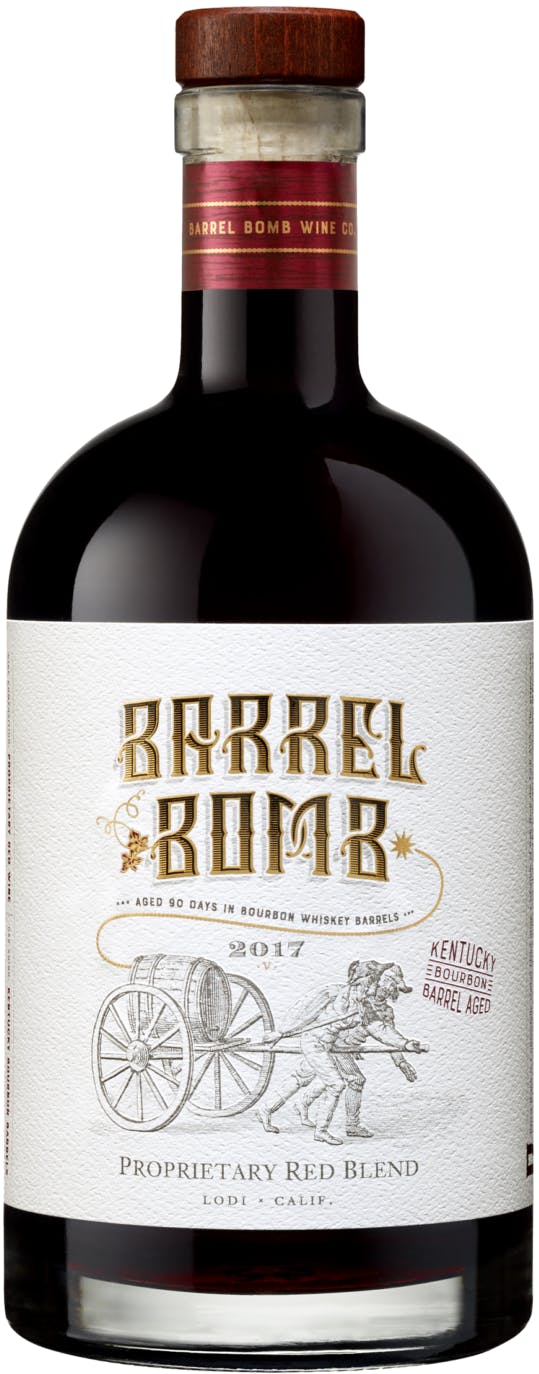
We arrived in Dayton on Christmas Day, only to discover that Pam's brother-in-law, Dapper Donnie, had been hit hard by the flu and spent Christmas Eve in the hospital. Alas, he wasn't able to join us in our holiday feed -- so we sent him a hammy care package. Donnie did send us a gift, though -- a bottle of wine that goes right along with the bourbon-barrel theme we've had running through the site's electrons this year: Barrel Bomb 2017 Red Blend.

Barrel Bomb has a similar origin to some of the 1000 Stories wines I've covered recently. The wine's made from a blend of red grapes sourced from Lodi, California. I'm not sure what the exact blend is, but figure that Zinfandel and Cabernet Sauvignon figure heavily. The wine comes in a stubby bottle with a replaceable cork -- which might make it easy to lose among the bourbons in your liquor cabinet.

Let's start with the truth-in-advertising bit. "Bomb" is an accurate descriptor for this wine. Any wine backboned with Zinfandel has the potential to wind up as higher potency, but the trend over the last decade has been towards more restraint in alcohol content. By contrast, the folks at Barrel Bomb decided to party like it's 2010 all over again. This wine clocks in at a muscular 16.5% ABV.

The winemakers, however, throttled back on the fruit-foward nature of these grapes. The flavor is actually somewhat restrained, if you can believe it. Perhaps the 12 months that the wine spends in oak, with the last 90 days in bourbon casks, mellows it out. The nose is big and fruity, with vanilla riding the back of blueberry and cherry. The body's not subtle -- big fruit, licorice, and smoke over a pretty considerable tannic base that hold on through a powerful but balanced finish.

In my mind, I think this might end up a better end-of-night sipper than a real dinner pairing. There's a little "portishness"  here, so I tried it with some really nice brie that we got as a gift from Lady Vertu, and it worked well -- although I'd probably go with even a bigger cheese, like a Stilton. Chocolate is also an obvious accompaniment.

All in all, if you're looking for something to sip on during these colder months -- you might give this a try. Also, if you're giving any more gifts, the aesthetic of the bottle itself is interesting.

Barrel Bomb retails for $16-18. They also make a straight Cabernet Sauvignon, which I haven't tried yet.

Happy New Year, everyone!


Sunday, November 24, 2019

1000 (More) Stories – More adventures in Bourbon Barrelling


Last year, I wrote about 1000 Stories Wines – California reds which derive a particular character from being aged in used bourbon barrels.

If you’re interested in more of the backstory about these wines, I welcome you to bounce over here for a refresher about these fairly interesting bottles.

Short version: Many wines are aged in barrels of one type or another. You’ll see wines aged in French, American, or Hungarian oak most commonly. The interior of these casks are usually “toasted” to some degree. The more toasting, the stronger the oaky flavor. Bourbon barrels, taller and thinner than most wine casks, as well as more heavily toasted, could potentially add a boatload of flavor. Even after being used, a barrel can still impart distinct flavors to whatever’s stored inside it.

Finding old bourbon barrels sounds like a difficult step, but, according to the legal rules governing distillation in the U.S., Bourbon can only be aged in a new cask. After that, the barrels have long been sold to distillers making whiskeys and other spirits – and sometimes beer makers. The recent “Bourbon Boom” has, naturally, added a great number of additional barrels to the market, and some winemakers have jumped at the opportunity to ride that particular wave of popularity.

1000 Stories produced the first California Zinfandel aged in bourbon barrels, which I tried when I wrote the initial article, alongside their proprietary “Gold Rush Red” blend. Fast forward a year and a month, and the Wine Fairy delivered another pair of 1000 Stories wines to my doorstep. No Zinfandel this year, but I got to try this year’s model: 1000 Stories 2017 Gold Rush Red, as well as the 1000 Stories 2017 “Prospectors’ Proof” Cabernet Sauvignon.

(Bonus points to their marketing department for proper use of the trailing apostrophe!)

One change I can report between last year’s vintage and this – Bob Blue, the winemaker at 1000 Stories, has dialed back the alcohol content somewhat. The Gold Rush Red now clocks in at lower than last year’s 15% alcohol, while the Cabernet sits at 14.5%. Don’t think this means that these wines are trending towards delicate. Nosiree. This pair of reds pack a considerable punch. Both should be opened for at least 30-45 minutes before you get down to drinking.

The Gold Rush, although slightly toned down, resonates with my comment from last year: “It’s a big ol’ bomb of intense dark fruits, especially plums and dark cherries.” My notes from now give it some plums and vanilla on the nose, with a body of ripe dark fruit, loads of tannin and graphite. The finish is very smoky and tannic. Will need an accompaniment of strong cheeses or grilled meats to really reach its best.

The Prospectors’ Proof gives me leather, vanilla, and a bit of an herbal note on the nose. The body was somewhat lighter than I expected after last year’s Zin. Some more restraint to be found here. Body’s got that classic cherry and currant flavor of Cabernet, along with a fair amount of smoke. The finish is charcoalish, with a note of green pepper that I wouldn’t have expected outside of Bordeaux. The wine’s a bit shy – the flavors fade in and out as it gets air over time until it finds its footing. Once it does, it’d be nice next to steak, mushrooms, or other grilled goodnesses.

1000 Stories has also added a bourbon barrel-aged Chardonnay and Carignan to their portfolio. I'll be curious to see how those would end up. 

These wines retail for $17-20. If you’re interested in a bourbon-tinged vanilla and smoke flavor with your wine this winter, it’d be worth giving these a go.

Friday, August 30, 2019

Naked Vine One-Hitter: Marques de Murrieta Rioja


Finally, a little chill in the air.

Here at our new pad in The Pennsylvania, we’ve been dealing with some of the joys of home ownership that inevitably come with buying a home that’s considered vintage. We’ve gone from our old place in Newport to our State College mid-century modern, built in 1951. The place has been (thankfully) refurbished a couple of times over the years – most recently in the late 90’s.

Alas, the late 90’s seems to have been the last time that our air conditioner was seriously serviced, so, of course, the compressor decided to go to the Scrapyard in the Sky during a particularly warm stretch here. We got a new unit installed – just as the heat broke, of course. But with that break came the first taste of fall, cool evenings, and bracing for our first Football Weekend in State College.

Wait, this is supposed to be about Rioja, isn’t it?

Anyway…autumn is just around the corner, which means that we’re sliding into the time of year when, for most of us (except for you, Uncle Alan), bigger, more powerful reds start coming back in vogue.

Along those lines, We had a chance to sample a new Spanish offering last week as we enjoyed some of the cooler weather. The Marques de Murrieta 2015 Rioja Reserva was on our table the other evening as we took some much needed solace from the sweat of the previous weeks.

Before I talk about this particular bottle, though – a little background. First off, Rioja is not a grape. Following the naming conventions of most European wines, Rioja is named for the region in northern Spain where it’s produced. Rioja reds are primarily blends, made up of Tempranillo, Garnacha (Grenache), Mazuelo (Carignan), and Graciano.

Rioja reds are typically built to age for a long time, and they’re often held in barrel for years. This same winery – Marques de Murrieta – finally released their 1942 Gran Reserva in 1983. If a wine is labeled “Reserva” – as the one I tried is, it must be aged for a minimum of three years, with a minimum of 12 months in oak barrels.

As with many potentially long-lived wines, Rioja improves a great deal with decanting. Because of the tannic structure, they really need some air to smooth out and let the flavors broaden. This wine was no different. The tech notes say to give it 20-30 minutes, but I found that the wine continued to develop over the course of hours, even into the next day. Seriously, decant this mother.

Experience-wise, I thought this wine had a gorgeous nose once it had opened up. A lovely bouquet of vanilla, violets, and cherries jump up quickly. The body had rich spice notes, dark fruit, and leather flavors quite evident. The tannins, predictably, were big – but they were really nicely balanced. (The SPinC, who basically doesn’t drink anything heavier than Pinot Noir these days, thought it was smooth enough for her to handle.) The finish is lasting and grippy, ending with a graphite and dark cherry double feature that really builds after a couple of sips.

Rioja is one of the more food-friendly “big” wines that you can find, in my experience. The notes say that it pairs with “baked red snapper…and lamb chops with buttermilk.” That’s a pretty broad range! Personally, I love to pair Rioja with the mean pan of paella I’ve been known to make Given I hadn’t made one since we moved to The Pennsylvania, I had to throw down. So glad I did. Made for an absolutely worthy pairing.

This was a pretty sexy wine, I have to say. It’s a bit of a splurge at $30, but if you’re looking for a really nice bottle to take to a dinner – this will be a crowd pleaser.

Have a good Labor Day weekend, everyone.  

Monday, January 07, 2019

Rabisco – Chewy, Portuguese, and (halfway) Autochthonal

Since it's the middle of winter (although it hardly feels like it these days), this is the natural season to consume a glass of that delightfully fortified product, Port.

Port, in the world’s least surprising reveal, originated in Portugal. Port is initially fermented like a typical wine, but a neutral grain spirit is added to stop the fermentation and leave some residual sugar in the mix, which ultimately conveys the sweetness to the stuff.

Practically all ports are blends. There are about 100 different grapes approved for use in Port making, but there are five primary native (or autochthonal, if you want to use the official terminology) varietals. The king of these native Portuguese grapes is a varietal called Touriga Nacional.

Touriga Nacional vines bear small grapes with a high skin to pulp ratio – meaning that the juice flavors tend to run to the powerful side. Touriga Nacional provides depth and color to most blends. Touriga Nacional vines are very fast-growing, but those vines have some of the lowest yields of any vinifera grape.

Although Touriga Nacional is generally considered the finest Portuguese red varietal, until the last few years it comprised only around 2% of Portugal’s total vineyard plantings. In the last decade, however, improvements in vine maintenance and crossbreeding have upped TourNac yields, and Portuguese winemakers have begun making dry red wine blends featuring it.

Enter Rabisco 2015 Reserva Tejo -- a dry red wine made from 50% Touriga Nacional and 50% from good ol’ Cabernet Sauvignon.

To break the wine’s name down a bit – Rabisco means “Scratch” in Portuguese. The winery from which this wine hails is part of an animal sanctuary and dozens of bird species pass through during migration. Most famously, storks winter in this region – and the wine label centers on a freehand pencil “scratch” sketch of one of these beautiful birds.

Tejo is the region surrounding the Tejo River, near the vineyards of the grapes. “Reserva” simply means that it’s a high quality, single vintage wine, but official aging or fermenting definitions aren’t attached to that term.

What’s this wine like? Well, for starters, it’s relatively inexpensive (as are many Portuguese wines) – retailing at $13. Not surprisingly, considering the skin thickness of the Touriga Nacional grape, it’s a big, honking mouthful of tannin, especially before the wine’s had time to open up. Decant for half an hour if you can. The Cabernet adds some dark fruit – blackberries and currants – which are deepened by the TourNac – but it’s certainly no fruit bomb.

It’s a wine longer on tannins than richness, so if you’re looking for something with a lighter body but a bigger flavor punch – it would probably appeal. I would imagine that the combination is somewhat of an acquired taste. I thought it was worth a try – especially alongside a braised pork dish or a tapas-y spread of appetizers. The SPinC thought it was too punchy for her palate.

All in all, it’s probably worth a try if you like full-flavored red wines. For someone who wants the combo of big tannin without an associated jamminess, it’s a good choice, especially at the price point. Fans of either Bordeaux or California merlots/cabs might not be quite as enamored.

Monday, October 01, 2018

Bourbon Barrel-Aged Wine -- Does the Wood Make it Good?


Fall, finally! Cooler nights, bigger foods, darker drinks.

Once the weather starts to turn away from heat, I tend to turn my sights back towards both bigger red wines and brown liquors. Outside of Derby, bourbon’s largely a winter drink for me. Red wine’s year round, of course, but my red rack’s generally filled with lighter stuff during the summertime.

What happens, though, when a winemaker decides to put wine and bourbon together?


Over the last four or five years, I’ve seen a few wines marketed as “bourbon barrel aged” popping up. Many red wines are barrel-aged. What’s the difference with aging wine in a bourbon barrel?

Barrel aging is an important stage in the life cycle of many wines, both red and white. When a wine spends time in a barrel, the juice seeps into the wood, extracting chemical compounds that mix with and change the flavor of the wine within. For white wines like Chardonnay, the “oaky” flavor often comes from contact with wood in barrels. For reds, barrel aging adds a depth of flavor and boosts the tannin level.

Reading the description of many wines – you’ll see wines aged in French, American, or Hungarian oak most commonly. The interior of these casks are usually “toasted” to some degree. The more toasting, the stronger the oaky flavor. Bourbon barrels, taller and thinner than most wine casks, as well as more heavily toasted, could potentially add a boatload of flavor. Even after being used, a barrel can still impart distinct flavors to whatever’s stored inside it.

Finding old bourbon barrels sounds like a difficult step, but, according to the legal rules governing distillation in the U.S., Bourbon can only be aged in a new cask. After that, the barrels have long been sold to distillers making whiskeys and other spirits – and sometimes beer makers. The recent “Bourbon Boom” has, naturally, added a great number of additional barrels to the market, and some winemakers have jumped at the opportunity to ride that particular wave of popularity.

I recently had the chance to try two bourbon barrel aged wines: 1000 Stories 2016 California Bourbon Barrel Aged Zinfandel and 1000 Stories 2016 Gold Rush Red (both $16-20). The former is a blend of Zinfandel from Lodi and Paso Robles, with a touch of Petit Sirah juice sourced from Lake County. The latter is a field blend largely of Cabernet Sauvignon, Syrah, and Zinfandel.

The winemaker, Bob Blue, states that it was rare to see wine aged in French Oak when he started learning his craft, and most American oak barrels were used for whiskey. Over the years, using these barrels has become more commonplace – and now Blue uses used bourbon barrels as a flavoring method.

In any case, both wines start out in standard American and French Oak barrels before being racked into used white oak Bourbon barrels. After a period of months, the wine is finished in older (some apparently 13 years old) Bourbon barrels.

Both these wines can use a little taming. The Zinfandel clocks in at 15.7% ABV, while the Gold Rush comes in at around 15%. If you pop and pour, you’re going to get a snootful of alcohol before you really get to any of the flavors. I’d suggest, at the very least, you either decant thoroughly or let it have at least half-an-hour’s worth of air after you crack it.

In both cases, the toasted vanilla and crème brulee flavors that are common in bourbon do find their way into the wine. The nose of the Zin has a bit of that smokiness in the background, on top of dark fruit and some fairly interesting notes of spice like nutmeg. On the palate, this is a big, honking glass of vanilla, spice, smoke, and considerable alcohol. Once it opens up, plum and sage flavors pop their heads out of the mix and the alcohol recedes a bit. The finish is long, dry, and smoky – the various oak instillings lending pepper and a tooth-staining level of tannin.

The Gold Rush red is more straightforward. It’s a big ol’ bomb of intense dark fruits, especially plums and dark cherries. There’s a spicy, leathery backbone to this wine – along with a long, tannic finish. I found it to be much more straightforward than the Zin. Either wine would be workable with some sort of barbecued meat, big cheeses, or dark chocolate.

To be honest, though – I don’t see how much of a difference, other than a slightly sharper oak flavor, that the bourbon barrels actually make with this wine over standard barrel aging. It’s an interesting marketing idea, especially if you’re interested in conversation with whiskey aficionados or Kentucky fans. But keep an eye on the price. These wines both seem a little more pricey than they should be, considering the competition. See what you think.


Sunday, July 16, 2017

Game of Thrones Wine -- Just in Time for Your Watch Party


Gather ‘round, Khals and Khalessi, Ladies and Sers. Game of Thrones returns after its hiatus to whisk us back to Westeros this evening and our respective water coolers on Monday.

The blood, the magic, the palace intrigue – they give welcome respite from the Drogon-ing of our country’s democracy. (And what I wouldn’t give to watch a face to face between Our Dear Leader and Lyanna Mormont…)

With Season 7’s premier in the offing, I got a text from my good friend The Wizard of Covington a couple of weeks ago that read “Winter is Coming” next to a picture of a bottle of Game of Thrones red wine. I did a little research and was able to make contact with my friends at Folsom, who are heading up the PR for this new label, and they were goodly enough to get me a couple of bottles to sample in time for the premiere.

Game of Thrones Wines are produced by Vintage Wine Estates – the California company behind Cosentino, Firesteed, Middle Sister, and many other brands. They make three versions of GoT wine – a Chardonnay from California’s Central Coast and a red blend from Paso Robles, both of which retail for around $20, and a Napa Valley Cabernet Sauvignon, which retails for $50.

My samples were of the first two. How were they? Well, as they say around (what’s left of) King’s Landing…

Valar dohaeris:”

Game of Thrones 2016 Chardonnay – This Chardonnay started out very floral, likely from the 10% Riesling blended in. I thought it smelled like peach ice cream next to a bouquet of wildflowers. The Chardonnay/Riesling interaction creates a pleasant, integrated set of flavors. Mouthfeel wise, there’s a bit of “stickiness” that comes from a Riesling, with a little accompanying apple-y sweetness. The Chardonnay creaminess and lemon flavors come through secondarily as the acidity kicks in. The finish is a bit on the fruity side, with the peaches returning, followed by a bit of lemon peel. Really not much oak to be found anywhere, other than at the tail, tail end of the finish. My guess is that this would be a crowd-pleasing white – the perfect sort of thing for a watch party – but it’s not one that I’d probably snag just for general consumption. The Sweet Partner in Crime thought that the wine was one of the better Chardonnays that she’d had in a while. She really liked the floral/fruity combination, saying that it reminded her a lot of a Viognier. I wasn’t quite as keen on it, but I certainly thought it was decent.

Game of Thrones 2015 Red Wine – When we first really got into wine tasting, we loved big reds. Back then, this field blend of Malbec, Tempranillo, Zinfandel, Petit Sirah, and Syrah from Paso Robles would be been right in our wheelhouse. “This wine would have been my jam,” said the SPinC, “and now it’s just jam.” She’s not kidding. This full-blooded, fruit-forward inky monster wouldn’t be out of place on a table with roasted joints of meat and mince pies. You want extracted blackberries and dark cherries? Check. You want tannins chewy as an old waterskin? Bingo. You want some vanilla and pepper in your finish? Aye. That’s your quaff. If you want to understand the XY side of the “masculine vs. feminine” wine divide, try this one. The testosterone level matches the alcohol. While it was too much for the SPinC’s pinot-loving palate, I thought it was a pretty strong offering for what it was – a wine that will pull your attention back from the screen to let you know you’re drinking *wine*. For science, I had this next to a strip that I bought from the local butcher. It was as good as you might expect.

While these wines may retail for around $20, your wine stores will probably be running specials on them not long after the premiere. Bottom line – they’re pretty solid wines, but they’re hardly subtle. But who watches GoT for the subtleties, I ask you?


So, saddle up with Dany as she gets across the Narrow Sea, pour yourself a flagon or tankard of your choice, and return to one of the last instances of “appointment television” that we still have left.  Enjoy, and try your best to be nice to that guy yelling “NO SPOILERS! NO SPOILERS!” from a few cubes down and the bummed out lover of the novels who can’t hit you with a “You know nothing” anymore.


Thursday, May 04, 2017

Locations Wine -- Blends that Break the Rules

What’s in a name?

When it comes to wine, nomenclature can mean a great deal – depending on which country’s soil you’re standing upon…or, more accurately, which country’s terroir you’re about to start slugging on.

As we’ve discussed in this space, especially among European wines, the name on the bottle typically refers to the region from which the wine is created. There are no grapes named “Bordeaux” or “Rioja.” Whether a wine drinker knows the exact grape or blend of grapes in a bottle, he or she can be reasonably confident of a wine’s style based on its locale of origin. French Burgundy, made from Pinot Noir, will necessarily have a different flavor than the Grenache/Syrah blends of the Rhone Valley.

These general naming conventions, blends of regional grapes, flavors and styles have been reasonably consistent (and often enforced by local and state food-related law) for decades or even centuries.

Enter Dave Phinney. Phinney, the winemaker who burst onto the scene in the late 90’s with “The Prisoner” – a Zinfandel-heavy field blend from California which put his Orin Swift Cellars on the map – has, over the last few years, built up a following around a set of blends he’s named Locations Wine.

(Side note: In case you’re wondering about who “Orin Swift” is, Orin is his father’s middle name and Swift is his mother’s maiden name.)

With Locations, Phinney and his team attempt to distill the essence of a country’s wines across its terroir – blending grapes from various wine growing regions to build a reflection of a “national” wine. Locations produces wines from Spain, France, Italy, Argentina, Portugal, and Corsica. On the domestic side, they produce blends from Oregon, Washington, California, and most recently, Texas.

So, for example, the California wine is a blend from Napa, Sonoma, Mendocino, and the Sierra Foothills – four regions with very distinct differences in terroir and grape type production. Juice from those regions rarely gets tossed in together. As for the European cuvées, many would consider such blending high heresy. Furthermore, the wines are non-vintage, which allows Phinney to blend wines from multiple years into the final mix. Each release is numbered. This year’s is “4.”

All but the Corsican wine are adorned with the formerly ubiquitous white oval stickers that used to adorn most cars in Europe before the advent of the European Union. (The Corsican wine is labeled with a silhouette of a wicked looking shepherd’s knife.) You’ve seen these labels before:

Locations Wine: France, Italy, Spain

I had the opportunity to try three of the blends at a “virtual tasting” with Phinney. He said that the general style of Locations is targeted towards the U.S. market. The idea, he said, was to give people an entry point to European wines; to try to turn people on to wines from countries they might not have tried before. He said that he knows that what he’s doing breaks a lot of traditional rules, so he spent a great deal of time putting together his blends. “I needed them to be beyond reproach.”

Locations sent three samples – their offerings from Italy, France, and Spain. One commonality across all three reflects Phinney’s comment about aiming these wines at American palates. All three have what I would consider New World sensibilities. I found them all to have, in general, bigger mouthfeels and more fruit-forward than most wines I’ve tried from the counterpart country. The French wine, for instance, lacked the “funk” that many Old World wines sport. I certainly don’t mean that as a defect – just know going in that you shouldn’t expect a Cotes-du-Rhone or Chianti.

Italy – The Italian entry is a blend of Negroamaro and Nero d’Avola from Puglia in the South and Barbera from the Piedmont in the North. Thick dark fruits on the nose – plums and blueberries. The nose feels as if it’s going to be attached to a wine of considerable weight, but the palate is surprisingly limber. Some nice spicy notes there, too. There’s a hint of that Italian chalkiness hanging around on the finish, backed by dark fruits and smoky tannins. This was my favorite of the three. Dynamite with a red-sauced pasta.

France – The French version is a blend of Grenache, Syrah, and “various Bordeaux varietals” (meaning some mix of, Cabernets, Merlot, et al.) from the Rhone, Roussillon, and Bordeaux. It had a fairly thick nose of strawberries and cotton candy with some floral notes. The palate is a nicely balanced mix of strawberries, raspberries, and earth. It’s fairly tannic, with a dry, lasting finish. It really calls for some kind of roasted meat, if you’re going to pair it up.

Spain – Labeled with an “E” for “España,” which I’ll sheepishly admit threw me for a hot second, this blend of Garnacha, Tempranillo, Monastrell, and Cariñena is sourced from regions all across Spain: the Priorat, Jumilla, Toro, Rioja, and Ribera del Duero. The nose is full of dark fruit and licorice, backed up with menthol and mint. The tannins harden gradually after a few sips into a slate-smoke finish. There’s light tarry flavor of coffee over dark plums. I had it with paella, and it was a tad big, but still a very nice complement. The fruit on this wine faded quickly – even stoppered, I found there was little fruit the next day, leaving largely a tannic, graphite flavor which wasn’t my favorite.

The Locations series retails for around $20. I think it’s an interesting take – and I admit interest in checking in on some of the other blends. (I mean…Texas? I can be convinced, but…)


Friday, February 03, 2017

Slap On Another "Côtes"

I love doing side-by-sides with similar wines. In this case, I had the chance to give the once-over to a pair of Côtes du Rhône from slightly different classification.

As a quick refresher, Côtes du Rhône is (obviously) from the Rhone region of France and is the most widely available red wine from there. A wine labeled "Côtes du Rhône" can be made up from grapes grown anywhere within that region. This would be considered the "table" Côtes du Rhône.

There are other classifications for Côtes du Rhône. A wine labeled "Côtes du Rhône Villages" indicates a higher standard of quality -- and the blend of grapes must come from the eighteen "named villages" in the region.

Above that classification are those Côtes du Rhône which have the actual name of the single village from where the grapes are sourced. Puymeras, Vinsobres, and Chusclan are some examples.

Finally, there are "Côtes du Rhône Cru" -- which are from the best grapes around one of the particular villages. These wines are usually considered the best of the region, and some are known as the best wines in the world. Chateauneuf-de-Pape is the most famous of these Côtes du Rhône Cru, along with Côte-Rôtie, Condrieu (although mainly for whites) and Crozes-Hermitage.

Côtes du Rhône are always blends. There are 21 different grapes that can go into Côtes du Rhône, but the backbone of the wine is generally Grenache and Syrah. Wines from the northern Rhone tend to be Syrah-driven, while the hotter southern Rhone grows more Grenache.

Côtes du Rhône tend to be fruity, food-friendly wines. There's a pretty broad range of quality among Côtes du Rhône, and I was interested to see what this pair of bottles would yield. I tried the Les Dauphins 2014 Côtes du Rhône Reserve ($13) and the Les Dauphins 2015 Côtes du Rhône Villages Organic ($15). Both came primarily from the Southern Rhone, so they're Grenache-heavy.

You may note the "Reserve" at the end of the name of the first bottle -- and that I didn't mention it in the classification notes above. That's the case for the simple reason that...well...the "Reserve" doesn't refer to anything really in particular. It's simply a marketing term in France, just like it is here in the U.S. The only major wine producing countries that have legal requirements for "Reserve" are Spain and Italy.

The Reserve is one of the most reviewed wines on The Naked Vine -- this is the third time that it's popped up for me. It's a blend of 70% Grenache, 25% Syrah, and 5% Mourvedre. I sampled this vintage back in November around Thanksgiving time. It's a simple, straightforward, fruity red. Honestly, this bottle was so straightforward that I didn't find it particularly interesting. Red fruits came up front, followed by a middleweight palate and a softly tannic finish.

The Villages was considerably better, to my taste. This was a 60/30 Grenache/Syrah split, with  the remainder being divided between Mourvedre and Carignan. This was a much more interesting wine. The fruit was deeper and richer, with more plum notes and an earthier backbone. The tannins on the finish were chewier, and I thought it tasted much more "Old World" in style.

We tried both alongside some steaks that I'd grilled up -- grilled or roasted meats and strong cheeses are typical accompaniments to Côtes du Rhône. Again, the Villages was the better pairing with its more muscular tannin. If you have the choice, I'd suggest dropping the extra couple of bucks and going with the Villages.

Thursday, September 01, 2016

Montefalco Rosso (Slight Return) – and relief from the Italian earthquake

The good folks in Umbria must have had a couple of good Sagrantino harvests. I keep winding up with bottles of Montefalco Rosso, an Italian red made from that expensive to produce grape, blended with some other varietals. These wines make good options for your Labor Day grilling.

While the harvests have been strong, Umbria also has some pretty serious issues of its own at the moment. Many of you have probably read about the 6.2 magnitude earthquake in Italy that leveled hundreds of structures. The casualty numbers continue to climb. The epicenter of that earthquake was in Umbria, and many of these wines are produced scant kilometers from cities which stood from Medieval times until last week.


Obviously, we’re limited in what we can do to help directly – although purchasing Umbrian wine is one indirect help. If you would like to make a contribution, you can donate directly to the Italian Red Cross or to the National Italian American Foundation – both of which are currently working on relief efforts.

To refresh your memory, the Sagrantino grape has been grown in Umbria at least as far back as the mid 1500’s, with some scant records indicating it may have been grown as early as the turn of the millennium. This grape, grown primarily for sacramental and religious festival wines, was almost wiped out until the early 1990’s, when growers were able to gain a classified status for the grape and expanded the production.

On its own, Sagrantino creates enormous, tannic reds which have the highest concentration of polyphenols like resveratrol which are the compounds that give red wine its health-related benefits. It’s also the most tooth-staining varietal that I’ve ever happened across, just as a warning. In many regions, heavily tannic grapes are often blended with lighter varietals -- and the juice can be from either red or white grapes – to balance tannin and acidity in big wines or to create wines that are more approachable to the general public.

In neighboring Tuscany, the winemakers there blended their native Sangiovese grapes with merlot, cabernet, and other red wines to create the now-ubiquitous Supertuscans. Borrowing from that model, the Umbrians created Montefalco Rosso, a lighter-styled red wine which features Sagrantino in the blend. Since Sagrantino itself makes for big, honkin’ wine – a little of it goes a long way in the blend.

Also, grapes like Sagrantino tend to be fairly expensive to produce. Most Sagrantino Montefalco start at around $40 and go up front there. Winemakers like to turn a profit, and blending can help them produce quantities of wine at a lower price point to help with the bottom line. Here are a few of those Montefalco Rosso, which you can find for around $20-25.

Arnaldo Caprai 2012 Montefalco Rosso – Once this one got some air (which involved me pouring the wine through an aerator into a decanter, then funneling it back into the bottle after an hour), the Caprai opened right up into a very interesting, bold red. The tannins were considerably softer than many wines made with Sagrantino, and there wasn’t nearly as much heat and roughness as I’d run into previously. The nose is full of currants with a backdrop of menthol. The body is full and rich with red fruits and some firm but not overwhelming tannin. The finish is long with just a little bit of an alcoholic bite to finish. It’s a bold red for any occasion with which you’d like a bold red. Go with grilled meats, nuts, and stinky cheeses.

Scacciadiavoli 2012 Montefalco Rosso – We found this one to be a little more bold than the Caprai. If you like your Italian wines a little on the rustic side, this would be a solid choice. Lots of depth of fruit at first taste up in the plum/blueberry range. That’s accompanied by some slightly rough tannins that remain so even after considerable air. They’re not overbearing, but you know you’ve got a wine with oomph. Finish is long, fruity, and dry. We had this with an eggplant parmesan – both out of the oven and a couple of days later with leftovers. Good pairing which would do well with roasts, big sauces, and such.

Perticaia 2013 Montefalco Rosso – By far the most mellow of the three, and the most pleasant just to drink. The tannins are smoother than in either of the other two, and it’s a little more fruit-forward. Nose is plums again, with a little bit of an herbal tinge. The body’s full, although not as “clingy” as the others. The fruit and tannins are both dark and relatively well balanced. The finish doesn’t have the length that the other two do, largely expected with the lighter tannins. I thought it worked well against a marinara-laced penne dish.


I have learned that the winemakers of the area are also planning their own relief efforts on the ground, so watch this space for additional information there – as well as for some information about the whites from that region. You know, for balance…

Monday, May 16, 2016

What’s in your Glass? A Case of the Blends.

“I like Cabernet.”
“I like Merlot.”
“I like Zinfandel.”

These are typical responses to “What’s your favorite type of wine?” Simple enough question with a simple enough seeming answer. You love Pinot Noir, for instance. You go to the wine store and head for the sign that says “Pinot Noir.” You snag a bottle. You pay and head home. Pop. Pour. Drink. Easy peasy.

But how do you know that the pinot noir in your hypothetical glass is actually, you know, pinot noir? “It says so right there on the bottle,” you might say. In reality, that Pinot juice in your glass may have some friends along. Very few wines, especially American wines, are made strictly from a single varietal. Instead, they’re generally blends, with certain varietals being a greater percentage.

In the U.S., the Alcohol & Tobacco Tax and Trade Bureau of the Department of Treasury (that mouthful “acronyms down” to “TTB”) monitors the blending of wines. For a U.S. wine to be labeled as a single varietal, at least 75% of the blend must be made up of that varietal. That said, up to a quarter of that glass of Shiraz you ordered might be made up of different grapes – white or red. If a wine has less than 75% of a single varietal, it’s simply going to be labeled as “red wine,” often with the percentages of the various grapes listed.

Now, there’s nothing new about blending wine. If you’ve ever sampled Bordeaux (and if you haven’t, what in tarnation’s wrong with you?) – then you’ve gone to town on a blended wine. A bottle of red Bordeaux will be a blend of various percentages of primarily Cabernet Sauvignon, Cabernet Franc, and Merlot, with some Petit Verdot and Malbec thrown in for good measure. Chateauneuf-de-Pape, that magical wine from France’s Rhone region, may have up to 18 different grapes in the blend.

"We make there's none of that
pesky antifreeze in your wine..."
Why blend wine? There are some practical reasons – like trying to stretch production in a lean year or complying with regional winemaking guidelines. The terroir also plays a role. Not every harvest is the same. Varying amounts of sun and rain, seasonal differences in temperature, and other factors all affect the final flavor from a grape. Winemakers usually like to deliver a consistent product. A wine’s particular profile is, after all, what draws in a consumer initially. A skilled winemaker will often make tweaks to a wine’s final blend to try to create consistency from year to year.

Primarily, though, winemakers blend wines for flavor. Each grape has its own flavor profile. Some grapes yield wines that are fruity but watery on their own, while others are so inky and tannic that they are nigh undrinkable. Blending grapes in various ratios allow a skilled winemaker to produce something, as the cliché goes, more than the sum of its parts. A winemaker is typically trying to make the best of what’s around, which is, in my mind, the true art of wine production.

Blending should not be seen as a mark of inferiority. The most expensive wines produced domestically and abroad around the world are blends, such as Sine Qua Non’s “Queen of Spades” – a Syrah-dominant blend from Santa Barbara that will set you back about $5,000 a bottle. While I’m not willing to shell out that kind of scratch for a blend, I did recently have the opportunity to check out three blends at slightly lower price points.

The first was from New Zealand. The Trinity Hill 2014 “The Trinity” Red Wine has a slightly misleading name. This merlot-dominant (55%) blend is actually a mix of five grapes. Tempranillo, Cabernet Sauvignon, Syrah, and Malbec make up the remainder. Merlot on its own can be a little one-note, so the other additions add some complexity, tannin, and depth. I found this wine to be full of plums and spice, with a surprisingly earthy backbone – not something I see in many New Zealand wines. This wine’s very straightforward, so it’s an easy drinker on its own or would pair with any number of meaty or cheesy dishes. At around $15, it’s a pretty solid buy.

To South Africa for the Mulderbosch 2013 “Faithful Hound” Red Wine. South Africa is best known for the Pinotage grape, but there’s none to be found in this bottle. Instead, this is a straightforward Bordeaux blend – Cabernet Sauvignon and Franc, Merlot, Malbec, and Petit Verdot. Don’t expect the somewhat lean flavors of a Bordeaux here. This is a fairly burly offering with lots of cherries and leather flavors and a big smoky backbone. I found this wine
to need some considerable air before the tannins die down. Once they do, however, you’ve got a nice option for alongside any type of grilled meat. It’s around $25, which I thought was a tad pricey. (Also, the wine’s label tells the story of the “faithful hound” who kept a three-year vigil at a house on Mulderbosch farm after being abandoned by his master. The dog died. Side of sadness with your steak?)

Finally, back to the States for the Leviathan 2012 California Red Wine. The winemaker, Andy Erickson, has worked with some of the best known cult wineries in Napa, including Screaming Eagle, Harlan, and Staglin. Through his connections, he sources small quantities of grapes from across various California regions (though largely Napa-centric) to blend into his signature juice. I gotta say, Erickson knows his stuff. This is a gorgeous wine. With a name like Leviathan (which is a nasty mythological sea creature), I expected a knock-you-on-your-ass California monster red. What I found was a bold, rich wine – but it’s so balanced and silky that you don’t realize you’ve got 14.5% ABV in your glass. A blend of the Cabernets, Merlot, and Syrah, the flavor is a polished mix of candied plums, berries, smoke, and spice. The finish is velvety and lasting, full of cacao and happiness. It’s not cheap at $48, but I’d be hard pressed to find much out of Napa at this quality at that price. Try it with dark chocolate, close your eyes, and enjoy the ride.


Thursday, May 12, 2016

Umbria’s Left Jab to its Right Cross – Montefalco Rosso

We’ve featured the Montefalco region a couple of times here in ol’ Vine HQ – focusing specifically on the Sagrantino grape and Sagrantino Montefalco, the wine from the Umbria region I dubbed “the Italian Heavy Hitter.”

To refresh your memory, the Sagrantino grape has been grown in Umbria at least as far back as the mid 1500’s, with some scant records indicating it may have been grown as early as the turn of the millennium. This grape, grown primarily for sacramental and religious festival wines, was almost wiped out until the early 1990’s, when growers were able to gain a classified status for the grape and expanded the production.

On its own, Sagrantino creates enormous, tannic reds which have the highest concentration of polyphenols like resveratrol which are the compounds that give red wine its health-related benefits. It’s also the most tooth-staining varietal that I’ve ever happened across, just as a warning. In many regions, heavily tannic grapes are often blended with lighter varietals -- and the juice can be from either red or white grapes – to balance tannin and acidity in big wines or to create wines that are more approachable to the general public.

In neighboring Tuscany, the winemakers there blended their native Sangiovese grapes with merlot, cabernet, and other red wines to create the now-ubiquitous Supertuscans. Borrowing from that model, the Umbrians created Montefalco Rosso, a lighter-styled red wine which features Sagrantino in the blend. Since Sagrantino itself makes for big, honkin’ wine – a little of it goes a long way in the blend.

Also, grapes like Sagrantino tend to be fairly expensive to produce. Most Sagrantino Montefalco start at around $40 and go up front there. Winemakers like to turn a profit, and blending can help them produce quantities of wine at a lower price point to help with the bottom line.

I sampled two bottles of this Umbrian blend – the Colpetrone 2011 Montefalco Rosso  and the Tenute Lunelli 2010 “Ziggurat” Montefalco Rosso. Both blends featured 70% Sangiovese and 15% Sagrantino. The Colpetrone rounds out the blend with 15% Merlot, while the Ziggurat goes with 10% Merlot and 5% Cabernet Sauvignon.

Both Montefalco Rosso are considerably lighter than the big, bombin’ Sagrantino Montefalco, but they’re still wines of considerable stature. They also both need air – lots of it. While these wines are marketed as flexible food wines for picnics, I’d recommend letting them breathe a bit before heading out on your jaunt. Even if all you do is pour the bottle into a carafe and pour it right back, that’s still going to put you in a better place, tastewise.


The two wines were quite a study in contrast initially. The Colpetrone hearkened back to its bigger, burlier 100% Sagrantino cousin, hitting the palate with big dark fruits and fairly heavy tannin. The Sweet Partner in Crime had a similar reaction to that wine, as well – in that she thought it was too big to be pleasant. The Ziggurat, by contrast, was much more along the lines of a bigger Chianti, full of cherries and chalk. We found it to be much easier to drink.

Over the next couple of days with some different meals, we found the character of both wines changed. The Colpetrone softened remarkably. The heaviness lifted, yielding some smoky, raspberry tinged flavors that became nicely balanced. The Ziggurat, by contrast, deepened as it had its time in air. Some spicy, clove-like flavors emerged and the cherries took on a fuller, tarter aspect.

While both wines were good, I’d probably give the edge here to the Colpetrone on overall style points. Once both wines fully opened, I thought that it had the more interesting balance of flavor, tannin, and general drinking interest. Either would be solid choices with either big red sauces and roasted meats (perhaps a beef brasciole like the one we made to test the wines), or charcuterie boards with aged cheeses.

Both wines retail for around $20, so if you want to get a sense of what the big deal is with Sagrantino, you could ease into it through one of these Montefalco Rosso. If you’re looking for a burlier Italian wine, this might be one quality option.