Showing posts with label barolo. Show all posts

Saturday, October 04, 2014

Damilano Lecinquevigne -- A Modern Take on Barolo

A bottle of Barolo – the Italian “Wine of Kings” – recently made its way to Vine HQ for a visit.

Barolo doesn’t make many appearances around these parts. This wine from the same-named area of the Piedmont region commands respect on any wine list and an emptying of most wine drinkers’ wallets. Almost all Barolo are high-priced wines. Decent Barolo usually start at around $50 and go up from there. It’s not uncommon to see good vintages hung with pricetags upwards of $150.

When this particular bottle showed up, thanks to the good folks at Colangelo, I did a double-reason double-take. What was so different about the Damilano 2010 Barolo “Lecinquevigne”? First off, the vintage. 2010? Most Barolo, or so I understood, require around 7 years in bottle for its powerful tannins to chill out enough for the wine to become drinkable. Second – the retail on this wine was $35. Thirty-five clams for an actual Barolo? Inconthievable!

OK, so what gives here? Why is Barolo so expensive, and how’d this wine end up being so much less so? And why can I supposedly pop and pour this bottle, when I’d expect to wait until 2017 under normal circumstances?

Barolo is made from the Nebbiolo grape, a small, thin-skinned grape that’s notoriously hard to grow. The juice from Nebbiolo is super-high in both tannin and acidity. In the traditional method of making Barolo, the fermenting juice soaks with the skins of the grapes – a process called maceration -- for almost a month in some cases, extracting the maximum amount of tannin from the skins. The resulting juice is then aged in large containers called botti for at least two years and sometimes much longer. Once bottled, the wine had to sit for a long time, as I’ve already mentioned. The resulting Barolo’s tannic, powerful flavors can be challenging for many wine drinkers.

[Side note: Interestingly, “traditional” Barolo-making technique has only been around since the 1920’s, when the French, of all folks, brought these techniques to the region. Prior to that time, the Nebbiolo-based wines in that area were sweet, light in color, and slightly fizzy.]

In the 1980’s, the region went through what some writers termed the “Barolo Wars.” A group of winemakers, again influenced by their Burgundian counterparts, decided to employ more modern harvesting and winemaking techniques. These techniques included green harvesting (removing unripe grapes from ripening clusters to improve the remaining grapes), temperature-controlled fermentation, and the use of commercial yeast for more control over the product.

Additionally, these modernist winemakers used smaller barrels called barriques. Barriques typically hold around 60 gallons of wine, compared to botti, which can hold up to 4,000 gallons. Smaller barrels and shorter maceration times combine to create wine that is more approachable flavor-wise and can be drunk after a shorter period of time. These “modern” Barolo tend not to have the extended aging capacity as their more “traditional” brethren.

Which brings us to the Damilano. Damilano Winery was founded in the 1890’s, yet clearly falls on the “modern” end of the spectrum winemaking-wise. They make four “cru” Barolo (interesting that they’d use the French term) which are in the $70-80 range. The wine I received, the “Lecinquevigne,” is a blend of grapes from vineyards across these “cru.” Hence, it has a lower price – as seen with most second label wines. The name “Lecinquevigne” translates as “Five Vineyards” and has given my spellcheck a somewhat permanent case of the yips.

I wasn’t hip to the history of the “wine wars” before starting this column, and the Barolo I’d tried previously had been, as far as I know, from the “traditional” end of the spectrum. I didn’t know the history when I took my notes, and I was somewhat reassured when I tasted this – because I thought there was something a little different about the Lecinquevigne.

The nose flew at me rich and fragrant. I initially got strawberries, cotton candy, and some woodiness. The traditional “tar and roses” aroma that Barolo is known for emerged a bit as the wine got more air. But the flavors were soft and subtly dark. There’s plenty of mouth-coating tannin in the medium body, with notes of licorice, cherry, and leather. The finish is super-long, lots of strong tea flavor that lasts a couple of minutes if you let it. That said, I wouldn’t call it overly complex, compared to many other Barolo.

This isn’t meant to be a slam; it is a really good wine. The intent of the modernist winemaker clearly shows through. Traditional Barolo’s power and harsh tannin is Exhibit A of the male end of the “masculine vs. feminine” wine divide. It is the “Wine of Kings,” after all. Modern Barolo has a much softer, “feminine” flair. I enjoyed the Lecinquevigne quite a bit, but it might not sit as well with traditional Barolo enthusiasts. I don’t know if it would pass the Uncle Alan test. We had this bottle over the course of two nights – once with a beef tenderloin braised in three wines, and again with a late-summer-veggie minestrone. Both worked very nicely with this more mellow version of Barolo.

At $35, I’d certainly recommend it. I think it’s a pretty darned good wine – especially if you’re still learning about Barolo and deciding whether it’s for you.


Sunday, August 22, 2010

The Naked Vine Italian Wine Primer

Ah, Italian wine. Love it. Love it. Love it. As the foodie that I am, I’m hard pressed to come up with wine that goes better with a meal than Italian wines. After all, one of the few things that Italians do better than making wine is cooking, and because they’ve been making wine as long as they have, winemakers in each region have been tailoring wines to cuisine for centuries.

As such, each region’s wine varieties tend to be fairly consistent as far as the basic flavor profile goes. I wouldn’t choose to drink a lot of them on their own for one reason or another, but line up some steamed mussels next to an Italian pinot grigio or a Sangiovese with marinara-sauced pasta and you’ve got yourself a little slice of heaven.

The trick, though, is figuring out which of these heavily vowel-labeled bottles is the right wine. Like France, Italy’s gotten a little bit better about putting the names of grape varietals and/or descriptive blurbs in English on the bottle for the “ordinary American consumer.” For the most part, however, the traditional convention still holds. The names on the bottle are generally the producer and the region. The grape is often nowhere to be found. As I’ve mentioned before, I spent most of my pre-Vine life thinking that “Chianti” was a grape varietal instead of a region in Tuscany.

Further confusing matters are exceptions to this rule. Some Italian wines do put the name of the grape on the label as a matter of course. The name of the grape is usually followed by the name of the locale, so you’ll see wines like Moscato d’Asti, Barbera d’Alba, etc. The first one, for instance, translates as “The Moscato (grape) from Asti (the town).” You’ll even run into “Montepulciano d’Abruzzo” vs. “Vin Noble di Montepulciano.” The first is a fruity, easy-drinking table wine made from the Montepulciano grape. The second is a somewhat complex Sangiovese-based wine from the town of Montepulciano.

But why? Why stick to an antiquated, confusing system of nomenclature, especially now that the world has grown much more wine savvy? Why not just label the bloomin’ bottles with whatever the heck is in there?

The answer?

Two thousand.

There are at least 2,000 indigenous grape varietals in Italy. Gaining an encyclopedic knowledge of all the grapes in the Boot that go into their bottles of yummy would be next to impossible. So, how do you know what you’re getting?

The Italian government simplified matters for us a little. They created a classification system somewhat similar to the ones in France. If you look at most bottles of Italian wine, you’ll see “DOC” or “DOCG” somewhere on the label. Without going into too much detail, the DOC/DOCG designation shows that a wine was made in a certain region using pre-determined methods containing certain grape varietals. This usually aligns with the geographic region, but a grape will sometimes be included in the designation if the varietal is a specialty of the area – like the aforementioned Moscato d’Asti, et al.

In my experience, Italian wine is an experience where you largely get what you pay for. This isn’t to say that there isn’t really good inexpensive wine from Italy. Think about it this way -- if you blindly choose $30 Bordeaux, there’s a chance that you’ll end up with a wine inferior to the $10 dollar one on the rack nearby. Italian? $15 Chianti will be perfectly drinkable, but also usually consistent with its brethren of the same price point. If you splurge on a $30 bottle, you can usually tell a difference in quality (although you may not feel that difference was worth the extra moolah).

There are hundreds of DOC/DOCG growing regions, but many of them are extremely small and you probably won’t run into them very often. Here are some of the more common regions and DOC/DOCG designations you’ll run into at the local wine stores for your reading and drinking pleasure…

Region: Campania
Common wines you’ll see: Taurasi, Fiano, Falerno
Major grapes: Aglianico, Piedirosso, Primitivo (red); Falanghia (white)
General info: Campania is the region around Naples. The best known wine from there is a robust red called Taurasi made from the Aglianico grape. Fiano is a seafood-loving white and Falerno is another big wine made from Primitivo (Zinfandel). Much of the rest of the wine from there has traditionally been known as fairly generic, although it’s improved greatly in recent years.

Region: Tuscany
Common wines you’ll see: Chianti, Brunello di Montalcino, Vin Noble di Montepulciano, Rosso di Montalcino, Rosso di Montepulciano, IGT Toscana
Major grape: Sangiovese (red – not many whites in Tuscany)
General info: Ah, Tuscany – home of some of the most famous reds wines in Italy. Most Tuscan reds are backboned by the Sangiovese grape. Brunello di Montalcino is also Sangiovese, but a specific clone of that particular grape. There’s also “Vin Santo” – a sweet dessert wine. You’ll also find “super Tuscan” wines that are bigger and heartier. These are almost always Sangiovese blended with a non-indigenous varietal like merlot or cabernet, often to please an American palate. If you see “IGT Toscana” on the label, it’s probably a Super Tuscan of some stripe. The wines tend to be very flexible, since Tuscan cuisine is some of the most varied (and delicious) food in the world. However, in my opinion, these wines are not the best to drink by themselves. They need food to show their full potential.

Region: Piedmont
Common wines you’ll see: Barbaresco, Barolo, Barbera d’Alba, Barbera d’Asti, Dolcetto d’Alba, Dolcetto d’Asti, Moscato d’Asti, Gavi
Major grapes: Nebbiolo, Barbera, Dolcetto, Moscato (red); Cortese (white)
General info: Piedmont is the mountainous region in the northwest corner of the country. The bulk of Italy’s hearty reds come from this region – especially Barolo and Barbaresco. They’re some of the most famous of the world’s wines. Barbera is a big, juicy red and Dolcetto is a lighter, acidic red – both of which make excellent everyday wines in their “generic” form. The versions from “named” places (like Barbera d’Alba for instance) have more complexity. Gavi is a crisp white made from the Cortese grape (not to be confused with Dan Cortese) which makes an interesting contrast. Piedmont wines are built to stand up to heavier meats and sauces. Even the whites handle cream sauces easily. There’s also Moscato d’Asti – a low alcohol, sweet sparkling wine which may be the best brunch wine in the world.

Regions: Sardinia & Sicily
Common wines & grapes you’ll see: Cannonau (red); Malvasia, Vernacchia, Verdicchio, Moscato (white)
General info: The islands of Italy usually end up putting the names of the grapes on the label, so you can generally run with those. Both islands, especially Sardinia, produce quantities of dry, crisp white wines made from Vernacchia, Malvasia, and Verdicchio that go perfectly with shellfish. Sicily produces a huge amount of dessert wine. The most common red is made from Cannonau, which is currently getting a great deal of publicity for its hypothesized life-extending properties. Cannonau is similar to Grenache and often makes for powerful wines, but on the islands, they’re made in a much lighter, more aromatic style.

Region: Veneto
Common wines you’ll see: Bardolino, Valpolicella, Soave, Prosecco
Major grapes: Corvina, Sangiovese (red); Prosecco, Garganega (white)
General Info: The region around Venice cranks out a huge amount of wine. The reds are usually blends backboned by the Corvina grape. These reds tend to be some of the lightest bodied in the country. Many are often served slightly chilled, much like Beaujolais. There’s actually a “Bardolino novello,” made in a similar style as Beaujolais Nouveau. The whites, like Soave are usually fruity and more or less dry. The Valdobbiadene district is the home of Prosecco, Italy’s most famous sparkling wine. It resembles Spanish cava in many ways. Interestingly, with all the light reds produced in Valpolicella, it’s also home to the most powerful red wine in Italy: Amarone. Amarone is made from raisinated grapes, which yields a concentrated, potent (upwards of 15% alcohol), tannic, tasty wine.

There are 14 other major wine growing regions in Italy and literally hundreds of DOC & DOCG designations. It’s worth it to explore. Ask for your Italian wine expert at your local store. There’s usually one major “Italophile” in every shop. They’ll usually steer you correctly. But for basics, this should take care of you for right now. Hope it helps!

Monday, July 05, 2010

The Alphabet Soup Project – “D” is for “Decant”

How many times have you heard or read something to this effect in a wine description:

“Make sure you open the bottle and let it breathe for an hour or so before you drink it.”

Astute Vine readers probably remember that very recommendation from me in this space.

Guess what? Anyone who tells you something like this (including myself, admittedly) is more or less full of it as it applies to most bottles. Honestly, if you crack a bottle and let it sit for awhile, any difference in flavor – at least initially – is going to be largely psychosomatic…like most tasting notes. When someone tells you that a wine has a “strawberry nose,” you’ll unconsciously sniff for strawberries.

Same deal with letting a wine breathe. When you’re told that a wine tastes better after you uncork it for the hour, you’ll usually believe it. We think there should be a difference after a wine “breathes.” There is…if you actually let the wine breathe correctly. Correctly letting a wine breathe usually involves decanting.

Decanting wine is all about physics. Think about why we swirl wine – since alcohol evaporates on contact with air, bringing those wonderful aromatics to our nose so we get flavor. The more surface area gets exposed to air, the more aromatic a wine will become. Some wines also develop a sulfury smell or a sweatsock stink after being in bottle for awhile. Exposing the wine to air allows some of those scents to dissipate a bit. Simply opening a bottle and letting it stand only allows a tiny bit of the wine’s surface to contact the air. Using a decanter provides much more oxygen exposure, which causes the wine to “open” more quickly and effectively.

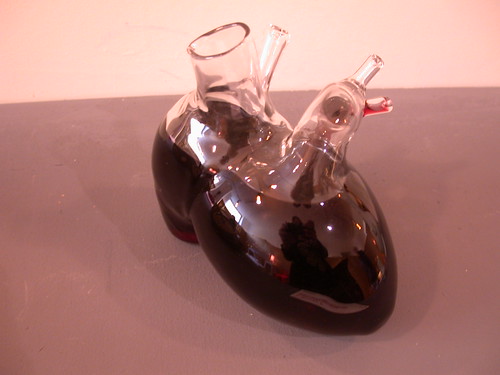
So, what is a decanter? In a nutshell, it’s simply any container into which you can carefully pour (usually) an entire bottle to expose more of the wine’s surface area to oxygen. Decanters come in all shapes, sizes, and styles, ranging from very simple to curvy, twisty shapes that make for better art than function. I mean, if you’re feeling vampiric…

Heart decanter

But, honestly, I prefer something like this:

IMG_0799

I can’t remember where we came up with this, honestly. I think it may have been a bottle of white zinfandel once upon a time that I bought for sangria, and we’ve used it as a flower vase ever since. It’s a perfect size – comfortably fits an entire bottle, easy to pour from, and I don’t have to worry about being clumsy with crystal. You can also use a water pitcher. Works fine. In a real pinch, just pour the glasses early and put them somewhere that they won’t be disturbed.

How to decant wine? Easy. Open the bottle, then pour the contents into the decanter slowly and reasonably gently. I use the pouring method long-perfected by any knowledgeable sophomore at a keg party – tilt the decanter and pour down the side. While you don’t have to worry about your wine foaming up everywhere, cabernet sauvignon stains don’t come out as easily as Natty Light. After you’ve poured your wine, just set the decanter down somewhere for 20 minutes or so (longer for certain wines) – and go to town. Now, if you want to show off the bottle itself, you can pour the wine into a decanter, let it sit, and then pour it back into the bottle. Use a funnel! (Another side benefit of decanting -- it’s an opportunity to get any sediment out of your wine – especially unfiltered wine. Wine sediment usually doesn’t have any effect on the taste, but “gritty” isn’t a sensation I want when I’m quaffing.)

During the afternoon & evening of the Sweet Partner in Crime’s recent birthday, we did a little experiment with a few bottles. We opened each bottle and tasted it immediately. Then we decanted, let the wine sit for a bit, then sampled it again. We used the following bottles:

  • Domaine Bachelet-Monnot 2007 Bourgogne Blanc
  • Saintsbury 2004 Carneros Pinot Noir
  • Tenimenti Fontanafredda “La Villa” 2000 Barolo

First up, the white Burgundy. I don’t usually decant white wines since they’re made to be drunk young. As a rule, the younger a wine’s made to drink, the less good you’re going to do by decanting. Most of these wines, however, are built to last and we thought it would be interesting to see the contrast. At first taste, the “typical” white Burgundy profile came out – fairly crisp and minerally in a lean style with plenty of citrus. After decanting, new flavors emerged. Peach and pear popped up, as did a mild oakiness that really pointed up the lemony flavors. Made a good wine that much better. I decided to do a “day of small plates” and started off with some smoked salmon and crackers. The oakiness worked well with the smoked flavors and the acidity cut through the oils nicely.

I picked up the Saintsbury on a “vintage clearout” sale – it’s typically around $35. This vintage was getting towards the end of its “recommended peak,” and it was pretty straightahead pinot at first taste. I certainly got the “smoked cherry” flavors you’ll get from most pinot, but it didn’t seem overly complex. When you have a wine that’s getting near the end of its peak, decanting will allow you to wring all of the flavor you can from the wine. With the Saintsbury, after a little decantation, revelation. The nose picked up a caramel twist and the body added some yummy ginger and raspberry flavors. The smokiness was enhanced at the end. This went from a solid, everyday pinot to something more supple and sexy. I made a little “seared sashimi” with it. I read it was a good pairing, and I can stand and tell you to three decimal points that it’s heavenly.

Finally, the Barolo. Now, Barolo is a special case. These powerful Italian wines from the Piedmont are so tannic on bottling that they usually need a minimum of 8-10 years in bottle before the bitter edge has softened enough to drink. Tannic wines almost always improve with decanting. (The same applies to young California cabernets and the like.) This Barolo was a great deal from Garagiste Wines – even so, it was still around $45. When first opened, the light color of this wine belied the power within. At first sip, though, it was tannic but not overly so and fairly easy drinking. I might have even confused it with a Chianti. The recommended decant time for Barolo is at least a couple of hours, so I set it aside and got to work on my special birthday eggplant parmesan. When I served it up and poured the wine – a transformation. The wine “woke up.” That’s about as well as I can explain it. Everything was more powerful. The tannins were stronger, the plummy, somewhat tarry flavors were pronounced, and the wonderful complexity showed up. It went delightfully with the parmesan. Actually, the post-decanting version was too strong in the opinion of the SPinC. She said that she liked it better before decanting, actually. As I’ve said, everyone’s palate is different.

So, when should you decant? Almost anytime you can, really. Unless a wine is a bargain-line wine, you’re probably going to see a marked improvement in flavor and complexity after you decant a wine for a bit. In a pinch, you can use an aerator. These work well for most wines – but for something that needs more time in air (older European wines or younger American wines in general), you’re still going to be better off finding something to pour the wine into for awhile.

Monday, June 23, 2008

The Ballad of Barolo

As I mentioned, more on the birthday celebration...

Just after New Year's 2008, I decided to put the wheels in motion for the Sweet Partner in Crime's 40th birthday. I thought it might be an interesting idea to get a bottle of wine born two-score years ago and open it during our celebratory shindig.

Trouble is, options get pretty limited when you're trying to procure a wine that old. Ports, brandies, cognacs, and armagnacs are regularly that old -- but none of those are faves of the SPinC, especially not while enjoying dinner on the patio in summertime. There are some French wines that can hold up that long, but they're prohibitively expensive. See what the going rate on a 1968 first-growth Chateau Latour is these days, for instance.

That brought me to Italy, where several types of wine are built for the long haul. The one I really wanted to see what I could do with was Barolo. As I'd mentioned before, I'd tried the Italian "Wine of Kings" before and wasn't all that impressed -- largely because Barolo takes 10-15 years to get into its wheelhouse. Also, since the Sweet Partner's favorite kitchen creation of mine is my somewhat nontraditional eggplant parmesan, it seemed a natural match.

Any wine aged that long is going to be a crapshoot. A buyer is gambling that the bottle has been stored in good, stable conditions and that the cork has managed to hold together in a reasonable fashion. You're also hoping that the natural fermentation hasn't already turned the wine into an expensive bottle of vinegar. Unless a wine's been cared for properly, maybe 1 in 100 bottles will be drinkable.

There are companies out there who specialize in selling "collectable wines." A little research led me to one whose name I won't publicize here (for reasons that will become apparent). In mid-January, I called them to inquire about some of their selections. They had five Barolos from 1968. They put me through to "Troy," their Italian wine specialist. I asked him which one he would get if he wanted one that would drink well. He made a recommendation and I placed my order. He said it would be to me in a couple of weeks.

Three weeks passed. I called Troy again. He said there "had been a dock strike" and the wine shipment was held up in port. He said to call back in a couple of weeks. Three weeks passed again. I called again. Troy told me that the "strike was over," but that my wine wasn't on the shipment, he'd be checking on it, and he'd get it to me for sure. Then came the height of basketball season, and I got distracted for awhile. The beginning of April rolled around, and I called yet again. I was informed that "Troy was no longer with the company" but my order was still pending. I started to get a bit nervous.

Finally, the beginning of May rolled around, and I still hadn't received the wine.I called back one more time and spoke to their new Italian wine guy. He told me that the original Barolo was unavailable, but there were a couple of other potentials he could check on. He said to give him a week. I finally heard from him after ten days, and he gave me the news that there were no Italian 1968's to be found anywhere. He offered me a refund. I took it, swore loudly after hanging up, and then started madly Googling.

Call it fate, divine intervention, or just dumb luck, but I stumbled across WineCommune.com, a sort of eBay for wine -- and discovered a seller with excellent reports and several Barolos from that vintage. After a couple of emails, I placed another order. Four days later, I had a bottle of 1968 Renato Ratti Barolo in my greedy little hands. I smuggled it into the house, put it in the wine fridge, and set the wheels in motion.

After a birthday dinner and wonderful brunch from Julie Francis at Nectar, picking yet more cherries, some absolutely top-notch massages, and some relaxing at home, I was ready for the main event. I put together my parmesan (I grill the eggplant instead of deep frying it. The smoky flavor is perfect, in my opinion.) got it to baking, and relaxed for awhile on the patio with some Pinot Grigio.

Just after taking it out of the oven (it needs to sit for a few minutes before digging in), I made the presentation. At first, I think she thought it was just another bottle of Italian wine -- until she saw the date. "Ecstatically Stunned" would be an apt description. We shared some happy tears, then went inside to open it. The wax seal on the bottle was intact, and the cork looked to be in good shape. However, after the first half inch or so, the rest started to crumble when I extracted it. With the help of a mesh screen and some slow decanting, I was able to salvage almost all of the wine.

The first small pour was enough for us to know that what we had was an actual bottle of wine, not vinegar. The nose was fragrant and unique -- cherries, sort of, but other aromas I couldn't put my finger on. The flavor was actually somewhat thin, which surprised me, knowing how big this wine was supposed to be.

We served up the parmesan and poured a little more of the wine. Even after another 20 minutes, the wine started to change remarkably. The nose, tight at first, began to open up into a broad combination of cherries, spice, and smoke -- mirrored by the flavor continuing to deepen, becoming more tannic, but certainly not overwhelmingly so, and the fruit flavor deepened as well. The most interesting addition was the finish, which lasted for what seemed like ages. To me, it was a sensation of peeling back smoky layer after layer, balanced on top of the tannin. Needless to say, it echoed the flavors in the meal exceptionally well. We ended up eating and drinking much more slowly than we usually do, savoring the changes the wine continued to exhibit.

Finally, we settled into the lounge chairs to enjoy the rest of the wine. We tried it with some dark chocolate with mixed results, but we simply sipped the rest of it over the course of the next couple of hours, relishing the evolving and deepening flavors.

I'll draw the curtain at this point. While every day should be a celebration, I don't think there's anything wrong with going a little over the top. While the bottle certainly wasn't in the neighborhood of $15, I would recommend any wine lover trying something like this once, just for the experience. Just make sure you share it. You'll be glad you did.