Ah, Italian wine. Love it. Love it. Love it. As the foodie that I am, I’m hard pressed to come up with wine that goes better with a meal than Italian wines. After all, one of the few things that Italians do better than making wine is cooking, and because they’ve been making wine as long as they have, winemakers in each region have been tailoring wines to cuisine for centuries.
As such, each region’s wine varieties tend to be fairly consistent as far as the basic flavor profile goes. I wouldn’t choose to drink a lot of them on their own for one reason or another, but line up some steamed mussels next to an Italian pinot grigio or a Sangiovese with marinara-sauced pasta and you’ve got yourself a little slice of heaven.
The trick, though, is figuring out which of these heavily vowel-labeled bottles is the right wine. Like France, Italy’s gotten a little bit better about putting the names of grape varietals and/or descriptive blurbs in English on the bottle for the “ordinary American consumer.” For the most part, however, the traditional convention still holds. The names on the bottle are generally the producer and the region. The grape is often nowhere to be found. As I’ve mentioned before, I spent most of my pre-Vine life thinking that “Chianti” was a grape varietal instead of a region in Tuscany.
Further confusing matters are exceptions to this rule. Some Italian wines do put the name of the grape on the label as a matter of course. The name of the grape is usually followed by the name of the locale, so you’ll see wines like Moscato d’Asti, Barbera d’Alba, etc. The first one, for instance, translates as “The Moscato (grape) from Asti (the town).” You’ll even run into “Montepulciano d’Abruzzo” vs. “Vin Noble di Montepulciano.” The first is a fruity, easy-drinking table wine made from the Montepulciano grape. The second is a somewhat complex Sangiovese-based wine from the town of Montepulciano.
But why? Why stick to an antiquated, confusing system of nomenclature, especially now that the world has grown much more wine savvy? Why not just label the bloomin’ bottles with whatever the heck is in there?
The answer?
Two thousand.
There are at least 2,000 indigenous grape varietals in Italy. Gaining an encyclopedic knowledge of all the grapes in the Boot that go into their bottles of yummy would be next to impossible. So, how do you know what you’re getting?
The Italian government simplified matters for us a little. They created a classification system somewhat similar to the ones in France. If you look at most bottles of Italian wine, you’ll see “DOC” or “DOCG” somewhere on the label. Without going into too much detail, the DOC/DOCG designation shows that a wine was made in a certain region using pre-determined methods containing certain grape varietals. This usually aligns with the geographic region, but a grape will sometimes be included in the designation if the varietal is a specialty of the area – like the aforementioned Moscato d’Asti, et al.
In my experience, Italian wine is an experience where you largely get what you pay for. This isn’t to say that there isn’t really good inexpensive wine from Italy. Think about it this way -- if you blindly choose $30 Bordeaux, there’s a chance that you’ll end up with a wine inferior to the $10 dollar one on the rack nearby. Italian? $15 Chianti will be perfectly drinkable, but also usually consistent with its brethren of the same price point. If you splurge on a $30 bottle, you can usually tell a difference in quality (although you may not feel that difference was worth the extra moolah).
There are hundreds of DOC/DOCG growing regions, but many of them are extremely small and you probably won’t run into them very often. Here are some of the more common regions and DOC/DOCG designations you’ll run into at the local wine stores for your reading and drinking pleasure…
Region: Campania
Common wines you’ll see: Taurasi, Fiano, Falerno
Major grapes: Aglianico, Piedirosso, Primitivo (red); Falanghia (white)
General info: Campania is the region around Naples. The best known wine from there is a robust red called Taurasi made from the Aglianico grape. Fiano is a seafood-loving white and Falerno is another big wine made from Primitivo (Zinfandel). Much of the rest of the wine from there has traditionally been known as fairly generic, although it’s improved greatly in recent years.
Region: Tuscany
Common wines you’ll see: Chianti, Brunello di Montalcino, Vin Noble di Montepulciano, Rosso di Montalcino, Rosso di Montepulciano, IGT Toscana
Major grape: Sangiovese (red – not many whites in Tuscany)
General info: Ah, Tuscany – home of some of the most famous reds wines in Italy. Most Tuscan reds are backboned by the Sangiovese grape. Brunello di Montalcino is also Sangiovese, but a specific clone of that particular grape. There’s also “Vin Santo” – a sweet dessert wine. You’ll also find “super Tuscan” wines that are bigger and heartier. These are almost always Sangiovese blended with a non-indigenous varietal like merlot or cabernet, often to please an American palate. If you see “IGT Toscana” on the label, it’s probably a Super Tuscan of some stripe. The wines tend to be very flexible, since Tuscan cuisine is some of the most varied (and delicious) food in the world. However, in my opinion, these wines are not the best to drink by themselves. They need food to show their full potential.
Region: Piedmont
Common wines you’ll see: Barbaresco, Barolo, Barbera d’Alba, Barbera d’Asti, Dolcetto d’Alba, Dolcetto d’Asti, Moscato d’Asti, Gavi
Major grapes: Nebbiolo, Barbera, Dolcetto, Moscato (red); Cortese (white)
General info: Piedmont is the mountainous region in the northwest corner of the country. The bulk of Italy’s hearty reds come from this region – especially Barolo and Barbaresco. They’re some of the most famous of the world’s wines. Barbera is a big, juicy red and Dolcetto is a lighter, acidic red – both of which make excellent everyday wines in their “generic” form. The versions from “named” places (like Barbera d’Alba for instance) have more complexity. Gavi is a crisp white made from the Cortese grape (not to be confused with Dan Cortese) which makes an interesting contrast. Piedmont wines are built to stand up to heavier meats and sauces. Even the whites handle cream sauces easily. There’s also Moscato d’Asti – a low alcohol, sweet sparkling wine which may be the best brunch wine in the world.
Regions: Sardinia & Sicily
Common wines & grapes you’ll see: Cannonau (red); Malvasia, Vernacchia, Verdicchio, Moscato (white)
General info: The islands of Italy usually end up putting the names of the grapes on the label, so you can generally run with those. Both islands, especially Sardinia, produce quantities of dry, crisp white wines made from Vernacchia, Malvasia, and Verdicchio that go perfectly with shellfish. Sicily produces a huge amount of dessert wine. The most common red is made from Cannonau, which is currently getting a great deal of publicity for its hypothesized life-extending properties. Cannonau is similar to Grenache and often makes for powerful wines, but on the islands, they’re made in a much lighter, more aromatic style.
Region: Veneto
Common wines you’ll see: Bardolino, Valpolicella, Soave, Prosecco
Major grapes: Corvina, Sangiovese (red); Prosecco, Garganega (white)
General Info: The region around Venice cranks out a huge amount of wine. The reds are usually blends backboned by the Corvina grape. These reds tend to be some of the lightest bodied in the country. Many are often served slightly chilled, much like Beaujolais. There’s actually a “Bardolino novello,” made in a similar style as Beaujolais Nouveau. The whites, like Soave are usually fruity and more or less dry. The Valdobbiadene district is the home of Prosecco, Italy’s most famous sparkling wine. It resembles Spanish cava in many ways. Interestingly, with all the light reds produced in Valpolicella, it’s also home to the most powerful red wine in Italy: Amarone. Amarone is made from raisinated grapes, which yields a concentrated, potent (upwards of 15% alcohol), tannic, tasty wine.
There are 14 other major wine growing regions in Italy and literally hundreds of DOC & DOCG designations. It’s worth it to explore. Ask for your Italian wine expert at your local store. There’s usually one major “Italophile” in every shop. They’ll usually steer you correctly. But for basics, this should take care of you for right now. Hope it helps!
Sunday, August 22, 2010


Monday, August 16, 2010
Kinkead Ridge gets some notoriety
Our friends of the Vine at Kinkead Ridge Winery get some well-deserved international kudos:


Internationally-recognized, award-winning Kinkead Ridge Winery will be featured in Opus Vino, an illustrated wine reference book ($75) which will be published in the US, UK and Australia in November 2010, with foreign language editions in 2011 and 2012. Only two Ohio wineries are featured in this book, which features 4,500 international wineries.
The winery (904 Hamburg Street, Ripley, Ohio) will re-open for the release of the 2008 red wines on Saturday September 4 and Monday September 6. The vineyard will also be open to the public (4288 Kinkead Road) on these dates, from 10 a.m. to 6 p.m. The new releases are the 2008 Kinkead Ridge Cabernet Franc, Cabernet Sauvignon, Syrah and Petit Verdot. The winery will also be open on September 11 from 11 a.m.-5 p.m., and will then close for harvest until the Saturday after Thanksgiving.
For more information, visit the website at http://www.KinkeadRidge.com or call 937-392-6077.
Sunday, August 15, 2010
Festival of the Vine
(To be published in the Dayton City Paper.)
The demand for red wine in Lincoln Park was low this weekend.
Fraze Pavilion’s annual Festival of the Vine always brings out a crowd for sampling wine, kicking back to some cool jazz, and enjoying a shady afternoon. This year, however, with humidity approaching Evergladesian levels and heat indices to make Carl Nichols rethink his retirement, most of the crowd at the festival looked to be avoiding big mouthfuls of tannin.
However, the heat couldn’t stop the groove. A passing thunderstorm caused a brief scramble for shelter at one point, but for most of the afternoon, a steady diet of cool jazz and cooler wine kept the laid back attendees as comfortable as possible in the shade.
This year’s Festival of the Vine mirrored the previous ones. “Like in previous years, we want folks to get a chance to try a bunch of different wines, and hopefully they’ll find something that they like,” proudly stated Kevin Bratton of Heidelberg Distributing, provider of the 35 or so wines available during the evening. “We want to make sure that people get a chance to try things from everywhere. We’ve got New World – largely North American wine,” said Kevin, “We’ve got Old World wines and a sparkling wine tent. And we’ve got an Italian tent because of Claudio.”
This is a good strategy. With that many options, people will probably find new favorites. Festival of the Vine isn’t the kind of event where someone will be able to really *taste* different wines. What they will do is find out what wines are good to slug on a hot day, and that’s a good idea. On a 90 degree day, discussing nuances of torrontes vs. sauvignon blanc isn’t going to be a conversation I’ll want to have, but a “Yep. This helps me forget the heat for a second.” is.
The aforementioned “Claudio” is Claudio Salvador, importer of all the wines in the Italian tent and chief winemaker of Firelands Winery in Sandusky, Ohio. The same weekend as Festival of the Vine was “Toast of Ohio,” another wine festival in Northern Ohio. “I’ve got my crew up there taking care of that. I wanted to come down here!”
Claudio told me that he wanted to showcase some of his wines that were probably unfamiliar to many of the folks at the festival. “We like bringing wines in that people don’t necessarily know. They’re going to know them very soon. Everyone has Pinot Grigio, but with the whites, people haven’t usually tried Gavi or Grecho. Grecho, for instance, is originally from Greece. The Grecho is a very aromatic varietal. People think that it’s the ancestor of Sauvignon Blanc and such.”
Claudio said that he is planning to return to Dayton in November with some of the winemakers from the wines he was showing. “We’re going to do some dinners, which will all be just fantastic. We’re still figuring out exactly where we’re doing them.”
At Claudio’s recommendation, I gave the La Balle Grecho Basilicata a try. One a day like this, the crispness was a welcome respite from the heat. Fruity, acidic, and with a little bit of honey – I could certainly have imagined myself under one of the trees, wrapped around a bottle of the stuff.
I sampled a few of the other wines around the concourse as well. The Monticello Albarino was a refreshing quaff, as was the Grenache-based Belleruche Blanc, a white from the Rhone region in France. I also snagged a glass at one point of the Barefoot Brut sparkling wine. Despite the good banter at the tasting table – the conversation far outstripped the bubbly. The music outstripped both.
Besides, doing heavy wine tasting isn’t the point of an afternoon like this. I’ll definitely lean towards relaxing and good jazz. As my newest friend “Ron from Atlanta” put it, “The wine doesn’t matter to me. I’m here for the music, man. I came up here for a family reunion. I heard [Nate White] was playing, and I wanted to make sure I didn’t miss him. He’s smooth!”
“Oh, and this weather y’all are having? It’s like springtime! I feel right at home.”
The demand for red wine in Lincoln Park was low this weekend.

Fraze Pavilion’s annual Festival of the Vine always brings out a crowd for sampling wine, kicking back to some cool jazz, and enjoying a shady afternoon. This year, however, with humidity approaching Evergladesian levels and heat indices to make Carl Nichols rethink his retirement, most of the crowd at the festival looked to be avoiding big mouthfuls of tannin.
However, the heat couldn’t stop the groove. A passing thunderstorm caused a brief scramble for shelter at one point, but for most of the afternoon, a steady diet of cool jazz and cooler wine kept the laid back attendees as comfortable as possible in the shade.
This year’s Festival of the Vine mirrored the previous ones. “Like in previous years, we want folks to get a chance to try a bunch of different wines, and hopefully they’ll find something that they like,” proudly stated Kevin Bratton of Heidelberg Distributing, provider of the 35 or so wines available during the evening. “We want to make sure that people get a chance to try things from everywhere. We’ve got New World – largely North American wine,” said Kevin, “We’ve got Old World wines and a sparkling wine tent. And we’ve got an Italian tent because of Claudio.”
This is a good strategy. With that many options, people will probably find new favorites. Festival of the Vine isn’t the kind of event where someone will be able to really *taste* different wines. What they will do is find out what wines are good to slug on a hot day, and that’s a good idea. On a 90 degree day, discussing nuances of torrontes vs. sauvignon blanc isn’t going to be a conversation I’ll want to have, but a “Yep. This helps me forget the heat for a second.” is.
The aforementioned “Claudio” is Claudio Salvador, importer of all the wines in the Italian tent and chief winemaker of Firelands Winery in Sandusky, Ohio. The same weekend as Festival of the Vine was “Toast of Ohio,” another wine festival in Northern Ohio. “I’ve got my crew up there taking care of that. I wanted to come down here!”
Claudio told me that he wanted to showcase some of his wines that were probably unfamiliar to many of the folks at the festival. “We like bringing wines in that people don’t necessarily know. They’re going to know them very soon. Everyone has Pinot Grigio, but with the whites, people haven’t usually tried Gavi or Grecho. Grecho, for instance, is originally from Greece. The Grecho is a very aromatic varietal. People think that it’s the ancestor of Sauvignon Blanc and such.”
Claudio said that he is planning to return to Dayton in November with some of the winemakers from the wines he was showing. “We’re going to do some dinners, which will all be just fantastic. We’re still figuring out exactly where we’re doing them.”
At Claudio’s recommendation, I gave the La Balle Grecho Basilicata a try. One a day like this, the crispness was a welcome respite from the heat. Fruity, acidic, and with a little bit of honey – I could certainly have imagined myself under one of the trees, wrapped around a bottle of the stuff.
I sampled a few of the other wines around the concourse as well. The Monticello Albarino was a refreshing quaff, as was the Grenache-based Belleruche Blanc, a white from the Rhone region in France. I also snagged a glass at one point of the Barefoot Brut sparkling wine. Despite the good banter at the tasting table – the conversation far outstripped the bubbly. The music outstripped both.
Besides, doing heavy wine tasting isn’t the point of an afternoon
 like this. I’ll definitely lean towards relaxing and good jazz. As my newest friend “Ron from Atlanta” put it, “The wine doesn’t matter to me. I’m here for the music, man. I came up here for a family reunion. I heard [Nate White] was playing, and I wanted to make sure I didn’t miss him. He’s smooth!”
 “Oh, and this weather y’all are having? It’s like springtime! I feel right at home.”
Monday, August 09, 2010
Wine Festivals -- a couple to choose from...
In case you're looking for something to do this weekend in the state of Ohio (or thereabouts), you've got a couple of options.
First off, Fraze Pavilion in Dayton is hosting the annual Festival of the Vine on Saturday the 14th. The festival starts at 1:00 in Lincoln Park, just outside the Pavilion itself. A free jazz concert runs until 7:00. There will be over 30 wines for sampling and purchase by the glass. A ticketed concert featuring Jeff Golub, Gerald Albright, Kirk Whalum and Peter White begins at 7pm. Your intrepid wine columnist and the Sweet Partner in Crime will also be wandering the grounds. For more information, click here.
For those of you in the more northern reaches, the Toast of Ohio Wine Festival is this week from Thursday through Saturday in Sandusky at the Sandusky Bay Pavilion. The event "features twelve Ohio wineries, gourmet food, live musical entertainment and an artist's showcase." Admission to the event is $5 -- which includes a souvenir glass and two tastings. For more information, click here.
First off, Fraze Pavilion in Dayton is hosting the annual Festival of the Vine on Saturday the 14th. The festival starts at 1:00 in Lincoln Park, just outside the Pavilion itself. A free jazz concert runs until 7:00. There will be over 30 wines for sampling and purchase by the glass. A ticketed concert featuring Jeff Golub, Gerald Albright, Kirk Whalum and Peter White begins at 7pm. Your intrepid wine columnist and the Sweet Partner in Crime will also be wandering the grounds. For more information, click here.
For those of you in the more northern reaches, the Toast of Ohio Wine Festival is this week from Thursday through Saturday in Sandusky at the Sandusky Bay Pavilion. The event "features twelve Ohio wineries, gourmet food, live musical entertainment and an artist's showcase." Admission to the event is $5 -- which includes a souvenir glass and two tastings. For more information, click here.
Wednesday, August 04, 2010
Cincinnati’s Hidden Gem – The Summit
(Cross-posted at The Man Who Cooks.)
“I don’t think this is the second floor.”
The Sweet Partner in Crime and I were wandering the halls of a Cincinnati State classroom building, looking for The Summit – the restaurant that’s the centerpiece of the Midwest Culinary Institute at Cincinnati State where we were going to meet our friends Mike and Shelley. Music and the laughter of students having some kind of event on a Saturday night (which was cool to see at a community college) filtered down the hall, but there was no sign of a restaurant.
We discovered that we’d accidentally pulled up a floor short, so we climbed one more flight of stairs and found a small sign pointing us down a hall past a closed-up snack bar area typical of what you’d find in just about any student union on any college campus in the U.S. The hall was lined on either side with darkened (but impressive looking) test kitchens. Around another corner and there we were.
So, what is The Summit? It’s a fine dining restaurant largely run and managed by the culinary arts students. As such, it’s located in the academic building on Cincinnati State’s campus where the students get their training. We arrived and were greeted with a smile by the manager, Donna Schmitt, who poured us our first round of Albariño while our table was prepared.
We were lucky enough to be seated at the “Chef’s Table” beside a large window opening into the kitchen, so we could see this eager bunch of twentysomethings honing their skills. Having spent decades in the world of the academy, I know how important it is for students to get real-world, hands-on experience. Even though I’d heard really good things about the place, I still had it in the back of my head that these were chefs-in-training. I wondered just how good a student-run high-end place could be.
I don’t wonder any more. It’s good. Real damned good.
What the place lacks in décor, it more than makes up for in service and quality. The Summit’s dining room is little more than a large open room with 30-40 tables. There’s not a lot in the way of fancy décor – but we were there to eat after all, not stare at pictures or admire faux paint. Our server (name) informed us that the menu was left intentionally vague so that patrons would ask questions so as to give the waitstaff practice in discussing the ins and outs of each course. (There was only one minor bobble in the service – we had to ask for water.)
We also had a visit from the chef de cuisine, Matt Winterrowd (a former compatriot of both Jean-Robert de Cavel and David Cook of DaVeed’s), at one point. He gave us a unique experience. Have you ever been dreamily devouring a course at a restaurant and asked about the details of the preparation? Most chefs I’ve met are more protective of their recipes than mama wolves are of their pups. When the chef came to the table, we asked him about the preparation of this insanely good morel mushroom appetizer that three of the four of us ordered. Instead of being vague, he basically walked us through the entire progress – starting with the two stocks (mushroom and chicken) that he used as a base for the sauce and moving step-by-step through the prep. (Needless to say, there will be some replication attempts as soon as I find some good ‘shrooms.)
So, what did we have? Three of the four of us had an appetizer of morel mushrooms creamed in an Idiazabal cheese sauce with shallots and fresh oregano. Orgasmic, off the charts good. The SPinC was the outlier with a very solid choice – probably the best soft shell crab I’d tasted outside of Baltimore. It was presented with a salsa of black beans, lime juice, avocado, and chilis.
For entrees, Shelley and the SPinC had sockeye salmon topped with a parsley-based pesto in a roasted tomato sauce with roasted fennel and potato gnocchi. The SPinC greeted her meal with reverent silence for several bites, which is far from the norm for her while diving into good food.
Mike had handmade pappardelle pasta in a cream sauce with prosciutto, parmesan, and baby peas. As simple as the dish was – the freshness of the ingredients made the entrée memorable. Mike said it was “about best tasting pasta” he’d ever had. I hold Mike’s cooking skills in high esteem, so this is serious praise.
As for myself, I tried the “teres major,” which was a cut of beef I’d never heard of, much less tried. It’s sometimes called the “shoulder tenderloin,” and isn’t used often. It’s from the front of the cow rather than the rear. It looks like a very small filet and it’s sliced thin. Served up next to a cauliflower and porcini mushroom mash, grilled asparagus, and an absolutely scrumptious sauce that I embarrassingly cannot remember, I certainly enjoyed myself.
The four of us split a delicious artisanal cheese plate for dessert. There was a Tuscan Pecorino, a “Humboldt Fog” goat cheese, Mahon (another hard cheese) from California, and Maytag Blue – a delicious stinky number from Iowa.
Additionally, the SPinC and I split a “black and blue” – a blackberry/blueberry cobbler with browned butter topping some handmade ice cream. Mike and Shelley had angel food cake stuffed with strawberries and thyme with a buttermilk icing. By this point, we were beyond stuffed, but we were floating on a culinary cloud of goodness. And the cost? For the entire meal plus wine (they’ve got a very solid wine list, too), we got out of there for under $70 a person, including tax and tip.
This was one of the best dining values that I’ve experienced in Cincinnati – but there were less than a dozen tables occupied over the course of the evening that we saw. My guess is that the setting – finding one’s way through a college campus to get to the restaurant – discourages a number of people. It shouldn’t.
If you’re someone who needs five-star décor to go with your food, then the Summit isn’t for you. If you’re someone who appreciates good food and would enjoy a relaxed evening with friends where conversation and food can be the centerpiece, then you really owe it to yourself to give this place a try. Go. Quiz the servers, ask a bunch of questions, and enjoy. I can almost guarantee you a good experience.
“I don’t think this is the second floor.”
The Sweet Partner in Crime and I were wandering the halls of a Cincinnati State classroom building, looking for The Summit – the restaurant that’s the centerpiece of the Midwest Culinary Institute at Cincinnati State where we were going to meet our friends Mike and Shelley. Music and the laughter of students having some kind of event on a Saturday night (which was cool to see at a community college) filtered down the hall, but there was no sign of a restaurant.
We discovered that we’d accidentally pulled up a floor short, so we climbed one more flight of stairs and found a small sign pointing us down a hall past a closed-up snack bar area typical of what you’d find in just about any student union on any college campus in the U.S. The hall was lined on either side with darkened (but impressive looking) test kitchens. Around another corner and there we were.
So, what is The Summit? It’s a fine dining restaurant largely run and managed by the culinary arts students. As such, it’s located in the academic building on Cincinnati State’s campus where the students get their training. We arrived and were greeted with a smile by the manager, Donna Schmitt, who poured us our first round of Albariño while our table was prepared.
We were lucky enough to be seated at the “Chef’s Table” beside a large window opening into the kitchen, so we could see this eager bunch of twentysomethings honing their skills. Having spent decades in the world of the academy, I know how important it is for students to get real-world, hands-on experience. Even though I’d heard really good things about the place, I still had it in the back of my head that these were chefs-in-training. I wondered just how good a student-run high-end place could be.
I don’t wonder any more. It’s good. Real damned good.
What the place lacks in décor, it more than makes up for in service and quality. The Summit’s dining room is little more than a large open room with 30-40 tables. There’s not a lot in the way of fancy décor – but we were there to eat after all, not stare at pictures or admire faux paint. Our server (name) informed us that the menu was left intentionally vague so that patrons would ask questions so as to give the waitstaff practice in discussing the ins and outs of each course. (There was only one minor bobble in the service – we had to ask for water.)
We also had a visit from the chef de cuisine, Matt Winterrowd (a former compatriot of both Jean-Robert de Cavel and David Cook of DaVeed’s), at one point. He gave us a unique experience. Have you ever been dreamily devouring a course at a restaurant and asked about the details of the preparation? Most chefs I’ve met are more protective of their recipes than mama wolves are of their pups. When the chef came to the table, we asked him about the preparation of this insanely good morel mushroom appetizer that three of the four of us ordered. Instead of being vague, he basically walked us through the entire progress – starting with the two stocks (mushroom and chicken) that he used as a base for the sauce and moving step-by-step through the prep. (Needless to say, there will be some replication attempts as soon as I find some good ‘shrooms.)
So, what did we have? Three of the four of us had an appetizer of morel mushrooms creamed in an Idiazabal cheese sauce with shallots and fresh oregano. Orgasmic, off the charts good. The SPinC was the outlier with a very solid choice – probably the best soft shell crab I’d tasted outside of Baltimore. It was presented with a salsa of black beans, lime juice, avocado, and chilis.
For entrees, Shelley and the SPinC had sockeye salmon topped with a parsley-based pesto in a roasted tomato sauce with roasted fennel and potato gnocchi. The SPinC greeted her meal with reverent silence for several bites, which is far from the norm for her while diving into good food.
Mike had handmade pappardelle pasta in a cream sauce with prosciutto, parmesan, and baby peas. As simple as the dish was – the freshness of the ingredients made the entrée memorable. Mike said it was “about best tasting pasta” he’d ever had. I hold Mike’s cooking skills in high esteem, so this is serious praise.
As for myself, I tried the “teres major,” which was a cut of beef I’d never heard of, much less tried. It’s sometimes called the “shoulder tenderloin,” and isn’t used often. It’s from the front of the cow rather than the rear. It looks like a very small filet and it’s sliced thin. Served up next to a cauliflower and porcini mushroom mash, grilled asparagus, and an absolutely scrumptious sauce that I embarrassingly cannot remember, I certainly enjoyed myself.
The four of us split a delicious artisanal cheese plate for dessert. There was a Tuscan Pecorino, a “Humboldt Fog” goat cheese, Mahon (another hard cheese) from California, and Maytag Blue – a delicious stinky number from Iowa.
Additionally, the SPinC and I split a “black and blue” – a blackberry/blueberry cobbler with browned butter topping some handmade ice cream. Mike and Shelley had angel food cake stuffed with strawberries and thyme with a buttermilk icing. By this point, we were beyond stuffed, but we were floating on a culinary cloud of goodness. And the cost? For the entire meal plus wine (they’ve got a very solid wine list, too), we got out of there for under $70 a person, including tax and tip.
This was one of the best dining values that I’ve experienced in Cincinnati – but there were less than a dozen tables occupied over the course of the evening that we saw. My guess is that the setting – finding one’s way through a college campus to get to the restaurant – discourages a number of people. It shouldn’t.
If you’re someone who needs five-star décor to go with your food, then the Summit isn’t for you. If you’re someone who appreciates good food and would enjoy a relaxed evening with friends where conversation and food can be the centerpiece, then you really owe it to yourself to give this place a try. Go. Quiz the servers, ask a bunch of questions, and enjoy. I can almost guarantee you a good experience.
Sunday, July 18, 2010
Planet Bordeaux (Syndicate, Fool!)
Mike Wangbickler of Balzac Communications recently gave me the opportunity to get a first look at “Planet Bordeaux” – the new marketing project by winemakers in the Bordeaux region. The project’s mission is to help people realize they can afford Bordeaux wines of quality without either leasing their first-born or slugging the scrapings from the bottom of fermenting tanks. “Folks can afford Bordeaux as an everyday wine. It doesn’t just have to be for collectors,” said Mike.
First off, a quick review of Bordeaux wine. Bordeaux is arguably the most famous French wine region (the argument would come from their Burgundian neighbors). Some of the most expensive and sought after wines in the world call this slice of France home. Red Bordeaux is always a blend of cabernets sauvignon and franc, merlot, petit verdot, and malbec. White Bordeaux is a blend of sauvignon blanc and semillon.
Red Bordeaux, even though they’re a mix of some varietals that we may think of as heavy, tend to be lighter-styled, tannic reds. Even inexpensive Bordeaux can have complexity to the flavor. There’s usually an earthy or “cigar box” aroma and flavor along with the dark fruit, and finishes that are long and tannic. White Bordeaux usually are quite acidic, minerally, and have floral or herbal scents and flavors. They’re also usually very light in color. The deeper colored whites have more Semillon and tend to be heavier.
The mystery, allure, and frustrations of Bordeaux can often be traced back to the caste system for wines. In 1855, a “ranking system” for French wines was developed based on terroir, winemaking quality, overt and covert bribery, etc. The “best” single vineyard chateaux were classified into five “growths” – the Premier Crus are Chateau LaTour, Chateau Margaux, Chateau Haut-Brion, and Chateaux Lafite and Mouton Rothschild.
Below these are the AOC wines – wines from a certain region. These are your regional wines – Chateaux that can call themselves “Bordeaux” but aren’t in the “growth” rankings. The grapes must be grown in Bordeaux, but they come from one chateau or commune’s holdings, although they’re not necessarily single vineyard products. These tend to be a step below the “classed growths,” but are still considered from reasonably to really good wine. You know you’re looking at one of these wines if you see the following words on the bottle:
So, the top grade goes for hundreds of dollars a bottle. Collectors hoard these. Thus, there’s always a demand. The vin de pays can be found anywhere. It’s inexpensive. Thus, there’s always a demand. The AOC wines, trapped in the middle, were faced with quite a quandary. These wines are quite a cut in quality above the vin de pays, but many aren’t much more expensive. Imagine you’re a winemaker and you’re putting together quality product, could make a profit with a relatively low price point, and are still a really good deal in any case. If you could only get the word out – people would snap it up, right?
Enter the Byzantine (or would that be Gallic?) world of French wine law. There are restrictions on marketing. Chateaux and communes cannot partner to market their wines. They have to work individually, for the most part. So, not surprisingly, the Chateaux with the most cash get the most run in the press, since they can afford the publicity. The best selling AOC red Bordeaux is Mouton-Cadet – a little side project of Chateau Mouton Rothschild. You can find that Bordeaux almost anywhere. It’s almost as ubiquitous as Duboeuf’s Beaujolais.
So, along comes Syndicat Viticole des appellations controlees Bordeaux et Bordeaux Supérieur, also known as the Bordeaux Syndicate (not to be confused with Rhyme Syndicate). The entire region figured that since they can’t market against each other – they’d market alongside each other! “Planet Bordeaux” (online at http://www.planete-bordeaux.eu/) followed.
Thanks to Mike and Balzac, I was able to procure a few of the Syndicate’s samples. We had three bottles – one white and two red. Thoughts? First up, the white:
Château Thieuley 2009 Bordeaux Blanc ($14) – We opened this one weekend afternoon when we just needed something good to sip on. I was surprised at the nose on this wine. I expected more citrus, but I got a lot of melon scents and some yeast. The taste – it’s a nicely balanced flavor of thick citrus and mineral. The finish is soft and lingers for a bit with a touch of acidity. This wine probably deserved a dinner pairing, but hey – we were thirsty! “You can tell it’s not top line white Bordeaux, but it’s very drinkable,” commented the Sweet Partner in Crime. We moved on to the reds:
Château du Lort 2006 Bordeaux Rouge ($13)
Château Mirambeau Papin 2006 Bordeaux Supérieur Rouge ($20)
The difference between Rouge and Supérieur Rouge? The latter come from older vines as a rule, and they also must be in bottle for at least a year before release.
One tip: Bordeaux Reds MUST be decanted. The young ones need decanting to smooth their edges. The old ones need it to open up all of their potential yummy goodness. The contrast in both these wines was pretty remarkable once we let them sit for a bit. We tried them on their own first.
The “standard” had only a slight “Old World funk” on the nose -- more of a fresh-cut wood and some blackberry. The body starts almost tartly and hangs in there before transitioning into a tannic, graphite like finish that’s moderate. Not very earthy, if you like that kind of thing. The Supérieur had much better balance. The extra time in barrel smoothed off some of the tartness and gave it a “broader” nose – some earth, some fruit, some wood. The taste was quite pleasant, not too powerful or earthy, and with a nice transition of blackberry and cherry into tannins that hang in gently for awhile.
With some lamb loin chops, the standard red actually did quite well. The lamb calmed down the tannins and cut down on the edges of the tartness. The flavor became brighter and fruitier and turned into a nice contrast. After a few sips and bites, the Supérieur emerged as a dark, fruity sidecar.The Supérieur’s subtler flavor merged much more as an “alongside” flavor than the “standing out” flavor of the standard red.
After a couple of hours, they continued to evolve. The regular became “brighter” – with almost a floral bit on the nose. The Supérieur became deeper and darker, adding plums and tar to the nose, The regular red’s sharp edges smoothed and the wine balanced much more. Even so, I personally thought the Supérieur was a better wine all around.
Marketing or not, I think anyone who’s really interested in learning about wines owes it to themselves to form a decent idea of a region’s style and flavor. These AOC wines from Bordeaux give a nice window into those profiles, so these would all be good “starter” wines to help you develop a true sense of a) whether you even like these wines and b) whether you want to explore some more.
First off, a quick review of Bordeaux wine. Bordeaux is arguably the most famous French wine region (the argument would come from their Burgundian neighbors). Some of the most expensive and sought after wines in the world call this slice of France home. Red Bordeaux is always a blend of cabernets sauvignon and franc, merlot, petit verdot, and malbec. White Bordeaux is a blend of sauvignon blanc and semillon.
Red Bordeaux, even though they’re a mix of some varietals that we may think of as heavy, tend to be lighter-styled, tannic reds. Even inexpensive Bordeaux can have complexity to the flavor. There’s usually an earthy or “cigar box” aroma and flavor along with the dark fruit, and finishes that are long and tannic. White Bordeaux usually are quite acidic, minerally, and have floral or herbal scents and flavors. They’re also usually very light in color. The deeper colored whites have more Semillon and tend to be heavier.
The mystery, allure, and frustrations of Bordeaux can often be traced back to the caste system for wines. In 1855, a “ranking system” for French wines was developed based on terroir, winemaking quality, overt and covert bribery, etc. The “best” single vineyard chateaux were classified into five “growths” – the Premier Crus are Chateau LaTour, Chateau Margaux, Chateau Haut-Brion, and Chateaux Lafite and Mouton Rothschild.
Below these are the AOC wines – wines from a certain region. These are your regional wines – Chateaux that can call themselves “Bordeaux” but aren’t in the “growth” rankings. The grapes must be grown in Bordeaux, but they come from one chateau or commune’s holdings, although they’re not necessarily single vineyard products. These tend to be a step below the “classed growths,” but are still considered from reasonably to really good wine. You know you’re looking at one of these wines if you see the following words on the bottle:
- Bordeaux Rouge (Red) AOC
- Bordeaux Supérieur Rouge AOC
- Bordeaux Rosé AOC
- Bordeaux Clairet (Dark Rosé) AOC
- Bordeaux Blanc (White) AOC
- Bordeaux Supérieur Blanc AOC
- Cremant de Bordeaux (Sparkling) AOC
So, the top grade goes for hundreds of dollars a bottle. Collectors hoard these. Thus, there’s always a demand. The vin de pays can be found anywhere. It’s inexpensive. Thus, there’s always a demand. The AOC wines, trapped in the middle, were faced with quite a quandary. These wines are quite a cut in quality above the vin de pays, but many aren’t much more expensive. Imagine you’re a winemaker and you’re putting together quality product, could make a profit with a relatively low price point, and are still a really good deal in any case. If you could only get the word out – people would snap it up, right?
Enter the Byzantine (or would that be Gallic?) world of French wine law. There are restrictions on marketing. Chateaux and communes cannot partner to market their wines. They have to work individually, for the most part. So, not surprisingly, the Chateaux with the most cash get the most run in the press, since they can afford the publicity. The best selling AOC red Bordeaux is Mouton-Cadet – a little side project of Chateau Mouton Rothschild. You can find that Bordeaux almost anywhere. It’s almost as ubiquitous as Duboeuf’s Beaujolais.
So, along comes Syndicat Viticole des appellations controlees Bordeaux et Bordeaux Supérieur, also known as the Bordeaux Syndicate (not to be confused with Rhyme Syndicate). The entire region figured that since they can’t market against each other – they’d market alongside each other! “Planet Bordeaux” (online at http://www.planete-bordeaux.eu/) followed.
Thanks to Mike and Balzac, I was able to procure a few of the Syndicate’s samples. We had three bottles – one white and two red. Thoughts? First up, the white:
Château Thieuley 2009 Bordeaux Blanc ($14) – We opened this one weekend afternoon when we just needed something good to sip on. I was surprised at the nose on this wine. I expected more citrus, but I got a lot of melon scents and some yeast. The taste – it’s a nicely balanced flavor of thick citrus and mineral. The finish is soft and lingers for a bit with a touch of acidity. This wine probably deserved a dinner pairing, but hey – we were thirsty! “You can tell it’s not top line white Bordeaux, but it’s very drinkable,” commented the Sweet Partner in Crime. We moved on to the reds:
Château du Lort 2006 Bordeaux Rouge ($13)
Château Mirambeau Papin 2006 Bordeaux Supérieur Rouge ($20)
The difference between Rouge and Supérieur Rouge? The latter come from older vines as a rule, and they also must be in bottle for at least a year before release.
One tip: Bordeaux Reds MUST be decanted. The young ones need decanting to smooth their edges. The old ones need it to open up all of their potential yummy goodness. The contrast in both these wines was pretty remarkable once we let them sit for a bit. We tried them on their own first.
The “standard” had only a slight “Old World funk” on the nose -- more of a fresh-cut wood and some blackberry. The body starts almost tartly and hangs in there before transitioning into a tannic, graphite like finish that’s moderate. Not very earthy, if you like that kind of thing. The Supérieur had much better balance. The extra time in barrel smoothed off some of the tartness and gave it a “broader” nose – some earth, some fruit, some wood. The taste was quite pleasant, not too powerful or earthy, and with a nice transition of blackberry and cherry into tannins that hang in gently for awhile.
With some lamb loin chops, the standard red actually did quite well. The lamb calmed down the tannins and cut down on the edges of the tartness. The flavor became brighter and fruitier and turned into a nice contrast. After a few sips and bites, the Supérieur emerged as a dark, fruity sidecar.The Supérieur’s subtler flavor merged much more as an “alongside” flavor than the “standing out” flavor of the standard red.
After a couple of hours, they continued to evolve. The regular became “brighter” – with almost a floral bit on the nose. The Supérieur became deeper and darker, adding plums and tar to the nose, The regular red’s sharp edges smoothed and the wine balanced much more. Even so, I personally thought the Supérieur was a better wine all around.
Marketing or not, I think anyone who’s really interested in learning about wines owes it to themselves to form a decent idea of a region’s style and flavor. These AOC wines from Bordeaux give a nice window into those profiles, so these would all be good “starter” wines to help you develop a true sense of a) whether you even like these wines and b) whether you want to explore some more.
Tuesday, July 13, 2010
Wine and Dinner of the Month Club – July 2010
If you live in the Cincinnati area, as we do, one of the great culinary treasures is Findlay Market, a municipal market first opened in 1855. I don’t really consider myself a foodie, but walking in the market and seeing the goods on display at the various vendors’ booths almost always inspires me to try something different. With apologies to our vegan and vegetarian friends, some of my favorite places are the meat vendors. Often I have looked at a sumptuous rack of baby back ribs and thought, “I’d like to throw that on the grill sometime!” So this month I get my chance. I picked up the ribs at Mackie Quality Meats and a mesquite dry rub from the spice vendor Herbs & Spice and Everything Nice and got to work on July’s wine dinner.
Menu
Sweet and Sour Slaw
Warm Green Bean Pesto Salad
Barbecued Ribs
Wine
2008 Seghesio Zinfandel
In this case the ribs were actually the easy part. My brother-in-law, Rob, told me his method which was super easy and made for incredibly juicy, tender and succulent ribs.
[SPOILER ALERT: In order to help Rob maintain his Lone Star street cred, those of you from Texas please stop reading now and join back in below.]
When I pictured myself cooking these ribs it was standing at the grill, patiently watching over my prize as it cooked over low heat and absorbed the smoke from some wood chips I threw into the grill. You know, like a real man. But Rob gave me a better way – cooked in the oven. Start by putting on your Tommy Bahama-like shirt and pre-heating the oven to 225 degrees Fahrenheit. Coat the ribs in the dry rub and wrap in aluminum foil, sealing it tightly. Put the ribs on a baking sheet (juices will leak) and put in the oven for just a little less than 5 hours. I went with 4 hours and 45 minutes. You don’t even have to watch them, which gives you plenty of time to make side dishes. Once the ribs were done in the oven, I took them out and finished them on the grill a few minutes while brushing on some barbecue sauce. You could also do this in the oven under the broiler, which would probably have been easier since they were so tender that the rib rack started falling apart when I tried to turn it over on the grill.
[You Texans can rejoin the conversation now. I think Rob’s reputation is intact.]

And there you have it. You often hear the phrase “fall off the bone tender”, and these ribs really were! We could not even pick them up by the bone to eat because the meat would just fall away, and they were so juicy you could almost drink them.
While the ribs were cooking, I made the side dishes. The slaw can be made early on, and the recipe even suggests making it the night before so the cabbage and other vegetables can marinate in the dressing overnight. It was just slightly sweet with a good vinegary tang. I chopped the cabbage pretty thick so it was crunchy and hearty.
The green bean salad was sort of an olio of things we had around the house. The beans were from my parents’ garden last year. We had helped them pick, wash and break the bean, and Christine helped my mom can them. As my Dad said, “She got the full bean experience.” I added some small, boiled potatoes that we also picked up at Findlay, some corn we had leftover in the fridge and some chopped onion. I mixed into this some pesto that Christine had made from the basil in our garden and warmed the whole thing up. Just prior to serving, I cut up some tomato wedges and placed them on top. I had opened up the wine to let it breathe a little and after plating the meal, I poured us a couple glasses and we sat down to eat.

As I said before, the ribs were tender and juicy, and the barbecue sauce gave them a nice smoky flavor with just enough sweetness. The acidic tang of the coleslaw provided a perfect counterpoint to these flavors, and the bean salad provided additional flavor variety. The wine went nicely with the entire meal as it complemented the ribs and was not overpowered by them. It was a nice counterbalance to the tartness and acidity of the coleslaw. Needless to say, between the two of us we finished off the entire rack of ribs and the bottle of wine.

Christine relaxed for a bit while I cleaned up the kitchen and then we went for dessert. I had not planned a dessert because I figured what would be a better after a meal of barbecued ribs than ice cream, and in this part of the country, there is only one ice cream – Graeter’s. A couple years ago a Graeter’s store opened up about eight blocks from us. This is a good thing because now we walk over for a scoop instead of buying a pint and gorging ourselves with the whole thing. Self-control and Graeter’s are not two words that play well together. Christine had a scoop of her favorite, coconut chip, and I had a scoop of mint chocolate chip. We walked home completely satisfied. It was another great meal with another great wine.

Monday, July 05, 2010
The Alphabet Soup Project – “D” is for “Decant”
How many times have you heard or read something to this effect in a wine description:
“Make sure you open the bottle and let it breathe for an hour or so before you drink it.”
Astute Vine readers probably remember that very recommendation from me in this space.
Guess what? Anyone who tells you something like this (including myself, admittedly) is more or less full of it as it applies to most bottles. Honestly, if you crack a bottle and let it sit for awhile, any difference in flavor – at least initially – is going to be largely psychosomatic…like most tasting notes. When someone tells you that a wine has a “strawberry nose,” you’ll unconsciously sniff for strawberries.
Same deal with letting a wine breathe. When you’re told that a wine tastes better after you uncork it for the hour, you’ll usually believe it. We think there should be a difference after a wine “breathes.” There is…if you actually let the wine breathe correctly. Correctly letting a wine breathe usually involves decanting.
Decanting wine is all about physics. Think about why we swirl wine – since alcohol evaporates on contact with air, bringing those wonderful aromatics to our nose so we get flavor. The more surface area gets exposed to air, the more aromatic a wine will become. Some wines also develop a sulfury smell or a sweatsock stink after being in bottle for awhile. Exposing the wine to air allows some of those scents to dissipate a bit. Simply opening a bottle and letting it stand only allows a tiny bit of the wine’s surface to contact the air. Using a decanter provides much more oxygen exposure, which causes the wine to “open” more quickly and effectively.
So, what is a decanter? In a nutshell, it’s simply any container into which you can carefully pour (usually) an entire bottle to expose more of the wine’s surface area to oxygen. Decanters come in all shapes, sizes, and styles, ranging from very simple to curvy, twisty shapes that make for better art than function. I mean, if you’re feeling vampiric…
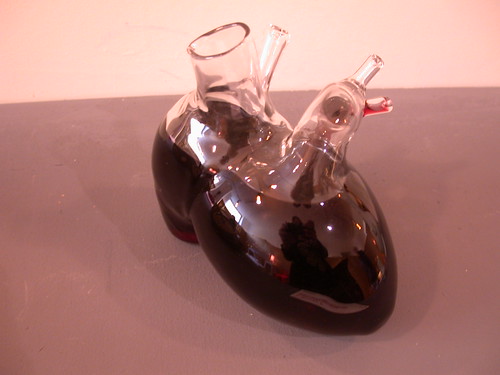
But, honestly, I prefer something like this:

I can’t remember where we came up with this, honestly. I think it may have been a bottle of white zinfandel once upon a time that I bought for sangria, and we’ve used it as a flower vase ever since. It’s a perfect size – comfortably fits an entire bottle, easy to pour from, and I don’t have to worry about being clumsy with crystal. You can also use a water pitcher. Works fine. In a real pinch, just pour the glasses early and put them somewhere that they won’t be disturbed.
How to decant wine? Easy. Open the bottle, then pour the contents into the decanter slowly and reasonably gently. I use the pouring method long-perfected by any knowledgeable sophomore at a keg party – tilt the decanter and pour down the side. While you don’t have to worry about your wine foaming up everywhere, cabernet sauvignon stains don’t come out as easily as Natty Light. After you’ve poured your wine, just set the decanter down somewhere for 20 minutes or so (longer for certain wines) – and go to town. Now, if you want to show off the bottle itself, you can pour the wine into a decanter, let it sit, and then pour it back into the bottle. Use a funnel! (Another side benefit of decanting -- it’s an opportunity to get any sediment out of your wine – especially unfiltered wine. Wine sediment usually doesn’t have any effect on the taste, but “gritty” isn’t a sensation I want when I’m quaffing.)
During the afternoon & evening of the Sweet Partner in Crime’s recent birthday, we did a little experiment with a few bottles. We opened each bottle and tasted it immediately. Then we decanted, let the wine sit for a bit, then sampled it again. We used the following bottles:
- Domaine Bachelet-Monnot 2007 Bourgogne Blanc
- Saintsbury 2004 Carneros Pinot Noir
- Tenimenti Fontanafredda “La Villa” 2000 Barolo
First up, the white Burgundy. I don’t usually decant white wines since they’re made to be drunk young. As a rule, the younger a wine’s made to drink, the less good you’re going to do by decanting. Most of these wines, however, are built to last and we thought it would be interesting to see the contrast. At first taste, the “typical” white Burgundy profile came out – fairly crisp and minerally in a lean style with plenty of citrus. After decanting, new flavors emerged. Peach and pear popped up, as did a mild oakiness that really pointed up the lemony flavors. Made a good wine that much better. I decided to do a “day of small plates” and started off with some smoked salmon and crackers. The oakiness worked well with the smoked flavors and the acidity cut through the oils nicely.
I picked up the Saintsbury on a “vintage clearout” sale – it’s typically around $35. This vintage was getting towards the end of its “recommended peak,” and it was pretty straightahead pinot at first taste. I certainly got the “smoked cherry” flavors you’ll get from most pinot, but it didn’t seem overly complex. When you have a wine that’s getting near the end of its peak, decanting will allow you to wring all of the flavor you can from the wine. With the Saintsbury, after a little decantation, revelation. The nose picked up a caramel twist and the body added some yummy ginger and raspberry flavors. The smokiness was enhanced at the end. This went from a solid, everyday pinot to something more supple and sexy. I made a little “seared sashimi” with it. I read it was a good pairing, and I can stand and tell you to three decimal points that it’s heavenly.
Finally, the Barolo. Now, Barolo is a special case. These powerful Italian wines from the Piedmont are so tannic on bottling that they usually need a minimum of 8-10 years in bottle before the bitter edge has softened enough to drink. Tannic wines almost always improve with decanting. (The same applies to young California cabernets and the like.) This Barolo was a great deal from Garagiste Wines – even so, it was still around $45. When first opened, the light color of this wine belied the power within. At first sip, though, it was tannic but not overly so and fairly easy drinking. I might have even confused it with a Chianti. The recommended decant time for Barolo is at least a couple of hours, so I set it aside and got to work on my special birthday eggplant parmesan. When I served it up and poured the wine – a transformation. The wine “woke up.” That’s about as well as I can explain it. Everything was more powerful. The tannins were stronger, the plummy, somewhat tarry flavors were pronounced, and the wonderful complexity showed up. It went delightfully with the parmesan. Actually, the post-decanting version was too strong in the opinion of the SPinC. She said that she liked it better before decanting, actually. As I’ve said, everyone’s palate is different.
So, when should you decant? Almost anytime you can, really. Unless a wine is a bargain-line wine, you’re probably going to see a marked improvement in flavor and complexity after you decant a wine for a bit. In a pinch, you can use an aerator. These work well for most wines – but for something that needs more time in air (older European wines or younger American wines in general), you’re still going to be better off finding something to pour the wine into for awhile.
Tuesday, June 29, 2010
Guest Column -- Wine and Dinner of the Month Club – June 2010
Another mouthwatering entry from Jeff, halfway through his gift to Christine the Pie Queen…
The wine this month was a very nice Beaujolais paired with a recipe suggested by Mike at TNV. I put together a small cheese plate for an appetizer and a very simple, fruity dessert perfect for the warmer months. You may remember that last month we had Thai grilled chicken. This month we are sticking with the Asian theme. Enjoy.
Menu
Assorted Cheese and Fruit Plate
Wine
Henry Fesse 2007 Moulin-a-Vin Beaujolais
I started by making the mango puree for the dessert and putting it in the refrigerator to chill. I then opened the wine and had a brief panic when the cork broke in half while still in the bottle. I figured that couldn’t be a good sign, but I was able to get the rest of the cork out and found finding the bottom of it wet and the wine just fine. The wine had good fruit with a nice soft finish and not a lot of tannin. It went great with the appetizer and the main course.
Next, I got to work on the cheese plate. I set out some grapes, sliced pears, and bread as well as three different cheeses that I picked up at our local Kroger: brie, boucheron, and morbier. They were in that order as far as pungency. The brie was creamy and smooth while the boucheron, a goat’s milk cheese, was a little more pungent but very tasty. The morbier was even more pungent – so much so that we couldn’t even eat it. I told Christine it smelled like feet. She said she didn’t mind that because she loves stinky cheese. But after smelling it, she described it as something dead and rotting in the ocean. I think we finally agreed that it smelled like feet, if you wrapped the feet in a dead jellyfish and let it sit in the sun on the beach for a week. In retrospect, perhaps we got a bad block of cheese, so we just stuck with the two other cheeses and the fruit and it all went very well with the wine.

After the appetizer, I started preparing the main course and side dish. I prepared the beef for the grill and, at Christine’s suggestion, put some sliced zucchini in a foil packet with some olive oil, graded ginger and garlic. I also threw in some seasoning – Trade Joe’s 21 Seasoning Salute to be exact – which added a nice zing. I wasn’t going to make the zucchini, but we had it to use and Christine is always pushing the healthy stuff on me. I put the beef and zucchini on the grill and prepared the rest of the salad ingredients, including some shredded mint from our backyard. After six minutes I turned the beef, let it cook for another six minutes, and then took it and the zucchini off the grill. I sliced the beef and added it to the other ingredients in the salad. I plated it up and we sat down to dinner. The wine went very well with the myriad of flavors in the salad and we finished the bottle. (Note from Christine: This was one of my most favorite meals so far – try it!)

After the main course, we took a little break and Christine relaxed by the pond while I cleaned up and prepared the dessert. I put some of the pureed mango in stemmed glasses and added watermelon balls with a sprig of mint for garnish. The dessert was cool, light and refreshing - a perfect ending to another great meal.

Here’s a quick preview of next month. I’ll be doing barbecued pork ribs to go with a zinfandel, and I might just have a recipe from a special guest contributor to this guest contributor. Check in and see how it turns out.
Sunday, June 27, 2010
The Sweetly Logical Fallacy
When I do wine tastings, a lot of people say, “I don’t like dry wines – I only like sweet wines.” There’s nothing inherently wrong with liking sweet wine. A person’s taste is…well…personal. However, the notion of a wine as either “dry” or “sweet” is little more than a logical fallacy – the same fallacy used so effectively by certain political parties: the false dichotomy.
In case you haven’t taken a philosophy class lately, a false dichotomy is presenting two alternatives as an either-or choice, even though other alternatives exist. “You’re either with us or against us” is a classic example, because rarely are things that clear cut. (Unless you’re a Teabagger …)
Yes, one can think of “dry” and “sweet” as the ends of a range, but using “dry” and “sweet” as the way to describe a wine is a false choice. Why? Because not only are there countless shades of gray in between the two, but there are also other ranges that play into wine’s flavor that get lumped into “dry” or “sweet” – so one can’t simply isolate the level of sugar and call it a description.
When most people start learning about wine, they gravitate towards the varietals they’ve heard people talk about over and over: cabernet sauvignon, chardonnay, white zinfandel. For many, the first experience with red wine is with big ol’ California cabs, and the high level of tannins isn’t an easy thing to deal with initially. So, after what probably wasn’t a pleasant experience, they ask someone about the wine and get “Oh, red wines are dry wines. That’s why they taste so strong.”
There’s a similar effect with chardonnay, especially California chardonnay. A mouthful of butter-covered charcoal can be a rough start. (Yes, oaky chardonnays are tannic whites.) They hear, “Yep. Chardonnay. That’s a dry white wine.” Our poor newbie then turns to the bottle of Beringer White Zin. It tastes sweet and easy to drink (and brings back memories of high school Boone’s Farm adventures) – so they stick with pink syrup and now have a prejudice against a huge slice of the wine world.
Seriously, think about how bitter your first espresso was. Coffee’s bitterness also comes from tannins. (Mine was in a coffee shop in the Mission District of San Francisco. Took me 45 minutes to drink the damned thing…and it wasn’t exactly enjoyable.) While the bitterness of tannin can have a “drying” effect – it’s not what makes a wine “dry.” A wine’s dryness or sweetness comes from sugar, not tannin.
Think about how wine is made. As I’ve mentioned before, when yeast is added to the grape’s juice, the yeast eats the sugar, farts carbon dioxide, and pisses alcohol (until it dies of either starvation or alcohol poisoning). If the yeast consumes all of the sugar in a vat of juice, the wine is totally dry. When a winemaker stops the fermentation before all the sugar is consumed, what’s left over is the residual sugar. The more residual sugar, the greater the level of sweetness. If you’re looking at the specs on a bottle of wine, the amount of residual sugar is either presented as a percentage or in grams per liter. (Take g/l, divide by 10, and stick a % on the end if you want to convert.) Dry wines will be under 1% residual sugar, if they have any at all. Off-dry wines will be between 1-5%. Sweet wines will be 5% and up. Also, the higher the residual sugar, in general, the lower the alcohol content.
Why would a winemaker leave residual sugar in a wine? A winemaker worth his or her salt strives for balance in wine. The balance of dry and sweet is an important factor. Too much sugar and the sweetness overwhelm everything else. Not enough and other flavors can take over, rendering a wine unpleasant. The balance for sweetness is acidity. To keep a sweeter wine balanced, the acid level needs to go up. Too little acid and too much sugar makes for a white zinfandelish experience.
As for red wines, “dry” and “sweet” don’t really apply, since there are very few “sweet” reds. Most red wines contain virtually no residual sugar. If you’re describing a red, you’re going to be more interested in the level of tannin than the sweetness, so there’s not really a complement to the “dry” of tannin – other than “not tannic.”
(There’s also another reason why winemakers leave residual sugar. There’s an old saying: “A little sugar covers a lot of flaws.” These winemakers are either unlucky or lazy.)
But let’s get back to the whole dry/sweet question. Stepping outside the world of White Zinfandel, word association with “sweet wine” usually lands on Riesling. If we just want to look at the real difference between sweet and dry, white wine is the easiest place to get an illustration – Riesling especially. While the fruit and other flavor characteristics are certainly varied, let’s just focus on the sugar levels for now. I looked at three Rieslings.:
- Pierre Sparr 2008 Riesling Alsace (bone dry)
- D’Arenberg 2007 “The Dry Dam” Riesling (off-dry)
- Mönchof 2006 Estate Riesling QbA (sweet)
If you decide to try these side-by-side-by side, start with the driest and work your way to the sweetest. Pour, swirl, and sip. The differences will literally leap out of the glass at you.
First, the Pierre Sparr. A lot of folks have “tooth achingly sweet” as their mental reference for Riesling. A sip of this will throw that notion out the window. There’s almost no sweetness to this wine at all. There’s plenty of fruit and a little bit of a mineral finish, but the yeast has done its work here. This is common with Rieslings (and most other whites) from Alsace. The general wine style is very dry. Residual Sugar – basically none.
Secondly, try the D’Arenberg. This is a good example of a wine that’s “off-dry,” which means that there’s a little bit of residual sugar as a balancing agent for the other flavors. In this case, the D’Arenberg is a fairly acidic wine, so a little residual sugar tames the tart “bite” that acidic wines often have. The sugar is more of an honey undertone than sweetness right up in your face. Residual sugar – 1.1%
Finally, the Mönchof. You could certainly class this one as a sweet wine. The residual sugar level is about 5%, which also yields a lower-alcohol wine. The acid level is similar to the D’Arenberg – but the acid in this case prevents the wine from becoming syrupy. If you want a general idea of the level of sweetness and flavor, think baked apples with a little less sugar. It’s still reasonably well-balanced and quite pleasant. (And, at under 10% alcohol, you could almost have it for breakfast.)
To go back to the beginning, to help someone transition away from the world of Black Tower, Beringer, and other such syrups, I’ll usually slide something along the lines of the D’Arenberg or a friendly sauvignon blanc. I might then let them try a merlot or zinfandel if they’re willing to go red. Once they’ve made that transition, it’s a quick jump to broadening the horizons – which is the point of trying new wines, after all…
Monday, June 21, 2010
Cherries Jubilee II – Electric Boogaloo
Some of you may remember the happiness that was our “Cherries Jubilee” dinner. As a refresher, the Sweet Partner in Crime and I were lucky enough to inherit a couple of cherry trees when we bought our house. These trees produced absolutely delicious pie cherries year after year. The previous owners of the house never picked the cherries, apparently. One of our cross-alley neighbors told us that her mother used to look out from the back porch and bemoan the fact that “all of those beautiful cherries are going to waste.”
Well, we certainly weren’t going to let that happen again.
Unfortunately, last year, one of the two cherry trees bit the dust. Whether it was lingering effects from the drought a few years back, disease, or that it was just its time, we had to take the old boy down, leaving one very misshapen tree.
Enter Christine the Pie Queen, her husband Jeff (whom you know from the “dinner of the month” guest column series), and a couple of their friends from Wisconsin – who just happened to own an orchard. The orchard owners agreed to come over last winter and do some tree surgery, pruning the remaining tree into a shape where it might have a change for survival. We held our breath and waited for spring.
The tree apparently survived and enjoyed its “haircut” – this year, the tree was not only extremely healthy, but produced an embarrassment of riches cherry-wise. We gave quarts and quarts away, but not before keeping enough to do another cherry dinner with Jeff & Christine.
We started with Jeff’s ”cherry cocktails.” We were a bit skeptical at first, but this mélange of citrus vodka and cava, garnished with bourbon-soaked cherries was also delightfully refreshing. This was served with an amuse-bouche of pesto-stuffed mushrooms. (Yeah, one dish without cherries…so it goes.) We lingered over these tasties for awhile before heading to the dinner table.
The Sweet Partner in Crime followed up with a fresh arugula salad with apples, toasted walnuts, goat cheese and dried cherries. We opened a bottle of Villa Maria 2008 Riesling from New Zealand to go alongside. The Riesling brought a little sweetness to set off the bitterness of the greens and the tartness of the cherries. Needless to say…yum.
We took a pause here for a palate cleanser. Christine had done a tart cherry granita, a wonderfully refreshing little palate awakener – and perfect for an evening with temperatures in the nineties.
The entrée – well, there are few things in the world that go better with cherries than duck, so we decided to prepare a quacking good course. Duck breasts with shallot and dried cherry sauce over saffron rice pilaf. We paired this with the Casa Marin 2006 Litoral Vineyard Pinot Noir. Considering the noises of sheer yummitude coming from around the table, I think the whole shebang ended up tasting pretty good. As a general rule, almost any kind of food that incorporates cherry flavors will be good with pinot noir, especially good pinot noir.
Finally, whatever sacrifices Christine made to the Pie Goddess were obviously warmly accepted, because the confection she put together was one of her best. Cherry pie. Plain and simple. And just about perfect. Alongside, a delectable dessert wine: Dashe 2007 Late Harvest Zinfandel. Neither pie nor wine lasted very long, and I opened a Frangipani 2004 Late Harvest Zinfandel to finish off the evening. It was good, but it wasn’t nearly as tasty as the Dashe. Still, by that point in the evening, going with something that didn’t require too much thought (considering our collective level of cognitive function by this point) was probably the best strategic move.
All in all, cherry-covered decadence and delightful anticipation for next year…
Wednesday, June 16, 2010
Fraud, Wine, Porn, Cash.
Some of you may remember the piece I wrote a bit ago about the wines of adult film actress Savanna Samson. Savanna was goodly enough to give me a chance to interview her. I didn't, however, find her wines particularly good -- which put me at odds with Robert Parker. Parker's 90+ score on her first wine gave her instant street cred in the wine world.
Fast forward a bit. Vine reader (and Phi Kappa Sigma fraternity brother) Nate L. forwarded me this article from Slate about the sale of high-end counterfeit wine. This article intertwines with the central story in the excellent read "The Billionaire's Vinegar." (This is a must read for wine aficionados and history buffs alike.)
In any case, one of the first names in the article is Daniel Oliveros, which sounded very familiar to me for some reason. I should have known it immediately -- but that's Savanna Samson's husband (her married name is Natalie Oliveros), and this little conspiratorial exercise in selling fake wine involved not only Oliveros, but Parker as well.
I don't want to cast too many aspersions here -- and I don't want to engage to fully in the sort of guilt-by-association stuff that so many other folks use as "journalism," but I've learned enough to know that the world of high wine Illuminati is a very small one.
Savanna's wine was an Italian red. According to her, Parker was tasting Chateauneuf-de-Pape at the time and happened to agree to give Savanna's wine a taste while he was in the midst of going through that spread. It seems quite the lucky coincidence that Savanna a) was able to squeeze her wine into this tasting, even though it was unrelated and b) that she just happened to be in the same place to garner such high praise from Parker.
I've got no problem with someone using his or her connections. This is a world of shameless self-promotion, after all -- but, at least in my mind, this calls into question a lot of the "objectivity" of the folks who move the wine world with a swirl of a glass.
Fast forward a bit. Vine reader (and Phi Kappa Sigma fraternity brother) Nate L. forwarded me this article from Slate about the sale of high-end counterfeit wine. This article intertwines with the central story in the excellent read "The Billionaire's Vinegar." (This is a must read for wine aficionados and history buffs alike.)
In any case, one of the first names in the article is Daniel Oliveros, which sounded very familiar to me for some reason. I should have known it immediately -- but that's Savanna Samson's husband (her married name is Natalie Oliveros), and this little conspiratorial exercise in selling fake wine involved not only Oliveros, but Parker as well.
I don't want to cast too many aspersions here -- and I don't want to engage to fully in the sort of guilt-by-association stuff that so many other folks use as "journalism," but I've learned enough to know that the world of high wine Illuminati is a very small one.
Savanna's wine was an Italian red. According to her, Parker was tasting Chateauneuf-de-Pape at the time and happened to agree to give Savanna's wine a taste while he was in the midst of going through that spread. It seems quite the lucky coincidence that Savanna a) was able to squeeze her wine into this tasting, even though it was unrelated and b) that she just happened to be in the same place to garner such high praise from Parker.
I've got no problem with someone using his or her connections. This is a world of shameless self-promotion, after all -- but, at least in my mind, this calls into question a lot of the "objectivity" of the folks who move the wine world with a swirl of a glass.
Monday, June 14, 2010
Juice Box Wines
I’ve written a couple of times before about box wines. Many of them are excellent values for everyday drinking. The only drawback to them is that they tend to be…well…boxy. The usual size of these is three liters, which is the equivalent of four bottles. The packaging is ingenious, since it’s basically airtight and wines will last a long time, especially while refrigerated.
One drawback, however -- while that size is handy to have around the house, it’s not particularly portable. Smaller versions have been popping up in some stores. J-Mac (not to be confused with J-Woww), one of the Vine’s regular readers, suggested: “It's summer, buy a couple of those "juice boxes," and have a picnic…” Not a bad idea!
The smaller versions come most frequently in one-liter containers, so there's an extra glass or so per carton compared to a regular bottle. You also can find them in 500 ml or 250 ml sizes, so they do start to approach the size of a Capri Sun. If you've got kids and you buy some of these, make sure you check closely when packing lunch. I’m not sure how well pinot grigio pairs with 4th grade civics.
These packages are also considerably lighter than glass bottles, so they make much more sense when you’re heading out to the local park, woods, levee, or anywhere else you may want to spread a blanket and enjoy some good company. In Europe, winemakers have been putting out this kind of smaller packaging for years, but it’s yet to catch on in the U.S. (although I think that will probably change in the future).
I headed to the local beverage superstore and picked out a few of these to sample. Here’s what I came home with:
Three Thieves "Bandit" 2008 California Pinot Grigio -- not half bad. Pleasantly peachy nose. Fairly substantial for a pinot grigio. Some weight to the palate with apple and peach flavors. A little bit of residual sugar, clearly. The finish is fruity and slightly sweet. It's not as acidic or tart as many pinot grigios, but I don't think that's the idea here. The purpose is clearly to create a wine that is food-friendly and inoffensive. Success recorded. For $5-8 a liter, an excellent value, especially when you're comparing it to other bottles of pinot grigio in the $4-6 range. It blows those away.
Vendange "Tetra Pak" (NV) California Chardonnay -- There's a saying I've heard somewhere in my travels: "A little bit of sugar covers a whole lot of flaws." This Vendange is a lovely illustration of just that. Since it's inexpensive California chardonnay, I expected either a load of oak or cream, with some fruit. I was one for three. Very little, if any, oak. No butter. Some pear flavors, but the nose is odd, and there's a residual sweetness that's probably there to cover the fact that, well, not a lot of care went into the making of this wine. It's leftover juice, fermented, sweetened a bit, and packed up to sell at about six bucks a liter. After a glass, my stomach hurt a bit. Give it a pass unless you're making spritzers.
French Rabbit 2004 Vin de Pays d'Oc Pinot Noir -- I'll admit I was looking forward to a portable pinot. I didn't have high expectations, of course. I just hoped for a light, food-friendly red that I'd be able to put a little bit of a chill on and slug on. Cracked it, poured it...and almost spit my mouthful across the monitor. This was an absolutely horrible wine. The whole point of having one of these "tetra paks" is that a wine is supposed to stay fresh. If this was "fresh" wine, I don't know who'd like it. Sour, acidic, and horrifically unpleasant. My immediate thought was to take your $8-9 and buy yourself a sixer of Smithwick's or something. You'll be better off. Bleah.
Something nagged at me, though. The Vendange and the French Rabbit seemed so “off” that I couldn’t believe a winery would actually send those out into the world. I was at my local Kroger and decided to pop into their wine store. They had the Vendange, but not the French Rabbit. Instead, I picked up the Alice White (NV) South Eastern Australian Shiraz.
The Alice White was, for all intents and purposes, the same as the Alice White that you’d get in a bottle. Straightforward, fruity, drinkable, and non-thinkable. Decent enough if no one’s looking. But my second go-round with the Vendange was a different experience. There was less sweetness and none of the weird nose. It still wasn’t my favorite chardonnay – even at that price point – but it was much more palatable.
So, what happened? My theory – the inexpensive wines are the ones handled with the least care. At some point along the line, these containers were probably left to sit in a hot truck or on a hot palette somewhere – and the wine began to turn to vinegar. In the French Rabbit’s case, that process was rather far along, I think.
I won’t name names, but I’ve had “vinegarized” box wine on a couple of other occasions from this same beverage superstore. I would be willing to give the French Rabbit another try, but I haven’t been able to locate it anywhere else around here. I’ll update this entry when I get the chance to give it another go.
Just the same, like many of the inexpensive wines out there, as long as you don’t need to think too much about what you’re drinking, you can probably find something at least decently quaffable to pack along in a cooler or a basket. No breakage, no worries, and easy cleanup. Any of you have experience with these you’d like to share?
Tuesday, June 08, 2010
Quickie: In Praise of Unsolicited Recommendations
I’ll readily admit that I don’t always remember all the names of folks who come to the table when I’m doing a tasting. Talking to these folks, I often will get recommendations that I’ll try, but I often won’t get a chance to thank that person.
Such was the case with this Sella & Mosca 2005 Cannonau di Sardegna Riserva. This wine was recommended by a very knowledgeable woman I spoke with in the Covington DEP’s, but I have absolutely no memory of her name, unfortunately.
Cannonau is a grape grown mostly in Southern Italy (this one’s from Sardinia, surprise, surprise…). It makes generally light reds that can resemble Chianti, but there’s not usually so much of a chalky quality. She told me, “Just try this. It’s not spectacular, but for the price and an Italian meal, it’s killer.”
Well, I tried it. I made ribollita the other night and cracked open this bottle. It turned out to be a wonderful pairing.
So, many thanks to you, whoever you were. I sure appreciated your insight – just as I’m happy to take recommendations from any of you out there who have some ideas. Have a couple of columns coming down the pike based on just those, so stay tuned…
Sunday, May 30, 2010
A Day In The Life
I was talking to the Sweet Partner in Crime over dinner this evening (bulgogi-style chicken, fish sauce-soaked cucumbers, kimchi, and a tasty Brancott Sauvignon Blanc if you're curious) and I was feeling a little down. I got nominated for the international Wine Blog Awards, and I wasn't named one of the five finalists. Honestly, I was pretty disappointed, especially after I looked at the finalists and figured I could write circles around a couple of them. I was gritting my teeth a little that people didn't recognize.
When I started this little wine blogging adventure of mine, I had no idea where it would lead. Sure, I had "Julie & Julia" fantasies that I've mentioned before -- that someone from the Food Network would stumble across the Naked Vine one day, be so impressed that they'd ask me to take my "sommelier for the common man" act on the road, and people would know my bald pate all over the place.
I think I do what I do pretty damned well. But every single writer I've ever known who's published publicly does as well. While there may be nothing new under the sun, every writer thinks that he or she has a unique take, even if it's a topic that's been covered a million times before. It's like the old guitar joke:
Q. How many lead guitarists does it take to screw in a light bulb?
A. Four. One to screw in the bulb, and three to say, "I could do it better."
Anyway, there are now thousands of wine blogs on the Internets, and there are a fair number of good writers. Complicating matters, I'm a bit of a throwback. I'm not much on social media. Hell, I have an actual job, people...I'm at a loss as to how people have time to work, tweet 200 times a day, and harvest their Farmville crops. I'm more interested in getting in print than being a Twitter trending topic. I also lack the energy to play the grip and greet game, so I don't know too many of the "people who know people."
Leave it to the SPinC to give me some perspective. She looked me right in the face during the midst of my little rant and asked me, "Do you still enjoy doing this?" In a typical display of my brilliant repartee, I looked right back at her and said, "Huh?"
"Really, why are you doing this? Are you having fun, or is this just something that you're doing to try to get people to give your site hits?"
I've learned one thing over the last eight-plus years. When the lady's right, she's right.
Every now and again, it's really is a good thing to count your blessings. Ever since my conversation with Scott so many years ago, this little endeavor of mine has allowed me to meet some pretty damned cool people, exposed me to a body of knowledge and science that I didn't fully understand, got me the occasional wine sample, and is something I take pride in.
So yeah, I do have fun, especially when I get on opportunity like last weekend. D.E.P's Fine Wine and Spirits let me have the run of their tasting table for their weekend tastings. I decided to do a live version of my last column.
I had a great time talking with people about the wines and why I found them interesting. I used to worry that I sounded like a complete clod, and while I still may, at least I'm a semi-authoritative clod, and most people walked away from the table with a bottle or two in their hands and a smile on their face, so I must have been doing something right. Since I have that little victory under my belt, I give you, straight from the soundboard, my picks:
I poured a pinot grigio next to a pinot gris to illustrate the difference. I had the Kris 2008 Pinot Grigio from Italy ($13) and the King Estates 2008 Pinot Gris from Oregon. The Kris was light, crisp, and full of citrus. A great lawnmower wine. The King Estates was fuller, had some softer fruit and had a honey-ish sweetness. I found it an instructive contrast between the two styles of the same grape.
I'd picked out a pinot noir to go between the two contrasts, but K2 let me know that there wasn't enough of the one I'd picked, so he substituted the Underwood Cellars 2008 Pinot Noir instead. This was a super-light pinot. Some nice cherry flavors out of such a light body. Not as much smoke and depth as I'd usually like. I prefer my pinots a little bit heavier, but it was certainly drinkable. At $10, a pretty decent value.
The last two wines I did was the syrah/shiraz comparison. I had the Gordon Brothers 2005 Syrah ($17) set up next to the Torbreck "The Woodcutter" 2006 Shiraz. ($19) The Gordon Brothers is from Columbia Valley in Washington State. It took a little while to open up, but once it did...yum. A somewhat restrained syrah, there were layers of dark fruit, coffee, and chocolate. As I told more than one person, "Pour a glass of this and get some dark chocolate, have some of both, and just lay back and let it happen..." The Torbreck was a typical ballsy Aussie shiraz. Lots of fruit with enough backbone to keep it from being a mess. Lots of in your face flavors that pair well with anything on a grill.
Like most writers, I fall into the trap of taking myself too seriously -- but yes, this is still fun, especially because of all of you out there -- both those who I've met and those I haven't. Thanks to all of you who came by the tasting to visit, that regularly read me or who have stumbled over here for the first time. From the bottom of my heart, I appreciate you letting me share this little experiment with you. You guys make my life better. Thank you.
Subscribe to:
Posts (Atom)