Showing posts with label Greece. Show all posts

Wednesday, July 05, 2017

Greek Wine: From Across the Ionian Sea

There are wines in the Vine’s archives from all over the world – but one place we haven’t stopped often in our oenological travels is Greece. The Greeks have been making wine longer than anyone else in the Western world. They’ve got nearly 6,000 years of experience cranking the stuff out. Why don’t we Statesiders know more about them?

The Vine's proprietor gets all animatronic
at the Santorini Wine Museum
First off, production – Greece produces in the neighborhood of 300 million liters (about 80 million gallons) of wine each year. Compare that to their neighbors across the Ionian Sea, Italy, which churns out between four and five billion liters annually. Second, winemaking processes in Greece only really began to modernize in the 1980’s. Before then, Greece produced a lot of interchangeable table wines and Retsina – a native wine-based beverage flavored with pine resin. Yes, you read that correctly – and it’s as much of an acquired taste as you might imagine.

Third, not to disparage Greek language, but the nearly 300 autochthonal (Winespeak for “indigenous”) varieties of grapes carry names that translated, to the uninitiated, can look like a Scrabble draw pile. While many American consumers would undoubtedly enjoy a glass of Athiri or Malagousia – they tend to shy away from unfamiliar grapes.

Well, stop overlooking them. Greek wines are excellent food complements, especially seafoods, cheeses, and other Mediterranean-styled dishes. If you’d like to give them a go, there are four primary Greek grapes with which you should start your explorations. Here are examples of each of the Greek Big 4:
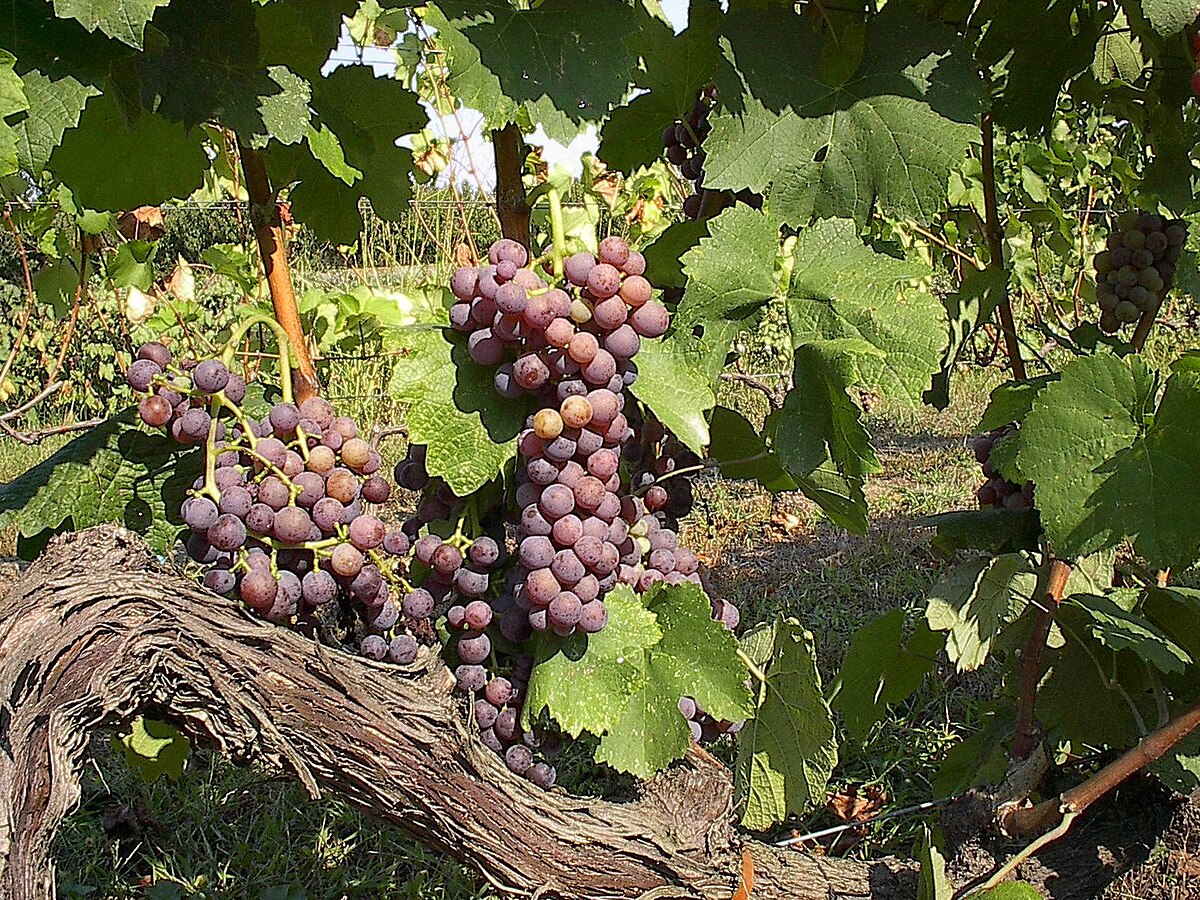
Moschofilero grapes -- red grapes for white wine!
Tselepos 2015 Mantinia Moschofilero White Wine – OK, first -- to unpack this wine’s name: “Tselepos” is the winery. “Mantinia” is the region, which is just north of the city of Tripoli in Pelleponese. “Moschofilero” is the grape. This particular grape, pronounced MOS-ko-feel-er-o, although used to make white wines, is reddish in color. I found the wine’s flavor to be quite similar to a Muscadet – fairly high in acid, floral notes on the nose, and lemony flavors over a flinty, minerally backbone. The finish is crisp and cool. Noting that it was Muscadet-ish, shellfish immediately sprang to mind as a pairing, and we tried it with a bay scallop ceviche. Our thoughts were correct, as the acids complemented each other to make a lovely meal on a warm summer evening. $16.

Bairaktaris 2015 “Monolithos” Nemea Agiorgitiko Red Wine – This red wine’s moniker comes from, what else, a giant rock that sat in the midst of the vineyards of Nemea. This rock was demolished and the dust spread across the vineyards, which apparently improved the quality of the soil. For mythology geeks like myself, Nemea is the site of one of the 12 Labors of Hercules, where he slew the Nemean Lion and then probably settled in for a flagon of red wine made from Agiorgitiko (AY-ee-or-YEE-tee-ko), the most widely cultivated red in Greece.

I found the wine that the Big Man might have been drinking to be quite an interesting quaff. It’s a lighter-styled red in body, but there’s still a considerable amount of tannin and flavor punch here. Plenty of cherry and blackberry flavors and scents alongside nice, even tannins and an interesting mineral character. I think it’s along the lines of a Languedoc red or a less “chalky” Chianti. We had it alongside a couple of grilled lamb steaks, and I thought it a very solid summertime red. $18.

Chatzivariti 2016 “Eurynome” Goumenissa Assyritiko White Wine – Eurynome is one of the Titans who ruled Mt. Olympus before the Greek Gods took the place over. When cast from Olympus into the earth-encompassing Ocean, according to myth, she had nowhere to rest, so she
“split sea from sky” and danced on the waves, creating the land. (Hey, don’t ask me for the physics of it…) Assyritiko (Ah-seer-tee-ko) is Greece’s signature white – the most exported and well known grape on the international market.

This wine, made from 100% Assyritiko, is a difficult wine to pin down. Initially acidic, the wine develops an interesting creaminess as it gets some air. Reminiscent of a Sancerre or a light unoaked Chardonnay, there’s plenty of peach and citrus over a steely backbone. The creaminess that emerged made for an interesting balance. We actually tried this with a thin crust pizza with serrano ham, artichokes, olives, roasted garlic, and Parmesan. Darned good combo, if you ask me, although the price of this particular bottle -- $24 – seemed a tad high.

Boutari 2012 Naoussa Red Wine -- This wine is made entirely from our fourth autochthonal Greek varietal, Xinomavro (Ex-SEEN-o-Mahv-ro). Nouassa is a region in northern Greece in Macedonia. (This is not to be confused with the Republic of Macedonia, which was once part of Yugoslavia – a locale which also makes darned good wine.)

After I cracked the bottle and poured, I could have been looking at a glass of light-styled Beaujolais. The nose is a little more alcohol-scented than a Beaujolais, but the basic profile is similar, and reminded me somewhat of cranapple juice, minus the sugary scent. There are some nice understated red fruit flavors -- it's almost delicate…until you swallow. The wine then hits you with a load of tannin on the long, dry finish. The bottle suggests pairing with "roast meats and cheeses of…an intense character." I can certainly see that -- the tannins will slice through just about any kind of rich flavor. Lamb, again, would be great with it, not surprisingly. $14.


Since these wines are lesser-known at the moment, they’re fun to spring on your wine-loving friends as a change of pace. They’re certainly worth getting to know, especially in restaurants, where their relative anonymity will keep the markup to a minimum. Give them a go.

Sunday, September 14, 2008

Stateside

Greetings, Vine denizens! I'm tan, rested, and ready to roll again after a much-needed vacation. I'm fresh from floating in the Mediterranean with the Sweet Partner in Crime on our first cruise. We did plenty of research to find a ship and itinerary that would be fun, interesting, and wouldn't have hourly updates about the hairy leg contest on the Lido deck. (We ended up going with the Celebrity Summit.)

This vacation was about relaxation, pampering, and -- of course -- food and wine. I could easily wax poetic about the four course meals in the Summit's main dining room, or the six-courser that we had in the exceptional SS Normandie Restaurant one evening, but I'll focus on our gustatory experiences off-ship.


The difference in attitude towards eating and drinking between the parts of Europe we visited and the US was stunning. Honestly, it's been quite jarring to readjust after only a couple of weeks. We quickly got used to this relaxed, easygoing attitude towards dining. Most restaurants don't open until noon at the earliest for lunch and often 8:00 or later for dinner. Servers almost seem offended if you ask for the check before you've had time to drink your coffee after dessert. What's the rush?

Since we weren't on this schedule, we found ourselves in a couple of cafes before opening. No worries. The waiter would explain, "The kitchen's not open for another 25 minutes, but feel free to have a seat." Drinks were fetched, and we settled in for the next couple of hours. Multiple courses and flavors were the rule rather than the exception. Portions were considerably smaller, but I never felt underfed. And, of course, there's the wine.

In fact, there's almost always wine. What the US Government defines as "binge drinking," most Italians define as "lunch."


During our entire jaunt, I can't think of a non-breakfast meal where there wasn't at least some kind of wine on the table. Most placesetting are pre-set for meals with wine glasses (but not water glasses, we discovered). For instance, in Barcelona, I ordered cava to go with our delicious tapas at a fantastic little place called El Xampanyet. The server ducked into the cooler, pulled out a one liter bottle of house cava, opened it, and left it on the table. Heaven! No one bats an eye at a wine order with lunch. If I'd tried that in Cincy, I'd expect a comment like "Starting early, aren't you?"

Maybe I was simply being a tourist and didn't have to head back to work afterwards -- but somehow Europeans manage to maintain a stable economy while taking six weeks of vacation a year and drinking decent house wine at most every meal. I've heard people talk about how different the wine is in Europe, but their wine's made much the same way there as here. The alcohol content is similar, although the overall flavor of the house wines tend to be slightly lighter. Yet, I can't ever remember getting tipsy while enjoying my mealtime wine. Perhaps there's a lesson here somewhere...

I've said consistently that people historically make wine to complement whatever it is that they're eating locally. We were very excited about trying "indigenous cuisine" in the various ports of call. Of course, we also wanted to see what they were pouring alongside! So, what did we learn?

Italy -- We started the trip in Venice and docked in Naples, Civitavecchia, and Livorno during the second week of the cruise. We eschewed sightseeing trips from the latter two ports to Rome and Florence for wine tasting excursions to small towns in Lazio and Tuscany. Trying to generalize "Italian cuisine" is almost impossible, but "Italian coastal cuisine" has some commonalities. Lots of fresh fish, obviously, and pastas often contain or are flavored with shellfish or anchovies. The white wines tended to be very light and crisp and the reds had enough body and tannin to cut through the acidity of tomatoes, the minerality of shellfish or the oilyness of black sea bass. A red wine that reminded us of several we had over there was Falesco "Vitiano" 2005 Cabernet-Merlot-Sangiovese ($10) After we came home, I tried to emulate a pasta I had over there -- mushrooms, capers, and anchovies in a light red sauce. Cut through and complemented all of those flavors really well.

Croatia -- Our first port of call was Dubrovnik, an absolutely beautiful city nestled on a small peninsula. Interesting fact -- Dubrovnik was one of the most progressive cities in Europe in the treatment of Jews over the last 600 years. Foodwise, Dubrovnik is famous for shellfish, especially oysters and mussels. We sampled both at a restaurant called "Moby Dick," which, for my readers in Louisville, should raise a smile. It also gets very hot during the summer there, so the wines both serve as a cooling agent and a complement to anything you'd find on a raw bar. Try Toljanic 2006 Zlahtina at around $12 for an interesting change from muscadet.

Greece -- Athens and Santorini were our ports of call in Greece. Athens was a big city made up of ugly concrete apartment buildings surrounding incredible ancient sites. Santorini Island was once a volcano that exploded to form a beautiful "c"-shaped lagoon. We were familiar with "standard" Greek foods. We've chowed down at some very good local Greek places on dolmathakias, souvlaki, gyros, and so on. However, fish wasn't typically on the menu stateside, which is quite the contrast from our experience over there. Both Athens and Santorini had plenty of variety when it came to fish, shellfish, and mollusks for consumption. On the wine front, Greece is known for Vinsanto, a sweet dessert wine, and for bone dry, minerally whites that make wonderful aperitifs or go very nicely with the aforementioned sea life. Santorini itself is home to a very productive wine region. Interestingly, they grow grapes low to the ground because of the oppressive summer heat. (Also interesting was the Santorini Wine Museum -- off the scale on the Unintentional Comedy Meter.) Look for the crisp, slightly fruity Sigalas 2007 Santorini at around $15 if you want a nice example. I also discovered that I had a taste for both Ouzo and Metaxa, but that's a story for another time.

France -- We made one stop along the French Riviera. We tendered in Villefranche-sur-Mer, a small (but pretty daggone affluent) community between Nice and Monaco. The Riviera is exactly what you'd expect -- strikingly beautiful. This part of the Riviera is in the Provence region.Provençal cuisine is known for using lots of fresh vegetables (which led to a very "American" moment for me when I asked the SPinC, "So, what does Niçoise mean?" while she was relishing one of these salads...in Nice). The region is also known for wonderful seafood, with bouillabaisse as the local specialty. In the wine world, Provence immediately brings one thing to mind -- rosé. 50% of French rosé comes from this region -- the perfect pairing for both salads and fish. Domaine Houchart 2007 Cotes du Provence Rosé is a nice example at around $10.

Spain -- Our last stop on the trip was a couple of days in Barcelona before we caught our flight home. The space I have here is completely inadequate to do Barcelona and all of its wonders justice. (Anyone, religious or not, who can step into La Sagrada Familia without an overwhelming sense of awe is utterly dead inside.) The city is pleasure, decadence, and inspiration rolled into a one huge, wonderful package. Barcelonan cuisine also follows this "delicious mishmash." Paella and tapas. Ham, fish, poultry, bread, fruit and on and on. What wine goes with everything? As I've mentioned time and time again -- sparkling wine. Cava country is Penedès, just southwest of Barcelona. Longtime readers know what a sucker I am for good cava, so go pick up a bottle of Gramona 2005 Gran Cuvee at around $15, pair it with anything, and thank me later...

As a side note, we didn't experience any of the animosity that Europeans, especially the French, allegedly hold towards folks from the US. Most people we met spoke at least some English, and they weren't shy about using it, which was important -- since neither of us are fluent in anything other than our native language (unless you count the Eastern Kentuckian dialect I lapse into from time to time...). I try to imagine my reaction if someone came up to me and started asking me questions in Greek. The secret to our success, in my opinion? We took the time to learn a dozen or so useful words or phrases in the language of wherever we went. Saying "Govorim malo Hrvatski. Govorite Engleski?" in Dubrovnik went a long way in smoothing out international relations.

There will be other stories from this trip to weave as the weeks go on-- but I now prepare to face the unenviable task of readying myself to go back to work. Eek! Also, for Cincinnati metro readers or avid road trippers, make sure that you have Wine Over Water on your social calendar for the evening of Saturday, September 20th. It's going to be a great time, guaranteed...


Stumble It!

Monday, February 04, 2008

Resting on the Ottoman

Followers of the Vine know that the SPinC and I enjoy exploring. From ambling the twisty roads of Sonoma to the back roads of Indiana, we're on the lookout for new tastes in new places. Thus far, our oenological travels have been largely domestic. Our "international wine" exploration has largely stemmed from perusing the aisles of our local wine stores. (With the exception, of course, of the Thai wines…)

As winemaking technology spreads, so do the abilities of "nontraditional" wine areas to crank out a respectable vintage. Argentina, Chile, South Africa, New Zealand have all placed themselves firmly on the "check 'em out" list next to Germany, Italy, France, and Australia.

When wine that's not from a "typical" wine producer shows up, I'll give it a go -- for research's sake, of course. I recently stumbled across a few bottles from "elsewhere" to try:

Naoussa Boutari 2004 Dry Red Wine -- Greece, as much as any country, started the Western world down the oenological path. Were I a pantheist, Dionysius (the Greek God of wine and the liberation of the mind) would be one of my patron deities, of course. The Greeks boast the oldest recorded wine production in Europe -- starting about 6,000 years ago. Indigenous Greek grapes were the roots of many varietals around the world, especially in Italy. Greek winemaking flourished until its conquest by the Ottoman Empire, when wine production was repressed. The subsequent World Wars didn't help much either. In the 1950's and 60's, an inexpensive Greek wine called "Retsina" dominated the market, but it wasn't highly thought of outside the country's borders. Only in the last 40-50 years have Greek winemakers been interested more broadly in producing exportable product.

In this wine's nomenclature, "Naoussa" is the region. Boutari is the family name of the winemaker. This wine is largely made from the indigenous Greek Xinomavro varietal. This is one of the two main red varietals used in Greek wine (The other is Agiorgítiko). After I cracked the bottle and poured, I could have been looking at a glass of light-styled Beaujolais. The nose is a little more alcohol-scented than a Beaujolais, but the basic profile is similar. The nose reminds me a little of cranapple juice. There are some nice understated fruit flavors -- it's almost delicate…until you swallow. The wine then hits you with a load of tannin and a long, dry finish. The bottle suggests pairing with "roast meats and cheeses of…an intense character." I can certainly see that -- the tannins will slice through just about any kind of flavor like that. Lamb would be great with it, not surprisingly. $10.

Monarchia Cellars 2006 Pinot Grigio -- This is a Hungarian wine from near Budapest. The only other language with an indigious word for "wine" is Hungarian. (The word is "bor.") Hungary has produced wine since the 5th century AD. The best known wines in Hungary are either dessert wines from the Tokaj region, or a red wine concoction known as "Bull's Blood." I recently tried the latter, which was rather thin, watery, and did not make me grow horns.

The only other Hungarian offering I've had has been a novelty wine called Vampire, which pops in from Transylvania once a year -- and you're better off drinking blood, honestly. Hungary's wine industry was also slowed by the Ottomans for a long time, and the phylloxera epidemic did additional damage. In the mid-to-late 20th century, Hungarian winemakers started experimenting with varietals from other places, especially many of the German & Austrian varietals, along with pinot noir and cabernet sauvignon. Only in the last 20 years have their big indigenous varietals come back into play.

I was able to locate a pinot grigio from Monarchia, one of the larger Hungarian producers. Their pinot grigio has an appley-citrusy nose and a pleasant initial tartness. The body of the wine starts to go a bit south after first sip. After a few sips, it becomes a little watery instead of staying crisp. The finish is soft and not too tart. It's an easy drinking wine, but not really anything out of the ordinary. It's a good experiment with a grape, but there are probably better ones out there. $9.

Kavaklidere 2006 Yakut -- Turkey is one of the largest producers of grapes in the world, but only two percent of its yearly harvest is used for wine. Once again, the Ottoman influence had a major effect. Turks are not big wine drinkers. Americans consume 33 times more per capita, while the French consume almost 215 times as much. Even so, Turkey is starting to explore its winemaking abilities as well. They are making some higher quality products. Yakut is the varietal. It's made of two native varietals (Bogazkere and Öküzgözü) and islabeled "red table wine." Honestly, that's exactly what it is. The nose is interesting. It's got a lot of plum up front, but there's something behind it that almost smells like apples. There's some good dark fruit on the medium palate, and the finish is long, dry, and a little earthy. It's similar in style to a Cotes-du-Rhone, and I'd probably pair it with similar foods -- like cheeses, hearty soups, and saucy meats. About $10 if you want to give it a go.

A number of other countries are getting into the act. Russia and the former Soviet Republics are producing more and more wine, and China will likely be a big player in the international wine market in the years to come. They shouldn't have any trouble from the Ottoman Empire, either. The number of varietals available on the market continues to expand, and I'm all for the options. Have any of you tried wines from "elsewhere?" Do share in the comments, if you would.