Monday, August 07, 2017
Naked Vine Triple Play: MOAR ITALY!!!
Monday, September 01, 2014
Naked Vine Triple Italian -- Three for September's Start
Wednesday, May 15, 2013
The Alphabet Soup Project – “N” is for “Nero”
![]() |
| Teenage Wasteland! |
![]() |
| "Ambassador Spock will be joining us at our next wine tasting." |
![]() |
| Now we're talking! |
Monday, May 21, 2012
20 Mondi
“Italy is not spaghetti and Chianti wine.”
-20 Mondi introduction
I imagine Michael Loos sitting at a table in a trattoria in Milan, Italy, musing on his fledgling project, 20 Mondi. “Over the years of living in Italy, discovering the immense varieties of Italian wines, I yearned to share the experiences with my friends outside of Italy. Basically, I wanted to let them in on the ‘other world’; the non Merlot/Chardonnay/Cabernet world.”
Loos grew up in Dayton, Ohio “watching Gilligan’s Island while eating warmed-up Spaghetti-O’s.” An alum of Butler High School, he graduated from the University of Cincinnati’s world-renowned graphic design program in 1985. He worked in New York City as a graphic designer until 1989 when he lit out for Florence, Italy. In 1997, he moved to Milan and opened his own design business, Loos Image Communications. His passion, however, is the country of Italy and its wines.
20 Mondi, which translates as “Twenty Worlds,” is Loos’ attempt to explore and document the winemakers and, by extension, the people and the culture, of each of Italy’s 20 wine growing regions. Loos pointed out that few outsiders realize that much of Italy lies in central Europe – bordering and sharing languages with Slovenia, Austria, Switzerland and France. It also extends southward to within 43 miles of Africa. (I had no idea.)
The driving force behind the project? Autochthonal grapes.
What the heck’s an “autochthonal” grape? Pronounced “aw-TAWK-tow-nal,” autochthonal is the proper term for a grape indigenous to a specific region. There are over 600 autochthonal varieties of winemaking grapes in Italy. Some of them are fairly well known – Sangiovese, Nebbiolo, Prosecco, Nero d’Avola. But most of us have never had a glass of Forgiarin or Pompanuto. “The small producers [of these grapes] are being squeezed out by more mainstream, primarily profit-driven producers,” explained Loos. Many of these producers are introducing better-known grapes like merlot and chardonnay to more easily market wines internationally. “Each territory,” Loos said, “is a treasure island unto itself, full of unique landscapes & family trees, folks & folk tales, and oral & oenological traditions and customs.”
Loos wants to bring attention to these grapes and, by extension, the people who carry on local traditions in winemaking, special regional foods, and local arts and crafts. Historically, people from a certain region tailor local wine to go alongside “hometown” cuisine. Loos fears the loss of these distinct regional Italian identities, so he wanted to showcase them. His plan? Get a camper, some close friends (including his sister and brother-in-law), and take a 10,000 mile road trip around Italy, exploring these winemaking worlds. “I start with suggestions from people I know in each region, then connections usually progress by word of mouth… I ask about their wines and the stories begin. People talk when they have a glass of wine. Or two.”
Loos is currently raising funds for 20 Mondi across Italy and the globe. “The Barolo-colored camper is waiting on the sales lot for us to plop down the cash,” said Loos. He’s optimistic about raising the capital to make the trip a reality. “The great thing is that we've discovered that there is a real interest out there to support our project; we just need to harness it. In the meantime, we've started creating some content for our first "world,” Lombardia [the region surrounding Milan], just using the car.”
![]() |
| Michael Loos, friend to autochthonal grapes everywhere... |
As Loos and his companions travel around the Italian countryside, they hope to create a comprehensive video and photographic record of their trip, the wines, and local recipes. They are creating a series of online guides set up as downloadable apps for visitors to these various regions, as well as some large-format photo books, documenting the highlights. I’m certainly planning to follow along on his trek. To do my little part for the world of autochthonal winemaking, here are a few I’ve recently tracked down. Unfortunately, I didn’t have the time to put together autochthonal recipes to go alongside these wines, but I did the best I could:
Leone de Castris 2008 Maiana Salice Salentino – From Puglia, which is the “heel of the Italian boot.” This wine is made from a 90/10 blend of Negroamaro and Malvasia Nera grapes. When I poured it, the dark, dark purple gave me the expectation of a monstrous wine. Not so. It’s medium-bodied, bordering on lean. Imagine coffee-flavored cherries, with a mouthfeel a lot like coffee, and you’ll get the idea. The wine’s tannins are subtle, as is the “chalky” characteristic that many Italian wines possess. The finish is an interesting mix of tartness and soft tannins. I thought this was quite pleasant. Tried it first with a couple of cheeses --“drunken goat” cheese was a particularly interesting pairing. Dinner was flank steak marinated in lemon juice and garlic with some steamed veggies – it turned out yummy as I hoped. About $13.
Tenuta Delle Terre Nere 2010 Etna Bianco and Tenuta Delle Terre Nere 2010 Etna Rosso – Both these $15 wines are from Sicily, the island being perpetually punted by the Italian boot. These wines hail from vineyards on the slopes of Mount Etna. (“Bianco” is “white” – “Rosso” is “red.”) The Bianco is a blend of Carricante, Inzolia, Grecanico, and Cataratto. The nose is full of tangerines and flowers. The flavor starts with a biting acidity that mellows into an orange-ish citrus. Body-wise, imagine a pinot grigio muscling up to a chardonnay. The finish is tart and lemon-rindy. On its own, just OK. Sicily’s cuisine includes a lot of shellfish, so I made a meal of shrimp & beans seasoned with garlic, sage, and pancetta. The food dialed the wine’s acidity way back, but the flavor had enough oomph to stand up to the big flavors in the food. Nomnomnom.The Rosso was described to me as “very Burgundian,” which I can see since it’s lighter-bodied and fruit forward. I hit lots of cherry and mineral flavors right off the bat. Made from 100% Nerello, it’s certainly a friendly, delicate red. For dinner, though, I’d made an earthy pasta: rotini in a sauce of caramelized onion, pancetta, cremini mushrooms and parmesan. The pairing was outstanding. This wine was particularly to drink against a dusky background like that. Sign me up.
Azienda Agricola San Giovanni 2010 Il Lugana – This white, which you’ll probably find at a little closer to $20, is made from 100% Trebbiano from the province of Lugana in Lombardy. Two folks at one of my favorite wine stores independently described this wine as “killer.” I’d agree. This fairly complex, medium bodied entry is a dinner party pleaser waiting to happen – both flavorwise and because of its short, stumpy, cool looking bottle. It starts with a deliciously fragrant nose of apple cider and lemon meringue. The body is smooth with more apple and a twist of tartness to give it a little grip. The finish is lasting and slightly sweet. I thought this was a particularly nice white on its own, and it held up exceptionally well with a fresh green salad with a vinaigrette – a combination which would ordinarily be a wine killer. The salad was a side for some grilled chicken breasts stuffed with asparagus, tomatoes, and fontina cheese which, unsurprisingly, worked extremely well. I’d put this wine next to almost anything up to roasted red meat. Imagine an Italian dry Riesling if you need a comparison, but, as Loos points out, it’s best to think of these wines in context.
As we wrapped up, I asked Loos to posit a suggested pairing for his childhood lunchtime staple: “A good Bonarda [made with the autochthonous grape Croatina], I would guess would be superb with SpaghettiO's, but I'm just postulating from a 40 year-old memory!”
Information about the ongoing project can be found at the website – http://www.20mondi.com
Friday, May 27, 2011
Starting up the Summer
I had the good fortune last week to co-lead a tasting with my pal Danny Gold from Party Source. The theme of the tasting changed quite a bit during our planning stages. We thought about doing wines from every continent or just sticking to cabernet blends from all over – but neither of those really rang true.
We each ended up picking three wines that were relatively inexpensive and we “just liked.” To our sold-out crowd, this seemed to work just fine. Only after everything was over and done did I realize that we’d unknowingly cobbled together a pretty decent slate of beginning-of-summer bottles: two easy drinking and interesting whites, a couple of light and flexible reds, and a couple of bigger red wines suitable for grilling. So, Since Memorial Day and the “official start of summer” are upon us, without further ado:
Cucao 2009 Pedro Ximenez – This light white caught my eye because of the grape. “Pedro Ximenez” (or “PX”) is the name of a Spanish grape used largely in the production of Sherry. (If you recall, I haven’t had the greatest experiences with that particular tipple.) Certain grapes do interesting things when planted outside their native home. I’m a huge fan of Malbec, which was largely a minor French blending grape until it was planted in Argentina. I thought I’d take a chance and see what the soils of Chile might have contributed here.
Turns out that the Chilean terroir is very kind to PX. The nose is quite lovely, full of flowers and spice. It’s light bodied and quite acidic like a citrusy pinot grigio, but with an interesting melony flavor and a slight “briny” taste that echoed the not-unpleasant parts of Sherry. The finish is light and crisp. This would be a perfect summer porch day wine and the high acid content makes it a match with many summer cuisines – fish or shellfish, chicken, salads, light pastas. At around nine bucks, it’s a pretty complex, intriguing wine. Certainly worth a try. Vote for Pedro!
Terra di Briganti 2009 Sannio Falanghina – Danny’s selection was another “unfamiliar” grape – this time from Italy. I admitted being somewhat skeptical. My first experience with Falanghina was the wine sent by Savannah Samson a few years ago. It wasn’t, shall we say, the tastiest of whites. Danny knows his stuff, though. This one won me over. Another light bodied white, although with a somewhat creamier feel. The flavor brought more tropical fruits – peaches and pineapples – to the table. The finish was soft and pleasant with a nice little acidic zing. Goat cheeses would go nicely, as would richer fishes like trout or salmon. Lobster would be divine here. I also found it very drinkable on its own. If you’re a fan of Italian whites, give this a run at around $15.
Domaine Dupeuble 2009 Beaujolais – I make no secret of my love of Beaujolais in the summer. I ask you, what’s more perfect for a warm weather bottle than a light, easy-drinking red wines that pair with almost anything foodwise and taste best with a slight chill? Sign me up! The 2009 vintage in Beaujolais was, by all accounts, a year for the ages. Some of the best Beaujolais are being compared favorably to higher end Burgundy. The 2009’s are now readily available and you should snap them up if you’re into this sort of thing.
Off the bat, lovely waves of rich cherry flavor and a bit of smokiness greet you here. Most straight Beaujolais are nowhere near this “full” tasting. Great fruit, nice acid, and just an overall sense of well-balanced yumminess follows. There’s a lot to pull apart in this wine, but don’t work too hard on it. I think it’s best enjoyed as a whole, non-thinking “experience.”
French wine can be confusing, as I’ve mentioned on numerous occasions. One thing you can do is to check the bottle of a French (or Italian or anywhere, really) wine that you liked and check the name of the importer. This particular Beaujolais is a Kermit Lynch selection. I’ve had very good luck with almost anything that has his name on it. Around $13.
Tenuta delle Terre Nere 2009 Etna Rosso – Danny was stoked about pouring this. The Rosso is from vineyards on the side of Mount Etna in Sicily which were left fallow for decades. Winemaker Mark DeGrazia opened these vineyards and made this red from the indigenous Nerello grape. The grapes are grown at the highest elevation in Europe for growing red grapes in soil that’s basically volcanic ash. The method of production is almost identical to that used in Burgundy. The result is a light-bodied, fragrant, exceptionally tasty wine that strongly echoes the flavors of French pinot noir. It’s very well balanced, has a light earthiness to the flavor that I really enjoyed, along with layers of raspberry and minerals. I’d nestle it up nicely next to light red-sauced pastas, grilled fish, or something like a chicken/veal picatta. $15-18.
Charles Smith “The Velvet Devil” 2009 Washington State Merlot – I like throwing Charles Smith’s wines in tastings when I can, since they’re just fun wines. Smith, self-taught winemaker and former manager of Scandinavian death metal bands, has a number of wines in his “Modernist Project” set of offerings. Modernist Project wines (easily locatable in your store by the black and white labels and interesting names) are designed to be wines you can crack, pour, and drink – but that aren’t one-note, unbalanced wines. I think that this merlot is absolutely killer. Blackberry, cinnamon, dark chocolate – all blended and balanced. For a wine this sumptuous, it’s very easy to drink. Grill some meat. Pour this wine. Eat. Drink. You’ll be happy. You’ll also be happy if you want something with a chocolate-based dessert later on and you have a bottle of this on hand. And at around $10, you can afford a couple of bottles.
Thorn-Clarke 2009 “Shotfire” Shiraz – Danny wanted to finish up with a bang, so he dug into the Australian aisle and pulled out this monster of a red. The Shotfire is a jammy, high-alcohol shiraz. It checks in at around 16% alcohol, so make sure you give it a few minutes to catch its breath after you open it before you dip your nose in. You’re hit with big, plummy shiraz flavor backed with a white peppery finish. While you get some enormous flavors, I didn’t find them overwhelming. You just have to know what you’re in for and plan accordingly. If you’ve got yourself a slab of barbecue ribs or almost anything else with a rub or a sauce that you want outside, this is your wine. Like many Aussie Shiraz, it’s also a winner with chocolate, especially dark chocolate. Right around $15.
Drink up and enjoy!
Thursday, September 09, 2010
Italian Indigenous
As you might remember from our Italian Wine Primer, there are somewhere in the neighborhood of 2,000 grapes indigenous to Italy. Variety may be the spice of life, but that much variety makes the initially-confusing Italian wine nomenclature a straight must to keep the musts straight.
(Yes, yes. I know you’re not supposed to explain your own puns, but in case you’re wondering, “must” is WineSpeak for “freshly pressed grapes.”)
Luckily for us, there are only a few dozen commonly used grapes in Italy, so the major grapes aren’t usually that difficult to keep straight. Most of the others are grown in relatively small quantities and used in local table wines. However, as winemaking technology improves and becomes more and more available to smaller growers, some of these lesser known varietals – each with their own unique characteristics – are starting to find their way off the Boot.
If you’re looking for a change of pace, some of these wines can make very interesting alternatives. I suggest speaking to your local wine guy or gal about them. Also, since they’re not as well known, they tend to be pretty good values for some reasonably tasty juice. Here are a few that I’ve tried recently:
Mustilli 2008 Piedirosso Sannio – Sannio is a subregion of Campania, situated northeast of Naples. Piedirosso is the grape, used almost exclusively in this region. The wines made from Piedirosso tend to be on the lighter side. On a warm summer evening as I was whipping up some marinara from garden tomatoes to serve over some gnocchi, this seemed like a pretty good match to me. I wasn’t disappointed. It is indeed very light – about on the level of a Beaujolais-Villages. In fact, I’d certainly throw this out as a substitute if you like that sort of wine. I’d recommend a slight chill on it, just like a Beaujolais. It’s got a very nice cherry/pomegranate flavor with only a hint of tannin. There’s a little bit of that Chianti-ish “chalk” flavor as well, but only a hint. With I may have “over-basiled” the sauce a little (if such a thing is possible), and it was able to tame that flavor without getting overwhelmed by everything else. A really nice light red alternative with any kind of tomato-ish dish. $13.
Feudo Arancio 2008 Stemmari Grillo Sicilia – Sicilia, obviously, is Sicily. Grillo is a white wine grape. Stemmari is…well…the name of the product line. Sicily has extremely hot growing conditions and Grillo works well in those climates. Grillo is best known as one of the grapes used to make Marsala. (Marsala is a place, not a grape…surprise!) Hot weather grapes often have very strong flavor profiles. It’s quite aromatic with strong floral and lemon aromas. I thought it started just a bit sweet and then tails off into a moderately citrusy flavor. There’s a bit of oiliness to it similar to Viognier. The finish is semi-dry with a few lemony flavors on the aftertaste. It’s a pleasant enough quaffing wine. It held its own with a pseudo-vichysoisse that we created one night and served alongside some “everything” bagels with smoked salmon. A very flexible food wine. You’ll find it for under $10 – an extremely solid value.
Cascina Gilli 2006 Freisa d’Asti – Freisa is a lesser-known red varietal in Piedmont. It’s overshadowed by Nebbiolo, from which Barolo and Barbaresco come; and by Barbera & Dolcetto, the more common “drinking wines.” Freisa yields a tannic, acidic wine like Nebbiolo, but it lacks the power and fullness you’ll see from that grape. This isn’t a bad thing. You end up with a wine that can stand up next to fairly heavy food without being heavy and overpowering itself. Case in point, I recently made eggplant parmesan – one of my specialties. It calls for a muscular wine. The Friesa reminded me of a light Zinfandel with a little Chianti “chalk” thrown in. It pointed up the pepper and the garlic in the sauce while still cutting through the earthiness. I would imagine it would also pair nicely with anything Zinfandel would work with – like barbecue or ribs. Besides, any grape varietal that Robert Parker describes as “totally repugnant” is worth a try in my book. $15-18.
Monday, February 25, 2008
Fiddling with the Sicilians -- Nero d'Avola
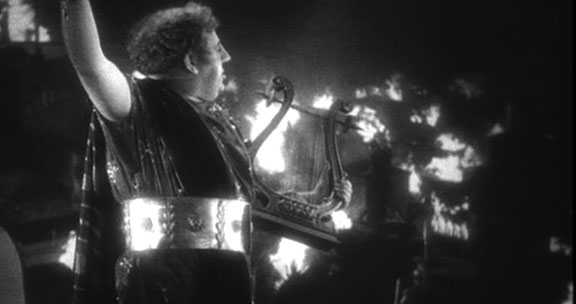
This image has become the allegorical embodiment of decadence and detachment. This, of course, is an apocryphal story. Nero reigned over the
Dievole "Pinocchio" 2006 Nero d'Avola -- Dievole Winery itself is not in
Arancio 2006 Nero d'Avola -- Feudo Arancio wines are Sicilian in origin. This wine is a decent representation of what the grape has become in its native soil. It's not as fruity as the first one -- considerably earthier, and with a little bit of that Italian chalk. It's still pretty fruity, but has a nice spicy undertone that I liked. It would be a great pairing with almost any hearty Italian food. We had it with chicken tortellini soup and it was fabulous. For the price, you can't beat it. $6-10.
Morgante 2005 Nero d'Avola -- When I was a teenage sci-fi/fantasy geek -- back in the days before I discovered that kissing girls was much more fun than Dungeons & Dragons, I read a series of books by Steven Brust. In this series of books, there was a type of weapon called a "Morganti" that destroyed a person's soul. This similarly-named wine didn't quite have that effect, but it did leave my spirit dampened. Available for $11-18, this was the most expensive of the wines that I bought, and was by far the most disappointing. The nose was nice enough -- lots of fruit. The taste of the wine was unimpressive, however. No pronounced character of much of anything, and a finish that could only be described as flabby. Perhaps I just got a bad bottle, but I'd snag two bottles of the Arancio in its place in a heartbeat.