Showing posts with label meritage. Show all posts

Monday, January 12, 2015

Fifty Shades of Grey Wines

It’s the “literally” that got me.

I was shopping for Riesling the other day. In the wine store I frequent, the Rieslings are shelved next to the American white blends, and my attention was snagged by a “Fifty Shades of Grey” label.

I’m sure you’re at least aware of the “Fifty Shades” books by E.L. James. This trilogy of beach-ready…I guess you’d call it “BDSM-lite erotica” was all the rage a couple of years ago amongst some broad swaths of the population. I was not covered by one of those swaths, and those books had receded from my mind except for a brief conversation with a co-worker disappointed because Charlie Hunnam was no longer playing Christian Grey in the upcoming film adaptations of the books, with the first due in theaters around Valentine’s Day. 

According to the website, the wines are designed by James herself. The bottles and corks both bear the slogan “You. Are. Mine.” – a sentiment somewhat central to the trilogy’s ostensible plot. I discovered a passage in the novel centering on the protagonist, Anastasia Steele, receiving a punishment if she spilled wine. That particular passage begins like this:

”He reaches down, and from his pants pocket, he takes out his silver grey silk tie… that silver grey woven tie that leaves small impressions of its weave on my skin. He moves so quickly, sitting astride me as he fastens my wrists together, but this time, he ties the other end of the tie to one of the spokes of my white iron headboard. He pulls at my binding, checking it’s secure. I’m not going anywhere. I’m tied, literally, to my bed, and I’m so aroused.”

The recovering English major in me thought, "Gah! What’s that word doing there? How else would she be tied to her bed? Figuratively? Tangentially? Is Anastasia Steele somehow related to Chris Traeger, Rob Lowe’s character on Parks & Recreation?"

The scene goes on from there, eventually arriving at Anastasia’s proclamation of herself as “just one ball of sexual, tense, need.” Anais Nin or D.H. Lawrence this isn’t. Heck, from my perspective, it’s barely Cinemax.

But I digress. We’re not here to discuss the ins and outs of Anastasia and Christian’s adventures. We’re here to talk about what’s under the cork. There are two Fifty Shades wines created by ol’ E.L. herself – a red and a white, both blends. 

The first I tried was the White Silk White. White Silk is a mischievous little blend of Gewurztraminer and Sauvignon Blanc. I found it intensely floral and tropical on the nose – strong enough that the bouquet comes through right out of the fridge like a chilled, overripe lychee nut. (An overly-cold wine usually loses much of its bouquet.) The main flavors are the tropical fruits – pineapple especially – from the Sauvignon Blanc. The finish is slightly sweet and lasting. There’s also just a little sting of pepper at the end from the Gewurz. I found it relatively decent. On the website, it lists for $18, but the retail in my wine shop was $16.

Next came the Red Satin Red. “What would I do,” I mused, “If I were trying to appeal to fans of these books who often, in my experience, start oenological conversations with ‘I don’t like dry red wine.’ What sorts of sensual stimulations would I layer to tease, to tempt, to make them raise that scarlet-filled glass, hesitantly of course, to their lips? What would E.L. James do? I think I’d make a wine that smelled like dark, sumptuous red fruit – cherries and plums. I’d need some chocolate flavors, but there definitely can’t be a lot of tannin. The wine would need to go down as easily as one of Christian’s concubines and finish with just a little dryness to make it a little naughty to a palate not used to tannin. In short, a straightforward inexpensive California merlot.” 

When I cracked the bottle, I discovered that the wine reflected my little tasting note fantasy to a T. However, instead of merlot, the Red Satin is a “blend of primarily Petit Sirah and Syrah.” 

“Primarily,” of course, can mean a lot of things. In this case, they’ve taken two intensely flavored grapes and blended them with some unnamed varietals to tone them down. The Red Satin is a perfectly drinkable wine, but overpriced at $18. If you’re looking for a wine that begs for chocolate and a trashy novel, I’d still suggest that sluggable merlot for about $7-8 less.

As I was trying to get the Fifty Shades wines out of the store without drawing too much attention, I also noticed few other bottles with entendre-laden monikers, which I also snagged -- for comparison’s sake, of course:


PromisQous (NV) California White Table Wine – This white is a blend of primarily Chardonnay, Chenin Blanc, Gewurztraminer, with a few “other white varietals.” It’s crafted with the same flavor idea as the White Silk – Gewurztraminer provides strong floral notes and lychee flavors, but since it’s a chardonnay-based blend instead of sauvignon blanc, it’s got more creaminess and the flavors run closer to melon than citrus. There’s a little acidic zip from some added chenin blanc balancing the residual sweetness. I thought it was another easy drinking wine, but with a little more structure and backbone than the Fifty Shades. It’s also a few dollars cheaper at $10-12.

Now, its darker complement, the PromisQous (NV) California Red Table Wine, did not fare so well. Simply, this was a $9 red wine that tastes like…well…a $9 red wine. Honestly, there’s nothing really outstanding to distinguish this plonky plonk plonk. One of my friends in the wine biz describes wines like this as “pop tart wines,” meaning it’s more or less indistinguishable from other similar, inexpensive wines -- the way you can't really tell a flavor difference between the various types of Pop-Tarts. I wouldn’t suggest spending your shekels on something so generic.


Folie a Deux (NV) “Menage a Trois” White Wine – This naughty sounding number is another floral-scented blend, this one a mix of Chardonnay, Moscato, and Chenin Blanc. This simple quaffer is lighter-bodied than both of the other whites. I found some good flavors of melon and peach on the palate, with a very light, tangeriney finish. Of the three whites, I think this one was probably my favorite, because it didn’t have that residual sugar “thickness” and  was a little more harmonious and restrained (since we’re focused on restraints) than the other two. Good value at around $10.

As for the Folie a Deux (NV) Menage a Trois Red, the best I can say is that it wasn’t quite as plonky as the PromisQous. There was a hint of vanilla lurking somewhere in the mix and a wee bit of tannin at the end. Another $9-10 entry. Take it for what it’s worth…literally.


P.S. This remains my favorite interpretation of the novels. And yes, NSFW:

Friday, November 12, 2010

DEP’s Twitter Tasting – Hahn Estates

Next Wednesday, the 17th, the Naked Vine will be participating in DEP’s Fine Wine and Spirits Twitter Tasting, featuring wines from Hahn Estates.
Four wines are in the queue – Hahn’s Chardonnay, Meritage, and Pinot Noir – along with Cycles Falcon Zinfandel. A pack of these wines is available at DEP’s in Ft. Thomas and Covington for $35.
On Wednesday between 7-8, taste ‘em and tweet ‘em. Want more info? Contact Kevin “K2” Keith at k2@depsfinewine.com
See you then!

Tuesday, October 13, 2009

Maryhill Winery

When I attended the Cincinnati International Wine Festival, I noted that Maryhill Wineries in Goldendale, Washington, was one of the labels with which I was the most intrigued. While my palate was somewhat blunted by the cacophony of flavors that I'd been working with that day, I found myself really drawn to Maryhill. They were priced right, seemed tasty and straightforward, and were easy to quaff.

They grow a broad variety of grapes, which can sometimes give pause, but they manage to keep the quality fairly consistent. Most of their wines are in the $10-20 range, which makes them quite attractive. Since the festival, Maryhill's done pretty well for itself. They were recently named the 2009 Washington Winery of the Year by Wine Press Northwest. Their production has expanded greatly over the last few years, and their wines are becoming much more available.

I was understandably pleased when a case and a half of the wine showed up on our doorstep to review. The Sweet Partner in Crime and I were up to the challenge, so over the period of a few weeks, we cobbled together some notes:

Maryhill Winery 2006 Cabernet Franc -- Because of a story too long to relate here that involved a Sangiovese that was...um..."missing" from our cellar, a rosé that ended up being too sweet, and a football game we needed to watch -- I ended up popping this wine on a night when we were having a more "Italian Friendly" meal. (I also ended up pulling a little trickeration on the SPinC...) This is definitely a more fruit-forward, "New World" Cab Franc. A plummy, slightly minty nose with a full mouthfeel. The flavor is quite fruity, with a nice blueberry and smoke undertone. I might have mistaken it for a Cabernet Sauvignon, except the tannins were much softer and the acidity level considerably higher. The finish is acidic and a bit smoky. We had a grilled salmon with roasted tomatoes and tomato risotto for dinner that evening. The pairing worked really well. The grilled flavor of the fish accentuated the smoke behind the fruit in the wine. The acidity tamed the oil in the fish, and the tomatoes didn't overwhelm it, as they could have. I opened another bottle of this with friends Danny and Ryan. We got to this one after a couple of other bottles and some tastes of old scotch. Surprisingly, the fruit still made it to our scorched tongues. ($18)

Maryhill Winery 2008 Rose of Sangiovese -- For folks who like slightly sweet rosés, this will be a favorite. I'd be interested to know how this wine came about. It's somewhat heavy in the mouth for a rosé, since it's got a fair amount of residual sugar. There's enough acidity to keep it from becoming cloyingly sweet, but I can't say that it was my favorite. It's actually the rosé I mentioned in the Cab Franc writeup. I think it would have been better if it were either made in a fruitier style or allowed to dry out a bit more. The sweetness made it neither fish nor fowl. (Although it might be reasonably tasty with either -- $14.)

Maryhill Winery 2007 Pinot Gris -- "Simple and uncomplicated" is about as apt a description as you'll find for this wine. It's a straightforward, summery wine. The nose is extremely light and lemony. The flavor is much like the bouquet, light and citrusy with some pear and lemon flavors. The finish is quick and acidic, with a bit of a lingering astringency -- almost like a little bit of oak crept through -- but not enough to really be a strong part of the flavor. There's also a little peppery hint as well. It's a decent enough wine. Not my favorite pinot gris, but certainly one that works well enough on a hot day to relax with. ($15)

Maryhill Winery 2006 Zinfandel -- We first tried this as a "second bottle" of the evening. We'd had dinner and had a bottle of pinot noir with it. We were having post-meal chocolate, and the SPinC asked, "Do we have anything that's good with chocolate?" After surveying the scene, I cracked this open. After it opened up a bit -- the nose is big and bold with blueberries and bubblegum. The palate is uncomplicated, but nicely jammy with more blueberry and raspberry flavors. This slides smoothly into a finish with balanced tannins and great flavors of dark chocolate and coffee. And yes, it went remarkably well with dark chocolate and brownies. We had to try both with it...you know, for science's sake. ($22)

Maryhill Winery 2008 Viognier -- We were putting together a salad of our garden veggies, some grilled chicken, and a balsamic vinaigrette and hadn't opened a wine for it yet. I took a shot in the dark here, and it paid off. The nose of this wine is less floral than many viogniers, nosing more of light wood and minerals than of flowers. The flavor is a medium bodied mix of pear and pineapple with a touch of the traditional viognier oiliness. Vanilla dominated the finish. Quite tasty. The salad had a number of strong flavors -- citrus, smoke from the grilled chicken, fresh lemon basil, earth from mushrooms, and this wine stood right up next to it all. It didn't overwhelm the salad's flavors, but it didn't turn either insipid or astringent. A great wine to pair with the salad. The longer the wine sat, the more pronounced the smokiness and vanilla became. I'd really consider letting this sit open for a half hour before diving in. We confirmed the pair's quality at the end when the SPinC reached for the bottle and said, "Hey...well...this sure didn't last long...." One of the highlights and a steal at $15.

Maryhill Winery 2006 Proprietor's Reserve Malbec -- We cracked this on a night where we'd both had a long week and wanted to put together a nice meal. We'd watched a few episodes of some old Julia Child shows from Netflix and we decided to try our hand at some green beans and stuffed mushrooms. For a main course, we marinated up a London broil in some vinaigrette and lime juice and tossed it on the grill. Grilled food & Malbec. We figured we couldn't lose. Nice nose of vanilla and dark fruit. I might have mistaken it for a good Merlot. Nice smooth, balanced fruit on the palate that slides easily towards a finish full of vanilla, pepper, and coffee. It's a very balanced Malbec without some of the really harsh tannins that some of them can have. It's also not quite as spicy, so if that's what you're focusing on, that's probably not going to ring a bell for you. But if you're looking for more of a balanced flavor, it's nice. I get the sense, also, that this is somewhat of an "experimental," limited production wine. It's about $30, so I might wait a couple of years on this one, unless you want to lay it up for a few years, which could prove interesting.

Maryhill Winery 2006 Syrah -- I'm very glad we had a spare bottle of this one from the shipment. We opened the first one and it drank easily enough that we went through the whole thing without writing a note! Second time through, we had it with what started as fajitas and turned into a "lots of beef, peppers, garlic and onions over black beans" meal. Yeah, so it might not have been the "perfect pairing," but it worked nonetheless. Really nice nose on this wine -- plenty of vanilla and soft wood scents. It's medium-bodied for a syrah, slightly jammy -- good blackberry flavor and some pepperiness. Good, easy finish with some lasting clove and coffee flavors. We made the meal with more of a smoky heat than a spicy one (Tabasco Chipotle sauce is great stuff...), and the peppery notes complemented those spices nicely. Again, dangerously easy to drink, but we held off a little for chocolate, and we were glad we did. ($20)

Maryhill Winery 2006 "Winemaker's Red" -- The Maryhill "Bordeaux Blend with a twist" is their most popular wine. It's a blend of Cabernet Sauvignon, Cabernet Franc, and Merlot, with the "twist" being some Syrah thrown in for good measure. It's got an interestingly plummy, funky nose -- very earthy for a wine from the Northwest. Like a Bordeaux, it's lighter on the palate than many of the California meritages, so they've got the body right. The finish is where the wine was a tad disappointing. Initially, the finish seemed a little watery, smoky and clipped. After some serious swirling (and drinking about half a glass), some coffee notes come forth and the balance improves. Not the most complicated wine, but very drinkable. I wonder what it would be like with another year in bottle. A decent value at $14.

Maryhill Winery 2006 Proprietor's Reserve Cabernet Sauvignon -- The few cabs that I've had from the Pacific Northwest have tended to be mellow, "drink me now" concoctions. The cooler climate tends to make more subtle wines. Maryhill's Cab is certainly subtle, but it carries a little muscle with it. It's not as powerful as many of the California versions, but it is a full wine just the same. The nose simply wasn't there at first, but after an hour of breathing and quite a bit of swirling, I got rewarded with a very smooth, licorice and berry nose. The palate is fruity once the wine opens. At first, it's a wall of tannin, but the fruit does emerge. Once it does, lots of dark fruit and coffee. The finish is long and a bit heavy on the tannin. With the steak we had for dinner, though, that tannin was a bonus -- allowing the wine's fruit to show up and balance the meat, the mushrooms, and even the wilted spinach. With the mandatory chocolate and cabernet pairing, we were a bit underwhelmed. It was good -- but the flavors didn't quite marry. The reserve is $36. (Their "normal" cab is $20.) Would be a good one to grab a few bottles of and stick in the cellar for 3-4 years. Once the tannins have calmed, this'll be a rock star.

To sum up, with the exception of the pinot gris, I'd recommend most of these. (Warm weather whites like pinot gris generally don't do as well in the Northwest, in my experience.) The price is right for most of them and they've all got some depth for wines at these price points. If you can find these in your local store, give them a go.


Friday, January 16, 2009

Cleaning Out My Closet

I didn’t want to leave you hanging all thirsty for some new bottles to try. As you can see from the site index, a fair amount of wine gets sampled around here. Not all of it makes it into the blog. Usually it’s for topical reasons – the wine just doesn’t fit what I’m writing about at the time, but it’s interesting enough for me to keep in reserve. I take my notes and stash them for a rainy day. Well, the clouds have come.

In no particular order, a few wines that were plenty good enough to make the Vine’s cutting, but just never wound up in a column:

Hogue 2005 Chenin Blanc -- Hogue is one of my favorite Vine-level producers. I've been extremely pleased with just about everything that I've tried from them. The Chenin Blanc certainly didn't disappoint. Within each of their varietals, I find the Hogue wines to be much richer than many of their counterparts. Not necessarily more complex, but more full-bodied and, for my money, more "elegant." The chenin has a nose of melon and green apples. I expected this to be a lighter-styled wine, but the body was rich without being cloying. A nice fruity, melony taste with a texture that reminded me a lot of a viognier. The finish is more lingering than crisp. I had this with cod loin with vegetables and herbs cooked in foil packets, and it was wonderful. $8-10.

96 Points 2005 Shiraz/Viognier -- One of the best marketing ideas I've seen – why worry about what Parker’s going to give your wine when you can slap a score right on the label? It's certainly an interesting wine. Australian shirazes are always fragrant, and the viognier in this blend amplifies that, giving this a very strong nose of strawberries, coffee, and mint. Lush on the tongue, and not as fruity as I would have expected. Finish starts out with a light tannin that strengthens for a long time into a lingering coffee flavor. Around $10.

Laurel Glen 2005 "Reds" -- Marketed as "a wine for the people" -- this red blend from Lodi, California is a blend of four grapes -- Zinfandel, Carignane, Petit Sirah, and Syrah. The result is a big ol' smooth red wine. The nose is cherries and blackberries. As you would expect with those particular grapes, this is a big-tasting wine, but the fruit-bomb tendency of the zinfandel is tempered by the syrah and petit sirah -- leaving a taste of smooth tart cherries. The finish slides easily into a slightly dry, slightly fruity end which is quite nice. This wine was born to go with grilled or roasted red meat. Rare roast beef and new potatoes would be scrumptious here. At $8-10, you can spend the extra money on meat from the butcher's case.

Woodsman's White 2005 Cserszegi Füszeres – I simply didn’t know where to put this wine when I first tried it. The grape is pronounced chair-seggy fooser-raish. A clone of a gewürztraminer grown in Hungary. reminiscent of Alsace gewürztraminer. It starts you out with a strong sweet apple nose. Body is initially very dry. After a couple of sips, a gentle fruit flavor comes out. Finish is somewhat crisp. Had this with a Thai eggplant, bean, and tomato salad and it went quite nicely. I first found this at Trader Joe’s for around $4, of all things – it’s definitely worth it!

Chateau de Pena "Ninet de Pena" 2006 Cuvee Rose – A good, basic table rose from the makers of my favorite red box wine. Expect nothing fancy here. The nose is straightforward -- a little bit honey and flowers. Full bodied full for a rose and more than a bit acidic. The finish is bone dry. If you’re just sipping at it on it's own, it's decent. But for something to throw back if you're eating some meat or other earthy stuff and for some reason you don't want a red, it's hard to beat this for $5-6.


Stumble It!

Wednesday, May 14, 2008

Another Derby Column? Neigh!

Busy times in VineLand. The past month’s been a blur. Birthday celebrations. Passover and other family gatherings. Employment craziness for both myself and the Sweet Professor in Crime. A healthy dose of seasonal allergies. And, smack dab in the middle of it all, our 3rd Annual Kentucky Derby Shindig.

We had a houseful for the First Saturday in May. Unless you’ve been living under a rock for the last couple of weeks, you’ve undoubtedly seen and heard about the breakdown of Eight Belles that followed the absolutely brilliant race run by Big Brown. A hush fell over our crowd, mirroring what happened at Churchill.

I consider myself a slightly more than casual fan of thoroughbred racing, but I’m not going to wax poetic about the fallen filly or the pro/con of the humanity of the enterprise. (Although the statements by PETA about suspending Eight Belles’ jockey may have been some of the more idiotic things I’ve ever read…) I'll simply say that the whole thing was tragic -- and such a thing is heartbreaking whether it's on the biggest stage or in a maiden claiming. The horses themselves love to run, and that's enough for me.

Our gathering found its second wind, thankfully. Much food was eaten, 3 ½ liters of my magic juleps were consumed by the partygoers, and everyone left with smiles on their faces at the end of the evening.

We did offer more to drink than bourbon-based concoctions. I was able to put together a few equine-themed wines for general consumption. With Preakness and Belmont coming up, you might want to consider one of these selections:

Horse Play 2005 Rollicking Red -- An interesting California blend from White Rocket wines, an offshoot of Kendall-Jackson. This wine is made from almost equal parts cabernet sauvignon and merlot with a shot of syrah to add some fruit. The cabernet dominates initially with lots of tannin at first taste. In my opinion, you're better off letting it breathe for a bit right out of the gate. A very rich wine once it settles down, with plenty of blackberry and currant flavors and a strong, tannic finish -- almost like a cup coffee. Its richness calls for stews. At the aforementioned party, when I went to the burgoo I'd whipped up in the slow cooker, I took a break from the juleps to drink this wine and it meshed well. What's burgoo? For the uninitiated, it's a stew initially made from whatever was around the kitchen. (Or, as Vine Reader Miss Judy put it, "Whatever's on the road that morning...") I took a little more care with it. You can find this for $11-13.

14 Hands 2005 Red Wine -- If you're not familiar with horse terminology, a horses' height is measured in "hands," a unit equivalent to four inches or so. The name of the winery refers to the height of the wild horses that used to feed on the grasses in this part of rural Washington. The blend of grapes was very similar to the Horse Play, but the more northern latitudes where it was grown gave it a much softer, fruitier taste. The merlot was much stronger in the blend. That said, it still had some muscular plum and berry flavors, but the finish was smoother and less tannic. It worked wonderfully well with chocolate. $9-11.

Tall Horse 2006 Sauvignon Blanc -- This South African sauvignon boasts a drawing of a giraffe on the label. So what if I'm taking liberties here -- since "Tall Horse" was the name of a giraffe given as a gift to the French by the Sultan of Egypt in the 1800s. Still, four legs -- hooves, and a general horse shape. Work with me, people. This wine is a very refreshing quaff. It has a bright nose of melon and grapefruit. The flavors of melons and lemons are very crisp. The finish is dry with more of the melon flavor. It'll run you $8-10, but is an excellent party wine.

If you want to spend a little more, you might also check out some selections by Equus Run (for the Kentucky wine experience) or Wild Horse. You could also nip over to the blogroll and click on Dark Horse (home of one of the tastiest zins that you’ll find) or Iron Horse,­ best known for sparkling wine but also purveyors of some other tasty selections like the Benchmark I just raved about.

Place your bets...


Monday, April 28, 2008

The Quasi-Outdoorsy

Overlooking the simple pleasure of a getaway is far too easy.

The Sweet Partner in Crime treated me to a weekend vacation at Natural Bridge State Park to celebrate my birthday. We had a rough agenda. Sleep in on Friday, get up at our leisure, and head down to Lexington to catch the last day of Keeneland. (I ended up breaking even on the day, thanks to a strong ride by a 10-1 longshot from Devil Eleven Stables bred by an old classmate of mine.)

After good times at the track, we headed down the Mountain Parkway to Slade. We stopped at Miguel's, one of the best little pizza joints you'll ever stumble across and unofficial community center to the "climber's commune" behind the place. We picked up a pizza and a salad there and headed for our cabin in the park.

We had a little mix-up at check-in. We opened up our cabin -- only to find someone else's bags already in the bedroom, newspaper in the kitchen. We called the front desk. I explained to the high-schoolish sounding attendant the situation and (after she asked "Are you serious?" and "Are you sure? Did you just check in?") said that she could get us another cabin. We went back to the lodge and received an apology and new keys from the manager. We ended up, by chance, in the same cabin where we did the Riesling tasting last year.

We settled in, finally able to enjoy the yumminess from Miguel's. Our need for bubbly with pizza is well documented, so we'd brought along a bottle of Royal St. Vincent Brut for the occasion (Usually around $15, found on sale for $10). The bubbly was crisp, dry, and had a little yeasty character. It tasted wonderful after a day in the sun and was simply delicious with the pizza.

The SPinC and I are what you might deem "quasi-outdoorsy." We love being outside, enjoy taking hikes, and think of ourselves as relatively adventurous -- but at the end of the day, rather than pitch a flimsy tent and sleep on roots and rocks, we'd much rather return to our cabin, shower, and cook a good meal in a fully-equipped kitchen. Some of you might consider that cheating, but hey...it's our vacation!

So, what did we bring along on this little jaunt of ours? Well, for general consumption after hikes and the like -- our old standard Redcliffe 2006 Sauvignon Blanc found its way into the fridge. For our evening chocolate consumption, we had a bottle of Benjamin Tawny Port from Australia ($10-13). An inexpensive port, it's got a strong but not overpowering sweetness, lots of flavors of vanilla and fruit, and a delicious finish. At the price, you probably won't find anything that can touch it.

The port also played itself into the meal we cooked on Saturday. We fired up the grill to cook some cardamom-and-balsamic marinated ostrich steaks. The ostrich was free-range raised by a colleague of mine at work (who, sadly, is getting out of the business). I'm a huge fan of the stuff, and if you haven't tried it -- it tastes like steak with the fat content of chicken. We did foil packets of vegetables and some boiled new potatoes. As a side, we diced a big apple and cooked it down with beef broth, the port, some honey, and more balsamic. Unearthly good as a chutneyish topping. Dessert was a couple of grilled pineapple rings, topped with more of the apple and port sauce.

To drink, I rolled the dice and tried a California meritage called Beauzeaux from BV ($9-12). 2005 was the first year of this blend, which has a Zinfandel base and includes juice from seven other grapes. It was nothing fancy -- just a straightforward, somewhat juicy red wine. Honestly, I wouldn't have wanted anything overly complicated with this dinner. There were so many fantastic flavors in the food that I was happy for the wine to stand at attention in a friendly fashion. For that purpose, it worked well enough as a complement. (Although I wouldn't recommend it with the pineapple.)

The rest of the weekend when we weren't eating? Other than a couple of wonderful walks in the woods (and with the slow spring we've had, we were right in the "wildflower wheelhouse" -- just beautiful colors) -- we didn't do much. We sat on the porch and watched the wind blow. We napped. We channel-surfed mindlessly (although the SPinC was fascinated by "Flip this House.") We talked and laughed. We relaxed. We slept like babies.

No email. No Internet. No cell phone service. We noticed that this was the first time in a long time that we weren't doing something. Both of us are really busy in our regular lives, and even when we have time at home -- we're usually doing something social, or catching up on watching shows, or we're checking email, or doing things for work, or running errands, or writing, or something that requires one or the other of us to be focused on something.

This weekend stood in stark contrast. Doing nothing, not plugged in for a couple of days -- not feeling the urge to be connected to people outside the room and the moment -- that peace was a luxury and a gift. No, we weren't completely "off the grid," but it was enough. The weekend gave us both nice recharge and a powerful reminder of just how easy it is to get caught up in the flow of what we find important in the "real world."

When did solitude become hedonistic?


Thursday, January 24, 2008

Ol' Red Ned & Ol' Rog Fed

About six months ago, the Sweet Partner in Crime wanted to start taking tennis lessons. Both of us had batted a ball around before, but neither of us really knew how to hit groundstrokes properly, serve consistently, or use any strategy other than "try not to shank the ball onto the adjoining court."

Along came The Coach, a colleague of the Sweet Partner's, who responded to her request to "give us a few pointers" by setting up weekly lessons, breaking down our bad habits, and giving us the ability to actually keep a rally going. Coach is always good for the pithy gem. On the first day he worked with us, he came out with this:

"You know what the best shot in tennis is? The one that goes over the net. After that, there's a world of possibility. The wind could blow the ball in. You could hit a bird. Your idiot opponent could hit a volley from the baseline. But if it goes in the net, the point's over. Everything goes from there."

As the weeks passed, I realized that I have the natural ability to play "caveman tennis" (not a good thing), learned that moving on a tennis court is like playing basketball defense instead of trying to fill a hole like a linebacker, discovered that I can hit a decent one-handed topspin backhand, and discovered a competitive intensity in the SPinC I'd never seen before. (Note: Hit to her backhand if you play her. One she lines up her forehand, you're toast.)

Obviously, six months isn't enough to turn me into Roger Federer (although I actually have been mistaken in public for Andre Agassi…), but improving has been fun. So, in honor of the Australian Open championships, the Vine features Australian Shiraz. Shiraz, as I've mentioned before, is Australia's most notable wine export. There are any number of inexpensive wines from Australia -- known down under as "plonk" or "red ned." These "pop tart" wines are often interchangeable, and I wanted to move a bit beyond Little Boomey & Yellowtail. We're approaching the Finals, after all.

These very distinctive Australian creations are, like a weak backhand volley, squarely in the Vine's wheelhouse:

d'Arenberg 2004 "The Love Grass" Shiraz -- Love Grass itself is a weed is native to Africa; introduced in Australia as livestock fodder and to stabilize soil. The name comes from its uncanny ability to spread by attaching its seeds to anything that brushes by the stalk, be it animal, vehicle, human, etc. [Insert your other easy spun double entendres here.] The nose is...honestly, I don't know. The SPinC and I puzzled over this one. Leather? Coffee? Mint? Vanilla? We couldn't quite get a handle on it, but it's distinctive and we liked it. It was also, to steal from Sauvignon Blanc, a little "herbaceous." [Again, insert appropriate "grass" comment of your own.] The flavor is big and full of berries, but the finish is a drop volley of tannin across the back of the tongue. This big, herby Shiraz is great on its own, but it blew our doors off accompanied by a little dark chocolate. $12-14.

Pillar Box Red 2006 -- Pillar Boxes are the British Empire's contribution to the mail system. These metal boxes were the forerunner of the modern public drop mailbox. These were used throughout the British Empire in the 1800's. They initially were any number of colours, but eventually (as typical of the English) standardized to red, hence the wine's name. As for the wine itself, in the US, this would be a "meritage" -- a blend of half shiraz, a good portion of cabernet sauvignon, and a dollop of merlot. The results? Impressive. The nose has layers of interesting aromas: cherries, vanilla, and something like a baking cookie. It's a well-balanced wine with plenty of fruit and a nice amount of tannin. The finish is long, a little fruity, and dry. $10-12.


Shoo Fly 2006 "Aussie Salute" -- Another blend. This one is largely Shiraz, about a quarter Grenache, and a splash of Viognier. The "Australian Salute" is the term for waving one's hand in front of the face to flick away the ubiquitous bushfly. The name of the winery and the decals on the bottle pay homage to this Australian native arthropod. It's said that the Australian accent is a product of nose-breathing to avoid inhaling these buggers. Inhale deeply of this wine, however! The natural perfumes of the Viognier amplify the fruit of the Shiraz, bringing you a powerful combination of plums and coffee. The flavor is fascinating. All three of these grapes are featured in Cotes du Rhone -- and the flavor is, as the SPinC put it, "Like a fruity Cotes-du-Rhone without the funk." The finish is somewhat fruitier than a C-d-R, but with similar tannins, allowing it to flex between earthy foods and chocolates. A very nice find. $11-13.


Hooroo...


Tuesday, November 06, 2007

Testosterone Sauvignon -- Wines for Men


Men like wine. Why don't we see it advertised to them?
Watch typical "male" programming. You know, talking sports, wrestling, action movies, "24," and so on. You don't see wine ads among the deluge of "light" beers, gadgets, and John Mellencamp singing about Awrrr Countreee. Heck, they'll advertise a flippin' minivan, but not a decent bottle of cabernet.
Men are a stable wine buying population. We drink the stuff. We write songs about it (from the Rolling Stones to Merle Haggard to Axl Rose). The majority of winemakers are men. The manliest writers -- think Hemingway, London, Kerouac, et al -- feature it prominently. Behind the pursuit of "yabyum" and enlightenment, a close third-ranking activity in "The Dharma Bums" was finding a jug of wine and hanging out. Basically, the same things we still do…
Perhaps winemakers think that men aren't a good target demographic. Perhaps they think that other avenues are more effective -- I'm not sure. Even with females making up the larger percentage of wine drinkers (52.5 to 47.5%), that still leaves about a billion bottles consumed by men each year in the U.S. alone, and they haven't even surveyed me yet. In my opinion, the first winemaker to catch on to the fact that there are more than Neanderthals watching "everyday man" shows will make a mint. Maybe a couple of winemakers are wising up. I heard an ad for Dancing Bull Wines on "Mike and Mike in the Morning" on ESPN Radio, so who knows?
Regardless, as a rule, men are usually more clueless than women in a wine store. Why? Genetics. We're preprogrammed to a) be the authority and b) never ask for directions. (That thud you just heard was the Sweet Partner in Crime braining me with an Introduction to Sociology textbook.)
Let a typical man loose in a wine store and what happens? A little aimless wandering, perhaps the "what have I heard of before" thought process -- and, eventually, the same thing happens to a man as a woman. He looks at labels and buys something that looks interesting. Shiny objects and pretty colors, you know. Breweries figured that out a long time ago.
Slowly, wineries are coming around to this way of thinking. I put myself in a mindset of looking at labels and walked the aisles, thinking, "What looks interesting?" Here are a couple that jumped out:

Bohemian Highway 2004 Cabernet Sauvignon -- For the ex-and-present hippies among us. This is a pretty straightforward cab. A cab you could pour and enjoy with a meal, or sit around and Kerouac right out of the bottle. The fairly strong nose is currants and blackberries. The body is big and fruity. Nothing you have to work too hard to wrap your palate around. The finish is straight fruit, almost Zin-ish. Not a lot of tannin to be found, so it would be an excellent party wine. The flavor blends well with anything smoky. $7.
Joe Blow 2005 White Wine -- Even more challenging than finding the right marketing for men would be finding a way to market white wine to men. At least red wine has the romance and the better descriptive words on the cards in the aisles. You don't hear a pinot grigio described as "muscular" very often. So, create a label that says, "Hey…no big deal…it's just wine." Ironically, the Joe Blow is made from three very "female" varietals: chardonnay, viognier, and chenin blanc. The nose is very interesting. I guess you'd call it "tropical," but I got an odd combination -- butter and papaya -- and it worked. The viognier makes the nose strong, the chardonnay gives it a full body, and the chenin blanc adds a nice crispness. A good hot weather wine or with anything spicy. $10.
Jarhead Red California Table Wine -- The Marine emblem stands out on this simply labeled wine, marketed as a wine "made by Marines for Marines." I'm not a veteran, but I certainly appreciate the service of the Marines and the fruit of the labors of a couple of them. Made in conjunction with Firestone Vineyards (most of the wines are out of Vine range, but if you get a chance to try their cabernet, splurge.) The Jarhead is a solid red, definitely a cabernet dominated blend. Plenty of fruit on both the nose and palate. The finish is dry, but not very long. More of a get in, get out wine with any kind of red meat. We had this outside one night in the company of one of our neighbors. The proceeds from the sale of this wine go to the Marine Corps Scholarship Fund (mcsf.org). This organization provides educational assistance to the children of fallen Marines. $13.


Sunday, August 05, 2007

Reese's Cup Wines

Allow me a moment of nostalgia.

I was speaking to a group of new freshmen at the institution of higher learning that funds my wine habit. As part of answering a question, I came out, for some reason, with, "You got your peanut butter in my chocolate…"

No one batted an eye. They had no clue. An entire generation of college students raised without "two great tastes that taste great together."

(Honestly, I don't remember the exact context -- and the Sweet Partner in Crime can attest that such a thing is fairly common.)

After the "jeez, you're getting' old" bell stopped ringing much later that evening, I decided to drown my sorrows a bit -- and what better way to honor that little piece of popular culture than with wines based on a similar principle.

Blending wines made from different grapes is almost as old as winemaking itself. Someone realized early on that proper proportions of different varietals greatly improve a wine's overall flavor. For instance, many cabernet sauvignons are bottled after being mixed with a touch of cabernet franc. This blend takes the edge off the tannin and brightens the fruit. Some wine growing areas even have laws requiring wines to be blended.

The French refer to a blended wine as a "cuvée." Literally translated, "cuvée" means "vat" -- which makes sense if you think about it. Cuvées were initially cheap table wine. The term has broadened significantly. Wine growers in Bordeaux and the Rhone valley specialize in cuvées. Practically all the wines from these regions, from inexpensive bistro wine to expensive first growth Bordeaux, are cuvées. Heck, Chateauneuf-de-Pape (a famous Rhone wine) is a blend of up to 13 different grapes!

American wine growers wanted to get in on the act. However, the growers couldn't call their wines "Bordeaux," obviously, and ATF regulations required a wine to be at least 75% of a single grape to be officially "named." If it wasn't 75%, it had to be labeled "table wine," which was unfortunate, considering the quality. In 1988, some California wine growers made up the term "Meritage" for blends of California grapes made in the style of French wine.

Meritage was the standard term for a bit -- but the growers discovered that few among the "normal" wine drinkers knew what the heck it meant. Then came the "Proprietary Blend" -- which basically meant that they'd put whatever they wanted in it. This was followed by "Rhone style" to add an element of gravitas. Finally, as with most things, we've come full circle. Many better American wineries are releasing "cuvees." In France, Georges DuBeouf has started making surprisingly decent blends out of leftover grapes -- called "Cuvée Blanc" and "Cuvée Rouge." Go figure.

Blended wines can be hit or miss. If the proportions are off, then the wine can end up a weak, flabby mess -- especially inexpensive blends. There are, however, many meritages with merit:

Oakley 2005 fourWHITES -- "It's very pretty," announced the Sweet Partner in Crime. This blend from Cline Cellars combines Gewurztraminer, Palomino (the grape from which sherry is made), Viognier, and Malvasia. I've never heard of that last grape. Honey and flowers on the nose like a viognier, a little of that sherry bite with the peach and citrus flavor, and a finish with a pepper like gewürztraminer. This one would be absolutely scrumptious with a salad with some mandarin oranges or something like bruschetta with fresh garden tomatoes and some balsamic vinegar. A steal at $7-9.

Toad Hollow "Erik's the Red" Proprietary Blend -- You want to talk about a serious blend? This wine has eighteen different grapes in the mix. It doesn't exactly follow any specific style -- rather, it's simply a tasty, full red. This wine has plenty of nice, deep flavors. Big dark fruit on the nose, coupled with a little of that Russian River valley boldness. The taste is soft and full of blackberries. The finish is long and fruity. While not very tannic, it's got enough muscle to hold up against some pretty hefty food pairings. It would go pretty well with a prime rib, I'd imagine -- but it's a really scrumptious companion for some dark chocolate. A good, solid, kick-back-and drink wine. $11-13.

Rosenblum Chateau La Paws 2005 Cote du Bone Roan -- One of my favorite French wines is Cotes-du-Rhone. The occasional problem with a CDR is that the earthy character of the wine often overwhelms the fruit, leaving it tasting flat. Rosenblum Cellars, known best for their Zinfandels, decided to do the Sonoma Twist with a Rhone style wine. They blended some of their Zinfandel with some of the traditional grapes of CDR (Syrah, Carignane, Mourvedre). The addition of Zinfandel creates an interesting nice balance -- a fruity wine with an earthy "backbone." The nose is plummy and spicy. It's a very big wine, as you'd probably expect. Lots more plum and smoke flavors. The finish has enough tannin to make it interesting, instead of trailing off into alcohol as many Zins do. We cracked this one simply by chance when we grilled up some marinated ostrich steaks with this. Yum! Simply put, this was one of the best grill pairings I've had in a long time. A filet mignon would also be scrumptious here. Give it a try. You won't be disappointed. $10-13.


Wednesday, October 18, 2006

For Jessie.

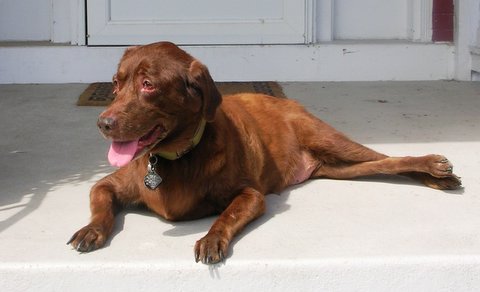
Jessie Red -- arguably the sweetest creature to ever put paws to soil. A chocolate lab whose smiles could light a room, and whose flatulence could clear it just as quickly. A chocolate lab with a lust for life that put Iggy Pop's to shame, and with a knack for mischief that…well…put Iggy Pop's to shame.

Jessie was the constant companion of my constant companion, Pam, for thirteen years. I've been told that Jessie was the screener five years ago for whether I got to join the household. (I'm glad I passed the test.)

Jessie was adopted a few weeks too young, so she never truly understood that there actually was a difference between human and canine. She saw herself as human and acted accordingly. Everyone entering the household deserved a proper greeting (she was always a proper lady) -- even if that meant bowling them over before drowning them in joyful slobber. People food was obviously prepared for her -- as was discovered upon walking into the kitchen to find Jessie hungrily devouring the second of two enormous porterhouse steaks that she'd jumped onto a counter and then onto a shelf to reach. Jessie would scarf down pretty much anything in reach, and she marginally preferred beef to recently-worn underwear.

So, aside from sentimental reasons, what's a chocolate Labrador retriever doing in a wine column?

Again, Jessie never understood what was and wasn't meant for dogs. Pam returned home from a long day in the salt mines of her graduate education to her usual enthusiastic Jessie Greeting, only to find shards of wine bottle glass all over the kitchen floor -- and nothing else. She'd left a wine bottle too close to the edge of the counter and Jessie -- in her ever-curious way, had knocked it off -- only to have it shatter. Jessie was a resourceful critter, however, and wasn't one to waste good wine. So she drank it.

All of it. Every drop. Carefully.

A panicked call to the vet followed. The vet asked if she was bleeding -- she wasn't. He gave the advice: "Keep an eye on her and make sure there are no signs of internal bleeding. Otherwise, just watch her." Jessie was skillful. She didn't cut herself at all. But, after the equivalent of five glasses of cabernet, Jessie had a BAC of approximately .23. She was very happy that night -- walking around with her usual big grin, and then staggering into walls, cabinets, before finally lying down to enjoy her buzz. And, yes, she was a bit hung over when all was said and done.

One year ago this week, we made the difficult choice to bid adieu to our sweet girl. After 13 years, her quality of life wasn't what it should have been, and she let us know in no uncertain terms that she was just tired and ready to go. We miss her every day...

In Jessie's honor this week: dog-themed wines…

Dog House "Checker's Cab" 2002 Cabernet Sauvignon -- "Welcome to the Dog House." I find it very fitting to open the wines here, as Jessie never met a stranger, neither canine nor homo sapiens. Jessie's constantly wagging tail of destruction would be flying after a few tastes of this very straightforward, compact cabernet. The big blackberry jam nose on this wine gives way to a slightly oaky red with some nice background tastes of licorice. The finish is very gentle for a cabernet sauvignon -- not terribly tannic with some lingering smoky flavor. Very easy to drink -- the Dog House would be a good "transition cab" for people who enjoy mellower reds like merlot and are interested in giving drier wines a try. Foodwise, the classic pairing with a cabernet is grilled steak, and this would be no exception. Pot roasts, ribs, or earthy mushroom-based dishes would be great here, as well. If you want a great tailgating wine -- the screw top (which you should not fear…more on that later) makes it a winner before a ballgame around the grill…that is, if you're not pouring Maker's. Dog House goes for $8-11, and the winery also makes a contribution with each sale to a nonprofit called "Guide Dogs for the Blind." As we need more of a reason to open a bottle…

Vinum Cellars "Pets" 2003 Petit Sirah -- Jessie would have been the wrong critter to ask about petit sirah. She didn't have much of a discriminating palate. However, she would have gotten along famously with "Tanker" -- the vintner's lab, featured on the bottle. Many people think Petit Sirah and Syrah are the same grape. While both grapes make big, bold wines -- petit sirahs tend to be extremely dark in color, almost black, and yield big, bold flavors and strong tannins -- much stronger than the mellower syrah (or Shiraz, which is the same grape). This wine needs to be opened and allowed to breathe for at least half an hour, but it's definitely worth the wait. The nose of this wine is powerful and fruity -- big scents of blueberry and blackberry. If you don't let it breathe, however, the fruit gets quickly overtaken by those signature tannins. However, with a little time exposed to air, the fruity complexity holds strongly against the tannin -- giving you a deliciously interesting flavor. The finish is long, spicy, and chocolaty. This big wine pairs up well with big foods -- roasted chicken or vegetables in sauce, prime rib, barbecue brisket. It also would go wonderfully with dark chocolate or big aged cheeses. Take the plunge with Pets to the tune of $12-15. And, in staying with the charitable theme, a portion of the sales go to the San Francisco Society for the Prevention of Cruelty to Animals.

Finnegan's Lake "Fin." 2005 Chardonnay -- Jessie was full of surprises, and this chardonnay, with a profile of the puppy that is the wine's namesake, certainly gave me a start when I tasted it. I'm not a huge fan of California chardonnays these days -- they're often too oaky for my tastes. However, this wine is light and subtle, much unlike Jessie -- although both would be great fun at a summer picnic. The "Fin." reminds me much more of a French Chablis than of most chardonnays you'll run into from California, as it has a much lighter, much more lemony nose than most chardonnays you'll run into from there. The very fresh body has notes of vanilla and only a little bit of oak. The finish is long and light with just a little bit of spice. If you're not into the heavy oak or very buttery style of most California chardonnays, you'll become a fan of Fin. Light pastas, almost any type of grilled or baked fish & shellfish would probably go extremely well. Chablis and oysters is a classic pairing, and this would probably fall right in line. Thai cuisine would also be a nice pairing, especially if fish sauce is in the preparation. You'll probably end up between $11-14 for this wine, so if Chablis-style chardonnay is your thing, you'll probably like it a great deal. Fin is a decent American substitute for a classic French wine -- and since the French were some of the first Europeans to trade with the indigenous population of the Labrador region of Canada, perhaps it follows that Jessie's wine would be more French in style.

Until next time…oh, wait…excuse me…Jessie's younger sibling Mooch is nosing my elbow. He wants to get in on the act. He may be a topic of a later issue, but sure -- why not. Here's Mooch's pick for this week:

McNab Ridge "Fred's Red" 2006 -- This syrah/zinfandel blend from Mendocino County would be good to have around the house as we start donning (or growing) our winter coats. Fred is the McNab Shepherd namesake of this winery's whose picture adorns the bottle. Much like Mooch -- this wine is quite straightforward. This is a just-released wine, so I'd be interested to see what a few months or a year would do here -- but it stands up now nicely enough. There's a very full nose here for such a young wine. You get a blueberry and cherry scent at first -- and you can also tell you've got a wine that's got a bit of alcohol in it. There's fruit and very solid tannins in the body, with a long finish of smoke and licorice. Right now, the muscle of the syrah is the dominant flavor. I'd be interested to see if the fruit of the zinfandel balances the tannin as the next year or two passes. Big meats, of course, will go well with this -- but I'd be interested to see how it would stand up to a baba ghanouj or other strong eggplanty dish. Fred's Red nestles into your wine rack for right around $10.

Until next time…throw your paws in the air, and wave them like you just don't care…

Friday, September 22, 2006

"To cellar, perchance to dream..."

Wine cellar.

Wonderful words -- evoking an air of distinction, privilege, and, most importantly, a ready store of really good vintage for on-hand consumption. Realistically, these two words are a fantasy for most of the wine drinking world, and they should be -- especially for those of us who don’t want to break the bank.

As you probably already know, wine's natural enemies are heat, light, and exposure to oxygen. If Sherman set the Wayback Machine to the early days of winemaking, someone discovered that wine kept in a cave lasted longer and the flavor often improved over time. Underground, wine is obviously protected from light, stays at a constant temperature, and the stable humidity prevents the cork (or other stopper) from drying out, thus keeping the wine nice, cozy, and unoxidized until brought out and opened. Many of us try to emulate the "cave" with what we have handy -- usually a hall closet or basement. We may even install or build a rack or two to keep the bottles organized. Alas, we're generally doomed to failure.

Wine, like a Florida retiree, is extremely sensitive to temperature change. The optimal storage temperature for wine is 55 degrees Fahrenheit. This allows the proper chemical reactions to take place, producing the flavors we love so much. Once a wine gets warmer, the chemical reactions speed up. This not only ages the wine more quickly, but it can throw the balance of flavors seriously out of whack. At a constant 70 degrees, a wine will age between two and eight times faster than at 55 degrees. At 90 degrees, a wine will age between four to fifty-six times faster. If your wine is in the kitchen by the stove for a month in that cutesy little wrought iron wine rack that looks like a French waiter, it can be as if you've had it for 24 years.

I can already imagine some of you thinking, "Great! I can buy some wine that needs to be aged, keep it in a warm place for a month, and I'm all set." Not so fast. Higher temperatures increase the speed of chemical reactions, but wide swings in temperature, especially in heating, have a nasty effect on wine flavors since the reactions and oxidations get out of whack. With such variations, you're going to end up with vinegar faster than you can say "gewürztraminer." The "hall closet" trick usually fails here as well -- since very few closets are temperature-regulated. (Put a thermometer in your closet and check a few times if you don't believe me.)

So -- what do we do to hang on to wine?

A few possible options: first, you could petition your local zoning board to let you drill 20 or so feet beneath the foundation of your home, and build yourself a wine cave. That should be sufficiently deep to avoid freezing, while maintaining consistent temperature and humidity. Just watch the sewer lines.

Second, you could purchase a wine refrigerator. Serious wine collectors do this -- cheap ones will run you several hundred dollars, but they do an excellent job keeping wine in a proper state indefinitely. You can also rig a spare fridge to maintain a relatively constant temperature (I do this for homebrewing lagers) -- but even then, you probably wouldn't want to keep your Lafite '61 in there. Typical refrigerators allow swings in temperature of 8-10 degrees, which will keep wine in the right ballpark – but for really long term storage, it’s problematic.

Third, and most practically, tone down your expectations and drink your bloomin' wine. If you've got a relatively cool, relatively stable temperature anywhere in your domicile -- even if it's not perfect, you can still “cellar” wine. But, if you're like me, temptation eventually overcomes you. However, if you can stay your hand for a year or so, you can work wonders with relatively inexpensive wine – since many of them are shipped to market prematurely (and new vintages can be bargains, since they have no track record), and nine months or a year of aging will improve some wines markedly.

Some rules of thumb -- less tannic wines don't cellar as well, so pinot noir, merlot, Beaujolais, etc -- these should be drunk relatively young. Cabernets, zinfandels, shiraz/syrah -- these you can have around for awhile. White wines generally don't cellar well -- but there are a few exceptions which I'll touch on below.

Here are a couple of inexpensive numbers you might want to consider picking up half a case of and forgetting about for a little while:

Pietra Santa "Sacred Stone" Master's Blend Old World Style Red -- The reference to "Old World" in this overly-nomenclatured wine is to the winemaking techniques of the Rhone valley in France. Sacred Stone is an American version of one of a Rhone red. Many of the wines made in the Rhone are blends -- syrah is usually the backbone, but there are usually other grape varietals floating around in the mix. There’s an appellation (WineSpeak for “type of wine”) called Chateauneuf-de-Pape (French for "Chateau of the Pope" -- this wine bears the papal seal on the bottle) that can contain up to 14 different grapes. Rhone reds are very earthy, and a wine drinker first trying one of these can be knocked back rather harshly by what could be termed a "mild nose of old armpit." Many Rhone wines taste best to me with a little decanting. The Sacred Stone is a Rhone wine with a dose of deodorant. This wine is a blend of Syrah, Grenache, Zinfandel, and a few other grapes. It has a nose of earth, plums, and pepper. When you taste it, the Zinfandel comes at you very strongly. There's a powerful fruit flavor with surprisingly mellow tannin considering the nose of the wine. The finish is peppery with a nice lingering fruit flavor and warmth. I think you should be able to find this one for $8-11, and you could certainly (as suggested by the label) cellar this one for a year or two and end up with what could be an extremely good value. Any kind of earthy vegetables, meats, shepherd's pie, etc. would be absolutely top notch with this one. I think this is a fantastic wine for the price.

Root:1 2004 Cabernet Sauvignon -- The official wine of The Wizard of Covington, Root: 1 is another South American entry into the world of inexpensive wines. I focused on Chilean sauvignon blancs, but their growths of cabernet continue to improve year by year. However, this particular wine has a bit of history. As I mentioned in the earlier installment, Chile is the only place in the world where original ungrafted (never attacked by phylloxera) European vines grow. Root:1 is a product of these original "old vines." If you're a fan of fruitier -- rather than more tannic -- cabernets, you'll really enjoy the Root:1. The nose of the wine is dominated by blackberries a little vanilla. The flavor of the wine is cherries combined with berries, berries, and more berries. There are some very soft tannins as you taste it -- they become much more pronounced on the finish, which is gentle, slightly coffee-flavored and dry. The wine is rich, and would stand up nicely to sirloins, grilled mushrooms, and rich sauces of just about any type. It reminds me more of a zinfandel or a blend than a straight cab. While this is a very good wine now for $10-14, with aging of six months or a year, the berries and tannins should balance nicely, and more complex flavors will undoubtedly come forward as it becomes more "cabby."

Mirassou 2005 Riesling -- Under most circumstances, there's no way in tarnation you'd want to cellar a white. Most whites are made to be drunk young – usually within a year of release. The basic idea for most whites: buy, chill, open, serve, repeat. However, there are a couple of varietals you can cellar if you wish, and, in some cases, you'll end up with a superior product. This offering from Mirassou is case in point. This is a wine that was probably released a little too early for its own good -- but vintners that mass produce wine generally don’t worry about finding the perfect release date for a wine. They are on a schedule, after all. The typical sweet fruit nose of a Riesling isn't as pronounced with this particular vintage. The taste is a little sharp on the tongue, almost spicy -- and a little dry for a "regular" Riesling (not to be confused with a "dry Riesling"-- which is another animal altogether, and we’ll touch on that next week). The finish is much more similar to a gewürztraminer -- again, a little spicy, although there are some nice pineapple undertones. The fruit, though, doesn't stand up as much as it should. If you put this one away for a year (after buying a few at $7-8), the spicy nature will surely mellow, and the fruit will become more pronounced, leaving you with an excellent wine to pair with either fruity desserts (apple pie would be outstanding) or spicy food like Thai.

Until next time, drink no wine before its time…unless of course you do.