Showing posts with label sauvignon blanc. Show all posts

Wednesday, August 21, 2019

A Dog Lover Tries “9 Lives”

Anyone who’s spent time around this little shabeen of mine knows that the Sweet Partner in Crime and I love our pups. One of the real stress points for us in our recent move to State College was worrying how our critters would adjust to living in The Pennsylvania.

We had some tense moments when we got here. Even though we have a fenced-in backyard at our new place, our dear girl Rosie is every bit the beagle – and she exploited every opening she could find. She escaped four times in the first two weeks, but managed to find her way home each time – although once, apparently, she made a visit to an open sewer first. She’s gotten much better. The Charles Dog has had no such inclinations. He just wants to snuggle.

So, when across the wires came the opportunity to try a couple of Chilean wines tagged with the moniker “9 Lives,” I hoped that my natural bias towards canines wouldn’t mess with my ability to be objective about what we were going to be tasting. I did my best.

The 9 Lives wine line comes from Viña San Pedro, a Chilean producer. As you know, I’ve long espoused losing the notion that most South American wine is cheap plonk. While there are some hastily made, one-note wines from below the Equator, there are also many affordable, well-made wines that regularly make their way north. I think these two offerings – a Sauvignon Blanc and a Cabernet Sauvignon certainly fall into that category.

The wine’s name stems from a black cat that would appear in the winery vineyard. The first winemaker at the place put a charm with the number nine around the cat’s neck – and the cat has never left.

Both these wines hail from Chile’s “Central Valley” – but, truth be told, that’s like saying that a domestic wine is “from California.” The Central Valley wine region is one of the largest in South America – with so many subregions and microclimates that just seeing “Central Valley” won’t tell you much about the wine style. These wines are also labeled “Reserve,” but that doesn’t have a particular meaning.

I can tell you, however, that they’re both quite decent. Each retails for right around ten bucks, so you’d be getting a pretty solid value, in my estimation.

Viña San Pedro 2018 “9 Lives” Sauvignon Blanc – Very light and refreshing. The tropical fruit flavors of Sauvignon Blanc certainly are in evidence, although the body feels much more like a well-made pinot grigio or a stainless-tanked Chardonnay. I thought it was nicely aromatic, with plenty of lemon and orange blossom on the nose. The body is crisp and dry, with lemon and pineapple flavors edging over a nice minerality which simply doesn’t exist in many contemporary SauvBlancs. The finish is crisp – reminiscent of the grapefruity finish on a vinho verde. Also really improves with a little bit of air. For warm weather, a real winner at the price.

Viña San Pedro 2017 “9 Lives” Cabernet Sauvignon – When I did my informal study on wine perception many moons ago, I made the observation that the more expensive someone thinks a wine is, the better they’ll usually think it tastes. Here, I’m trying a Cabernet that’s under $10 – so I had very moderate expectations. The wine blew right past those. Whatever magic that cat brought to the vineyard, it’s reflected in a very solid Cab. There are actual vanilla and tobacco aromas on the nose to go with the common red berries, and the flavors are really nicely balanced between dark red fruit, leather, and a very nice smoky tannin. The finish is the only place where things trail off a bit – it’s a bit soft on the end and the tannins don’t linger, but for ten bucks, I mean – whaddya want? If you’ve got grilled meat or big cheeses, set it and forget it.

I can appreciate cats, you know. In my days hanging with the Wizard of Covington, I had to overcome my allergies and was able to get along with critters of the feline persuasion. But nothing will replace the unconditional love of my pups – who are finally making the adjustment to this place, as you can see…

 
Charlie and Rosie, chillin'.

Monday, November 13, 2017

Montes & Kaiken...and a bit on climate

Let’s talk for a second about climate change. The planet is warming. One immediate impact is going to be on terroir. 

Tour any winemaking region, and a grower will tell you about the particular “microclimates” in certain valleys that make the grapes grow just so. A growing season’s weather largely determines the success of an individual season’s harvest.

While some regions are doing well, many of the major grape growing regions have been smacked simultaneously with some climate-driven calamities. Wildfires in California chewing through vineyards, huge hailstorms in France, abnormally hot weather in Italy and Spain – all these things are combining to produce, on average, one of the worst yielding harvests in memory across the Northern hemisphere.

The result? Well, aside from many boutique wineries shuttering permanently and vineyards that may take decades to recover from the damage – the immediate impact likely will be a steady increase in the price you’ll pay at the store for your vino, especially from regions in our half of the planet.

So, what to do? Well, grit our teeth and bear it, mostly, but it doesn't hurt to peek into some other regions to get the best bang for your wine buck. And our friends South of parallel zero will be happy to fill the need.

I recently had the chance to sample four bottles from Montes, a major Chilean wine producer. Montes began producing wine in 1987, and their Montes Alpha Cabernet Sauvignon was, according to their website, the first “premium” wine to be exported from Chile. They followed that with Chardonnay, Syrah, and Merlot – then began producing an “Icon” series of higher-end wines as well as some more affordable options. Eventually, the Montes operation expanded across the Andes into neighboring Argentina, where they began producing wines under the “Kaiken” label (“Kaiken” is a wild goose, native to the area, often seen flying over the Andes…)

Here were my thoughts about these reds and whites:

Kaiken 2016 Terroir Series Torrontes – The nose on this wine is striking and powerfully floral. Peach blossoms practically explode from the glass here, reminiscent of many Viognier. My first taste impressions of this medium-bodied white reminded me a lot of a Dreamsicle, if you dial the sweetness way back. The finish, however, is quite dry and slightly alkaline, which for me detracted a bit from the wine’s overall balance on the palate. I liked it well enough, but it would be better with the right food pairing, like sushi – even grocery store sushi – with which it worked nicely. Around $15.

Montes Alpha 2014 Colchagua Valley Cabernet Sauvignon – The tech notes for this wine include the statement “Recommend decanting for 30 minutes.” In all honesty, I was surprised to see this on a Chilean cab, many of which – especially in our regular price range – tend to be more of the “pop and pour” variety. This bottle, however, definitely needs to breathe a bit. And I’d recommend full-on decanting, rather than just opening the bottle. Even after an hour, this wine was extremely tight – I got little but tannin and a little dark fruit to go with the steak I’d made. The fruit was still emerging after a day or two – plums and blackberries with a fair amount of lingering pepper on the finish, to go with some pretty robust coffee and leather. A “beef and chocolate” wine, certainly. Around $20-23.

Montes 2017 Spring Harvest Sauvignon Blanc – If you’re a fan of citrusy, grassy Sauvignon Blanc, this is going to be a good choice for you. Fragrant nose of grapefruit and lemon leads into a crisp, acidic body of lemons and melons. Finish is tart, with a streak of minerality to go along with a lemon custard aftertaste. A very refreshing, lighter bodied Sauvignon Blanc that would pair nicely with harvest salads and the like. Let the wine’s acidity cut through heavier cheeses and fruits. $15-17.


Kaiken 2014 “Ultra” Malbec – The ol’ Argentinean champ, Malbec, is going to be a great alternative if you’re trying to find some richer flavors. This “Ultra” line from Kaiken is the complement to the “Icon” line from Montes which I mentioned earlier – these being wines of some complexity and depth. With this Malbec, I found raspberry and cherry on the fragrant nose. The mouthfeel is big bodied at first sip and lives up to the “Ultra” name. It’s quite tarry and mouth coating. The flavor runs to berries and dark, chewy tannins that lead to a leather and charcoal run at the end. It’s a big honkin’ wine — maybe too big for sipping solo – but with something that has a little fat, like a good chop or ribeye, alongside, it’s a quality choice. $18-21.

Friday, May 20, 2016

Naked Vine Double Barrel – Reminiscing with Nobilo

One of my first turns on the pouring side of a tasting table was back in 2007 at a fabulous fundraising event called Wine over Water. This annual event, held on the Purple People Bridge over the Ohio River, features gorgeous views of the Cincy Skyline and general merriment. Tasting  tables lined the bridge, while folks ambled up and down the bridge, noshing, drinking, and generally making merry.

Showing wines at an event like this is a curious experience. While the attendees usually like wine, they’re not there really to learn much, or to get in-depth tasting experiences like those you might have at a winery. I found I usually had about 10 seconds to take a drink ticket, pour wine, and give the tipsy person in front of me a quick nugget or two that they might remember.  

The Sweet Partner in Crime and I found ourselves pouring at a station that included Nobilo. I can still remember my patter: “This is Nobilo, a sauvignon blanc from New Zealand. It’s fruity and crisp, with flavors of pineapple and grapefruit. Some people say it smells like fresh cut grass.”

That was about all I had time for, since the bombardment of folks greedily holding their glasses out for more kept coming…and coming…and coming…

[Sidebar – the stations where the SPinC and I worked at this event were always among the most popular. Winos respect winos, I s'pose.]

Why share this story? An offer came over the transom to sample Nobilo Icon, Nobilo’s flagship line of wines. Specifically, the Nobilo Icon Sauvignon Blanc. Just seeing “Nobilo” made me get all reminiscent of the days when I had many fewer lines across my old bald pate. Took me right back to that tasting table.

Once I got my Icon sample, I made a bop over to Big Wine Store to pick up a copy of the “standard” Nobilo Sauvignon Blanc, termed their “regional collection” to do a side-by-side comparison. What better way to see if the “flagship” label is actually worth a few extra shekels, right?

For a little background, Nobilo is one of the older wineries in New Zealand, founded in 1943 by Nikola and Zuva Nobilo, natives of Croatia. In the 1970’s, Nikola helped spearhead the push to move New Zealand’s wine industry from largely local operations growing native grapes to a more global market producing Sauvignon Blanc and Pinot Noir, the grapes for which EnnZedd is now best known.

Sauvignon Blanc became New Zealand’s calling card. Instead of the flinty, acid balls of white Bordeaux or the super fruity California styles, New Zealand’s sauvignon blanc offerings were smooth bodied whites full of grapefruit and tropical fruit with a hint of that fresh cut grass. It’s a style I’ve very much enjoyed over the years, especially in the summers.

Side by side, I tried this pair – the Nobilo Icon 2015 Marlborough Sauvignon Blanc and the Nobilo 2015 “Regional Collection” Marlborough Sauvignon Blanc.

The difference was apparent from the very first swirl. The nose and palate of the Icon were full of tropical fruit: pineapple, papaya, and mango. The regular was much more acidic on the palate, with grapefruit and pineapple as  the dominant fruit flavors. There were some definite herbaceous overtones, which weren’t really present on the Icon.

The Icon’s body was slightly fuller, as well – more medium weight than the more Pinot Grigio feel of the Regional. The Icon was zesty and acidic at the end, which eased off into a long tropical fruit finish. The Regional’s finish was much more straightforward. Zingy grapefruit flavors and a clean, crisp end.

Of the two, I personally preferred the Icon’s richness and more tropical flavors. For those who think the “herbaceous” New Zealand Sauvignon has gone a bit over the top, this one would be a really nice change of pace. On the other hand, I know a lot of folks who really groove on the high-acid, grapefruity, grassy styles, and the Regional would be much more in their wheelhouse.

The retail on the Icon is $22 and the Regional is usually around $12. When I was at Big Wine Store, though, I saw the Icon on sale for $15. That would be about a three-second decision moving forward…

Sunday, August 02, 2015

Novas by Emiliana: A Little More Spice from Chile

After our recent spin through some of their new organic Chilean wines, I had the chance to try a few bottles from Emiliana Winery’s “Novas” line. “Novas” means “new” in Latin – and is the astronomical term often used for an appearance of a new star.


The Novas wines, according to Emiliana, are their line of smaller production wines, each highlighting grapes from a particular Chilean growing region. I received three bottles of the Novas, each labeled “Gran Reserva.” In some countries or growing regions, a “Reserve” wine can mean any number of things – such as the length of aging, types of fermentation, grape harvesting techniques, etc. I wanted to know what this meant for these South American selections.

According to the definitions I found, a Chilean wine can be labeled “Reserva” if it has “distinctive organoleptic characteristics.” The obvious question follows: What is an “organoleptic characteristic?”

Organoleptic,” according to good ol’ Merriam-Webster, means “acting on or involving the use of the sense organs.” Thus, a wine with “distinctive organoleptic characteristics” has…well…good flavor, as defined by the winery. Generally, “Reserva” will refer to the better wines made by a particular winery, but there’s not a consistent standard.

However, “Gran Reserva” (as well as the terms “Reserva Especial” and “Reserva Privada”) does have a particular definition. If a Chilean wine is labeled as “Gran Reserva” – then it means that it should be a good-flavored wine that’s at least 12.5% alcohol and has been treated in some way with oak.

Allow me to share with you my organoleptic observations of this set of Gran Reserva wines, all of which are available in the neighborhood of $16.

Emiliana 2014 “Novas” Gran Reserva Sauvignon Blanc – This 100% sauvignon blanc is from the San Antonio Valley, a coastal valley about halfway down the west coast of Chile. Cooling breezes from the sea allow for slow-ripening grapes like sauvignon blanc and pinot noir to thrive. In this particular bottle, I thought the nose was very reminiscent of a New Zealand Sauvignon Blanc with similar grassy, grapefruity aromas. I found it quite tart at first taste, with more of that grapefruit flavor, which included a little bit of a rindy bitterness. The body is medium-weight with a mineral-flavored backbone which prevents it from dropping into acid-ball land. The finish is crisp and acidic, with a peach note hanging on at the end. If you’re into EnZedd Sauvignons, you’ll probably get a kick out of this. If you’re more on the fruitier, more tropical sauvignon blanc end of the spectrum, I’d suggest you give this one a pass.


Emiliana 2012 “Novas” Gran Reserva Cabernet Sauvignon – I thought this was a very interesting little cabernet. It’s from the Maipo Valley, just inland from the San Antonio Valley. Maipo is one of the primary grape growing regions in Chile. In general, I’ve found many Chilean reds lean towards the juicy end of the spectrum. In this case, I was pleasantly surprised when I found a more brambly, Old-Worldish flavor waiting in my glass. Sure, there’s lots of fruit – blackberries and currant especially – but I thought it also had a good earthy backbone. “Grubby” was the word I used when I poured it for the Sweet Partner in Crime, and our resident “dirt drinker” concurred. The earthy edge smooths a bit as the wine gets some air, but it’s not a one-note fruit bomb. I would certainly recommend it, and I thought it was pretty darned nice next to a marinated London broil that I’d grilled up.

Emiliana 2012 “Novas” Gran Reserva Pinot Noir – A very straightforward pinot noir from the Casablanca Valley, which is located just to the north of San Antonio on the coast. Casablanca is also known for cool-climate grapes like pinot noir, as well as clean, crisp chardonnays. With the cool climate, I expected a little more smokiness and depth, but I was struck first by the fruit. Full cherry aromas get you right off the bat – aromas that are mirrored by the flavor on the palate. There’s definitely a smokiness, as well, but the fruit that goes with it isn’t overly complex. The cherry continues into some fairly strong, at least for pinot, tannins. If you’re looking for an easy drinking wine that’s got the good basic bones of pinot noir, it’s workable. If you’re looking for a subtle complex pinot, this isn’t really your wine. We opened this on a night not long after that we got home from vacation – and we powered through the bottle fairly quickly.

All in all, I do think these are slightly higher in quality than the first set of Emiliana wines, and the price point is just about right, especially for the cabernet.

Also, I would never have discovered “organoleptic,” which is my new favorite term. I think all Naked Vine readers should endeavor to use it in conversation at least once a day…

(Thanks to Rebecca at Banfi for the hit!)

Sunday, March 08, 2015

Naked Vine One Hitter O' The Green (Part 2) -- Mulderbosch

The next item in the St. Pat's Pack is not a stranger around these parts:


There are few more distinct brandings than the offerings of South Africa's Mulderbosch Winery. I've snagged samples of this bright green bottled concoction for the last couple of years. Here's what I wrote about the Mulderbosch 2012 Sauvignon Blanc last April:
 I found it quite delicate, flavorwise. It does have a pretty pronounced citrus fruit flavor, but one more in the sweet grapefruit range than many that end up with tart lemon or lime flavors. There’s also a fair amount of creaminess that belies the light body. The finish is more fruity than crisp and isn’t particularly lasting. I can see why this would be recommended as a brunch wine, although at 13.6% percent alcohol, it might be a strong way to start your day. I could see this going nicely with some fruit crepes or other dish that’s got some light cream in the recipe. Pleasant enough to sip on its own, as well.
There are a few minor modifications I'd make after the eleven additional months this wine's spent in bottle. It's still perfectly good. The wine's rounded out a bit. The really tart finish at the end has mellowed a little, although there's still plenty of acidity. There's a little astringency starting to form at the end, so if you get a bottle of it, you might want to decant a tad. Do drink it right away. It's not a wine for laying down.

The latest retail on this is around $18, so if you're looking for a cheap quaffer for a party, this probably isn't for you. If you're taking Wednesday off to ease your hangover and you find yourself looking for a brunch wine, however, it's a hair-of-the-dog consideration.

Tuesday, December 02, 2014

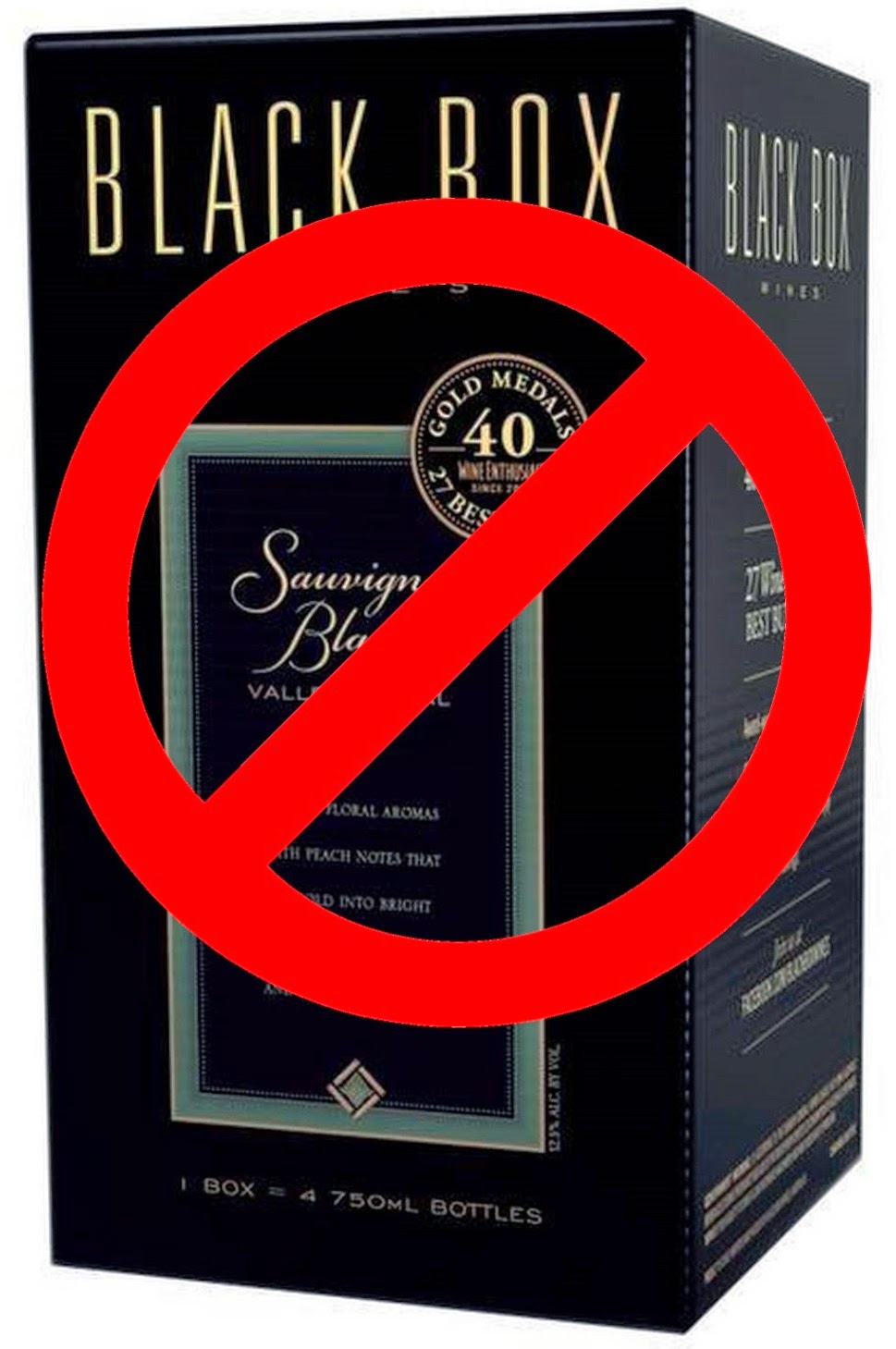
Bye Bye, Black Box

By this point in our online relationship, none of you should be surprised that I keep box wine around the house. As I've said before, I don’t keep it because it’s necessarily great wine. I keep it because I don’t always want to open up great wine. There are plenty of decent ones out there for when you just feel like being an unthinking sipper.

So long, Farewell, Auf Wiedersehen, Goodbye.
With a sense of regret, however, I must report that I'm swearing off the Naked Vine's unofficial-but-most-often-in-the-fridge "house wine," Black Box Sauvignon Blanc.

I'm not saying farewell because the wine's bad. Honestly, it's as good a box white as I've come across in my various samplings and sloshings. No...the problem, honestly, is a mechanical one.

Almost all box wines come with some sort of spigot at the bottom -- all the better to actually pour the wine. A few months back, I got a box of the Blanc just as I'd done on numerous occasions, chilled it, opened it up, poured a glass, and popped the box back in the fridge, thinking nothing of it.

I came back about an hour later to a big ol' mess.

The spigot didn't seal properly, and wine had leaked all over the top shelf of the fridge. Cursing a bit, I cleaned up the mess, laid the box on its back, and figured it was a one-off problem.

Until I got the next box. And the next box. That's three in a row. All leaky. All messy. All making the Sweet Partner in Crime and I very unhappy.

I went away from Black Box for awhile. Tried a couple of other boxes. Figured there might just have been a bad batch floating around. Since the Black Box Sauvignon is a fairly popular wine around these parts, I figured that the law of averages was in my favor. So, right before the Thanksgiving holiday, I decided to shoot the dice and pick up another box. The box got opened at some point during our Big Feed prep. Again, the box sat innocuously on the top shelf, and I didn't think anything of it...

...until the day after our family meal. Yes, another leaky box, and this one had some gumption. I'd estimate that probably a third of the box -- yes, that's a full liter of wine -- leaked into the fridge. Cleanup, as you might guess, was unpleasant with a fridge full of leftovers, stray vegetables, bottles of things, and various other sundries.

If Black Box decides to redesign their spigot or find a new spout manufacturer, I could be enticed to return to the fold. For now, though -- I'm on the hunt for another good box of sluggable white. Any of you out there in Vine-land have suggestions?


Wednesday, May 28, 2014

Sonoma and the Snowball

The Sweet Partner in Crime and I made our first trip to Sonoma County in 2005. Our first stop upon entering the county, before even checking in and unpacking, was at Iron Horse Winery, where we cobbled together a lovely picnic amongst rows of Cabernet Sauvignon vines. We hit a couple of other wineries before making it to our B&B, where we went to a happy hour down in their “speakeasy” of a tasting room. In just half a day, we had learned quickly that we were surrounded by so many good wines…zins, cabs, syrahs, merlots…and I wanted…no, I needed…to try them all. In three days. I saw the light. My mission was clear.

I went a little crazy.

The Origin of Madness
I had some recommendations from my more knowledgeable friends of several wineries to hit and we kept adding to the list as we tried new wines. We zoomed though the valleys, bouncing from tasting room to tasting room like a meth-addled census taker. I thought a dozen tasting rooms a day seemed perfectly logical, starting at the first one to open and running the gamut until they closed up shop. Sure, we covered a lot of ground, but needless to say, this isn’t the most relaxing way to spend a vacation.

To the great benefit of my palate, my liver, and the SPinC’s willingness to keep me around, my strategy has changed a bit in the ensuing years. I have no more illusions about trying to drain the contents of entire valleys. So, on our recent return to Sonoma, rather than trying to run down a bunch of wineries someone else thought would be good, we took matters into our own hands based on our own conversations and connections once we arrived. The Naked Vine Snowball Technique was born.

The Snowball’s central idea comes from a research method called snowball sampling -- a recruitment technique in which participants are asked to assist researchers in identifying other potential subjects. In short, after someone takes a survey, the researcher asks, “Do you know other folks who might be interested in participating?” Those referrals leads to other referrals, growing in number as the virtual snowball rolls down the hypothetical hill.

How does this work with tasting rooms? Start at the place where you’re staying. They live there. They know things. Say something like, “We’re looking for a good place to start. We want somewhere fun, laid back, and not overly pricey.” Replace those descriptors with whatever you want…expensive wines, pinot noir specialists, great gift shop -- whatever floats your cork. You’ll end up with at least a couple of recommendations. Pop in to one of them and do a tasting. Chat. Enjoy. If you feel like you make a connection, then repeat your question to the good folks behind the bar. They live there. They know things. They’ll mention a couple of other places. Those places will mention other places. Patterns form in the recommendations. You now have your guide. Go forth and enjoy.

We wanted a different experience this time around, so we parked it in the actual city of Sonoma, which is in the southern portion of Sonoma County. Our previous trips were to the northern end of the county near Healdsburg, and the surrounding valleys. Sonoma has 26 tasting rooms in and around its city square. (In the past, I might have tried to hit them all.) We found a distinct contrast with those tasting rooms. Most places we’d been, the tasting rooms were basically outlet stores for well-established wineries with very recognizable names. In Sonoma, however, the tasting rooms were generally run by smaller operations at which many didn’t own vineyards themselves. Many of these winemakers bought grapes from vineyards they liked that fit their needs, producing excellent wine. I like that notion. Egalitarian.

We got to town, dropped our bags at the Inn at Sonoma (highly recommended), made a couple of inquiries to get us started, and off we went. Did we hit all 26? Nope. Not even half of them, truth be told. We had a lovely, relaxing time and made some wonderful discoveries along the way. Heck, we barely had to move our car! Here are our top experiences from the trip:


Two Amigos Winery – We remarked that we’ve had good luck with “tastresses” when we’ve started our little treks. Our first trip to Sonoma was kicked off by a woman named Annalise. This time, Michelle was the one to get our trip off on the correct foot. She was there along with Bob, one of the aforementioned “amigos.” The other amigo is an actor named Squire Riddell, whom you’ll recognize if you watched any TV in the 80’s…


He also played Ronald McDonald after Willard Scott headed to the Today show, so plenty of McDonald’s and clown-themed memorabilia adorn the tasting room.

They had plenty of decent wines. Their 2013 Cabernet Sauvignon was fascinating for a wine that young. I’ll be curious how it develops. The other highlights were their Viognier, a port made from Syrah, and a Syrah from GlenLyon – which is Riddell’s other winemaking venture. Needless to say, McDonald’s must have been a pretty good gig. Michelle and Bob gave us the initial seed for the snowball, leading us to a couple of the following tasting rooms. (http://twoamigoswines.com/)


Bump Wine Cellars – We missed throwing our annual Derby Day party because of our Sonoma trip, but we felt right at home walking into Bump’s tasting room to find a beautiful horse-themed art exhibition by an artist named Tej Greenhill. Bump’s tasting room was far and away our favorite, with warm, contemporary décor and comfortable places to relax and sip. Sip we did. Bump was the best value we found in Sonoma. The winemaker, Geordie Carr, specializes in fermenting wines at cooler temperatures to preserve the aromatics. He sources his grapes from all over Sonoma County through friendly partnerships he’s developed in his travels. Their chardonnay was delicate and nuanced with just a kiss of oak. I don’t classify many zinfandels as “delicate,” but Carr’s technique of slightly early picking and cool fermentation yielded a beautifully aromatic wine that drinks like a good pinot – even at 15.2% alcohol. With nothing (currently) in their portfolio over $28, it’s a good time to stock up. (http://www.bumpwine.com/)


R2 Wine Company – Since we’re on a survey research kick, the SPinC, also sometimes known as the Queen of All Regressions, was so very excited to see a winery called R2. The r-square statistic, also known as the measure of “explained variance,” is a key measure of many of her multivariate analyses. While the name of the winery has nothing to do with statistics (it’s named after co-founders Richard and Roger Roessler), the notion of “Sonoma wine variance” shone through here. In tasting through the R2 portfolio, we noticed a distinct difference between wines made from Sonoma “mountain fruit” vs. “valley fruit.” The mountain fruit wines in general had earthier, deeper flavors with a mineral character, while the valley fruit wines had bigger fruit flavors and stronger tannins. We enjoyed their Black Pine pinot noir ($26), which was a delicious general California pinot noir. Their Hein Vineyard Pinot Noir ($48) was “smoketacular!” according to my notes. Their “1331” Cabernet ($54) was a quintessential example of a mountain fruit wine, and it was hedonistically complex. (http://www.r2winecompany.com/)


Bryter Estates – Oh, where to begin with Bryter? If you forced me to pick a favorite from this trip, the top prize would go to Bryter with its collection of nuanced, happy wines. Bryter is one of the few wineries we encountered with female winemakers. Terin Ignozzi, the winemaker and co-owner with her husband Bryan (“Bryter” is a fusion of their names), has crafted a portfolio with great range and exceptional quality. All of their wines -- red, white, and rosé – are exceptionally harmonious and clean. The Sweet Partner in Crime remarked, when we tried their rosé after getting back home, that it “tasted like what our walk in Yosemite felt like – sunshine and fresh air.”

We heard in at least three different tasting rooms that we needed to try Bryter “for their bubbles.” No lie. The “Le Stelle” brut sparkler ($38) is excellent, with a nutty, green apple flavor and a creamy mouthfeel. That would have been worth the stop alone, but as we went down the line, we found more surprises. The “Vivant” sauvignon blanc ($34) is crisp and melony – pleasant, pleasant!. Their “Jubilee” rosé of pinot noir ($32) gets a double plus for the lingering fruit and the touch of oak beneath the clean flavor. Our favorite was their “Cadeau” Pinot Noir ($50). “Cadeau” translates as “gift” and was, simply, the best bottle we had on our trip. My note says, “So subtle, so beautiful.” This wine edged its way in with my faves among the Oregon pinots. A must-not-miss. (http://www.bryter.com/)


Walt Wines – Walt sources grapes from all over the west coast, and they do an interesting array of wines. The highlight of our visit with Liz and Terry, our pourers, was their “850 Mile Road Trip” where they showed pinots from the Shea Vineyard in Willamette Valley, Oregon, “The Corners” in Anderson Valley in Mendocino, and Rita’s Crown Vineyard in Santa Rita Hills. (All $65) The pinot flavors ranged “from brambles to boom!” across these three wines, and the tasting was a wonderful exploration of terroir. They also release a wine each year called “Pinpoint Extreme,” which is an anagram for “pinot experiment.” Last year, they added roasted stems to the fermentation. This year, they flash-heated some of the grapes until they exploded. Fun to try new stuff. (http://www.waltwines.com/)


Hawkes Wine – Memorable wine-wise for a really fantastic licorice-and-dark fruit flavored merlot ($35) sourced from vines planted on a seam of clay in one of the vineyards where nothing else would grow; some very well-balanced cabernets; and an estate-pressed extra-virgin olive oil (proceeds to a local kids charity) that blew us away. Before we went to Hawkes, though, I realized that I hadn’t packed very well, and I needed another t-shirt. Hawkes has a neat logo, so I picked one up to wear on our flight home. On the way to the Sacramento airport from Yosemite -- which followed Sonoma on our itinerary -- we stopped for lunch at a restaurant in Lodi called the Dancing Fox. The waitstaff was mostly male and powerfully metrosexual. At least three of them stopped by my table to ask, “Is that Hawkes Winery?” Lodi is about two hours from their tasting room, so I guess it’s the winery of choice for expensive-yet-casually dressed men. (http://www.hawkeswine.com)
Kamen Estate Wines – Kamen is the child of Robert Kamen, whose name you might not recognize, but you’d know his work. He’s the screenwriter for “Taps,” "The Karate Kid," “The Fifth Element,” “The Transporter,” “A Walk in the Clouds,” “Taken,” and various other films. He bought a property in the mountains with the paycheck from his first screenplay, not realizing that he was sitting on a goldmine. His wines were some of the best we tried on the trip, and they’re certainly not inexpensive. His top-of-the-line, “Kashmir,” runs $100+ per bottle. The Syrah ($75) and Cabernet ($80) are also top notch with layer upon layer of flavor. “Opulent” is as good a descriptor as any. “Darned awesome” would also fit. It’s worth a swing through their tasting room – both to try these wines and to hear Robert’s story, which stands in contrast, and made a very interesting bookend, to that of Two Amigos’ Squire Ridell. Needless to say, a commercial actor and a screenwriter have very different views on how wine should be made and how life lands you in various circumstances. While we were there, we were lucky enough to meet Robert himself, who popped into the tasting room briefly. He struck me as an affably sarcastic M.O.T. -- much the same way I hope people think of me. His "Sin while you can -- otherwise Jesus died for nothing" shirt will live forever in my memory. (http://kamenwines.com/)

In addition to all of the wines that you can sample, the town of Sonoma is home to any number of fabulous restaurants, and we worked our way through several. Try the Red Grape for lunch. La Salette is a Portuguese restaurant with fabulous variety and flavor. The Girl and the Fig is a local favorite – contemporary French. The El Dorado Kitchen does some neat takes on American classic cuisine. One of our favorite dining experiences, however, was the Tuesday night we were there – which coincided with the first Sonoma community farmer’s market of the year. The farmer’s market turns into a big community picnic, so we joined right in with a bottle of Bump rosé. Once things started winding down, many locals head over to Murphy’s Irish Pub for an oyster roast and multiple beers. After a few days of wine tasting, beer made for a great way to close a wonderful stretch of vacation.

Saturday, April 05, 2014

Naked Vine Double Barrel: (Not Necessarily for) Brunch Wines

I’ve long said that brunch is my favorite meal of the day. I find something deliciously decadent about getting up late and having enough relaxed time in the morning to put together a meal that goes a bit beyond a bowl of Cheerios.

With brunch, I’m usually a bloody mary man, although I’ll occasionally nip over to the sparkling aisle to get the makings for some mimosas (especially if I can get some good oranges to squeeze). The folks at Colangelo PR (thanks, Megan!) suggest dispensing with all the prep work for morning beverages. “Just crack a bottle of food-friendly wine!” they suggest. They recently sent a couple of brunchable bottles to Vine HQ for review. Here’s what landed on the doorstep:


Mulderbosch 2012 Sauvignon Blanc – I wrote about the 2011 vintage of this light-styled Sauvignon Blanc from South Africa’s most famous winery last August. I found it quite delicate, flavorwise. It does have a pretty pronounced citrus fruit flavor, but one more in the sweet grapefruit range than many that end up with tart lemon or lime flavors. There’s also a fair amount of creaminess that belies the light body. The finish is more fruity than crisp and isn’t particularly lasting. I can see why this would be recommended as a brunch wine, although at 13.6% percent alcohol, it might be a strong way to start your day. I could see this going nicely with some fruit crepes or other dish that’s got some light cream in the recipe. Pleasant enough to sip on its own, as well. The price has risen a bit from last year – from $13 to around $18.

Berlucchi “’61” Franciacorta Brut Metodo Classico – Sparkling wine with brunch? Now we’re talking! Like many French sparklers, the Berlucchi is made primarily from Chardonnay, with a little bit of Pinot Noir thrown in for good measure. (Of course, I don’t need much of an excuse to crack a bottle of bubbly…) First off, a quick piece of translation. “Metodo Classico,” (“The Classic Method”) is the designation of an Italian sparkling wine made in the same method as the original French “Methode Champenoise,” so a wine like this will be as close as an Italian sparkler is going to get to Champagne. (Here’s a refresher on Methode Champenoise if you need it.)

The result was one of the most gentle sparkling wines I’ve ever tasted. The Sweet Partner in Crime declared this wine “silky” from the style of the bubbles. I concur. This wine is super smooth, with layers and layers of apple, pear, and pineapple. It’s very clean tasting and has just a little citrus snap at the end. Very pretty. We hadn’t had a good brunch occasion because of work and travel, so one night, the SPinC declared she was going to make “brinner,” so we had salmon benedict with a side of some nicely seasoned steamed veggies. I have to say, it was simply marvelous.

Now, this isn’t an inexpensive wine. The Brut retails for about $35, which means that it needs to be a really nice brunch. (The “61” in the name comes from the year of the first vintage of Berlucchi wines.) There is a less expensive “Cuvee ‘61” that retails for around $17, but I haven’t had a chance to try that one yet.

Wednesday, November 27, 2013

Naked Vine Double Barrel -- Geyser Peak Redux

When we checked in with Geyser Peak back in the summer, they were rolling out some new packaging, logos, and such to bring their California heritage to the forefront. Now, as winter party season rolls around, Geyser Peak is adding Pinot Noir to their stable of wines, which currently includes Chardonnay, Pinot Grigio, Merlot, Sauvignon Blanc, and Cabernet Sauvignon.


Geyser Peak’s selections are what I would term “walking around wines” – wines that you might have at a party when you’re walking around, chatting with folks, and not really thinking too much about what’s in your glass at the time. In general, these are wines with basic varietal character, not too much complexity, and straightforward flavors. They’d also make decent tables wines, in my experience.

Initial thoughts about the new Geyser Peak 2012 Pinot Noir? In my judgment, it’s just OK. The nose hasfairly strong cherry and wood aromas. After even a couple of sips, it tasted a little disjointed, like the flavors sort of careen around your palate without a lot of focus. There are some rich raspberry and cocoa flavors, but that’s about it. There’s almost a “hitch” in the wine’s flavor as it goes towards the finish. There’s a little smokiness at the end, but it almost tastes a little artificial – like Liquid Smoke flavoring. It’s definitely drinkable, but it’s certainly not going to make anyone shake their head and go “Yes! This reminds me of a fine Burgundy. Get me another bottle of this immediately!”

The Geyser Peak 2012 Sauvignon Blanc was a little better. It seemed a little different from the bottle I sampled back in July. There are some lime, floral, and melon scents on the nose and the palate is an acidic blend of grapefruit and more of that melon flavor. The crisp finish winds up a little bit on the grassy side, so if you like a New Zealandish style of Sauvignon Blanc, you’ll probably not be disappointed with this one. The finish on the bottle from the summer seemed more fruity to me than the acidic zip of this one.

For some reason, I had in my head that both these bottles retailed for around $8, which would have made them very solid wines for that price. Going back over the promo materials, I saw that the Sauvignon Blanc retails for $10-12. Certainly a reasonable value. The pinot noir is a $15-17 bottle, which I honestly feel is about five bucks too expensive. You can find better pinot noir at that price point. Think of it as Geyser Peak working out the kinks in the process. I would expect the 2013 to be better.

Are You Ready for Party Season?

(Reposting, since I've had a few requests for this...)

The stretch from Hallow’een to New Year’s is often the most heavily-packed time on most folks’ social calendars. Makes good sense, after all – weather’s getting colder, so we tend to gather in groups with libations in hand to have the occasional dinner party, watch some sports, gather with friends, and basically try to stockpile enough levity to get us through the bone-chilling days before Spring comes back ‘round again.

Whether you’re hanging with your friendly neighborhood ghosts and goblins, gathering for a girls’ or boys’ night, or just finding some excuse to be social, you’re going to need some wine, now aren’t you? Based on some recent samplings I’ve been lucky enough to get my hands on, here are a few suggestions for different occasions you might consider without breaking the bank.

Brunch

Still one of my favorite meals of the day, no matter what time of year. For brunch, you want something low-alcohol and festive. By festive, I often mean “something with bubbles.” One of my favorite brunch wines is Prosecco, and I’d put forward the Zardetto Prosecco Brut Treviso DOC as a possibility. Flavorwise, it’s on the peachy end of the scale along with a nice mineral character. Good firmness on the bubbles, too. I think it would be really in its element either as an aperitif, alongside a fruit and creamy cheese plate, or with a cheesy omelette or some crepes. Also, if you're a fan of bubbly as part of a cocktail -- like the prosecco and pear nectar drink above, it would work nicely as a mixer.  At $14, it’s a very solid value.

Tailgating
Your tailgate may not be this fancy.
“Deer lawrd, man – you’re bringing wine to a tailgate?” Well, hells yes, I am. Admittedly, you’re going to be just fine with an armload of beer and bratwurst – but meat or meat substitute cooked over flame goes splendidly with wine as well. Take a tip from the Germans here – they know their sausages. Besides beer, Germans drink a ton of Riesling. The Clean Slate 2012 Riesling Mosel for $11 is a workable choice here. There is some sweetness here, but it’s in the “honeycrisp apple” family of sweet. Alongside the orange and peach flavors in the body is a fair amount of the mineral implied by its moniker. It finishes sweet and a tad acidic. Overall, it’s really pleasant to drink and I think you could have this with any kind of sausage.

But perhaps you don’t want to be seen drinking white wine before a football game. I get that. No worries, comrades. Grab a bottle of Ravenswood 2011 "Napa Valley" Old Vine Zinfandel before heading to the parking lot. Ravenswood is a consistently solid bottle of red that goes very, very well with anything that you can drag or let stand across or near flame – whether it’s steak, burgers, chicken, pulled pork, barbecue ribs – even a quinoa burger if you’re into that sort of thing. Plunk your $14 down and enjoy.


The Casual Shindig

Here are a few wines that you really don’t have to think about very much. They’re simple, uncomplicated, and you can pour away without worrying about anything other than which bedroom your left your coat in when you got there.

For a flexible white, consider the Pepi 2012 Sauvignon Blanc for a tenner. Many inexpensive sauvignon blancs end up being tightly wound acid balls that work better at poolside than in the middle of autumn. This bottle is much balanced and friendly than the price point implies. The nose is full of pineapple and green apple. The body is fruity and citrusy, and the acidity never really becomes sharp – even through the lingering, citrusy finish. An easy pop and pour.

On the red side of things, especially if there’s some food around, I’d really recommend the Tin Roof Cellars 2010 Merlot – also at $10. The 2010 is a clear upgrade over the 2009 I reviewed last year, which wasn’t a favorite. This year, they’ve added a little bit of cabernet sauvignon and syrah to the petit sirah already in the blend. The result was a merlot with considerable structure and a much better fruit/tannin balance than last year’s. You get some coffee and cocoa flavors to take the edge off what had been a fairly “fruit-bomby” offering. From a value perspective, it’s drinking well beyond its price point and it’s flexible enough to serve as a worthy table red for almost any occasion.

If you’re hosting a party and you need some wine to have around in bulk, I’d suggest the Naked Grape Pinot Noir in a 3-liter box. Let’s be honest – this is a $20 box of wine.  It’s not going to blow you away as a pinot noir if you’re looking for smoky and sultry. It’s very straightforward and fruity – largely cherry and blueberry – but those fruit flavors linger all the way through a fairly soft finish with just a smidge of tannin. It’s a $20 box pinot noir – I wasn’t expecting big, complex flavors when I tried it. What I didn’t expect was just how dangerously drinkable it turned out to be. It’s relatively low in alcohol and easy to knock back – easy enough, in fact, that we powered through the box more quickly than almost any box wine I can remember. If you want to class it up a bit, pour it out into a carafe. Your peeps will think you’ve got style.

Dinner Party

Assuming most of you aren’t doing the whole white tablecloth thing, here are a couple of laid-back choices for your dining pleasure. For a red, I would consider at $13, the Poggio Anima 2010 “Asmodeus” Nero d’Avola. Asmodeus, as any owner of the original Dungeons and Dragons “Monster Manual” can tell you, is the Lord of Hell. I doubt the terroir for this wine is quite that intense, largely because brimstone is not part of this wine’s big, bright flavor. My first impression was of blackberry and cherry on the nose and palate. It’s medium-to-full body, but it’s not as “sticky” as a similarly bouqueted Shiraz would be. Instead, the finish leans out, turning first to a nice tannic dryness and then into that mineral character that many Italian wines possess.

In the pink wine family, look for Mulderbosch 2012 Cabernet Sauvignon Rosé. My initial note for this wine says, “a rosé of substance.” I found plenty of strawberry and peach on both the nose and palate along with just a hint of sweetness. It finishes long and fruity, with just a little acidic zing. I thought it made a quality table rosé. With a hearty and flavorful meal (think Thanksgiving dinner), this $11 number from the coastal growing region of South Africa was very pleasant to have in the glass alongside.

Finally, for a white, I give you the $10 Le Drunk Rooster 2011 Chardonnay. After a little air opens it up, a considerable amount of oak starts to emerge. I’m not talking Meridian Chardonnay levels of oak – more like a Mersault from Burgundy (although it’s not creamy like a Mersault). It’s got a tart, green apple character on the palate with a lasting oaky finish. Even as light-bodied as it is, the backbone allows it to stand up firmly next to some pretty hearty fare. We poured this with a chicken and Italian sausage casserole, and it worked just fine.

Party on, folks!

Saturday, October 05, 2013

The Deal with O'Neill

“Just in time for the holidays,” started the release that accompanied the latest set of samples from O’Neill Vintners – California-based makers of Tin Roof, Camelot, Martin & Weyrich, and Pepi wines, all of which have crossed the Naked Vine’s tasting table at one time or another because of the good folks at Balzac Communications. (Thanks, Stacey!)

The set contained wines from three of these labels – all relatively inexpensive bottles squarely in the “take to a party” or “crack at a casual dinner gathering” category.

How were they?

Camelot (NV) Pinot Grigio – A set of Camelot samples came to our rescue during our recent kitchen remodel, but this pinot grigio was not among that set. “It’s peachy,” were the first words out of my mouth at my first taste of this inexpensive white. I’ll say this for it – it’s certainly got more body and fruit than many wines at this price point. Most cheap pinot grigio tends to be fairly mild and almost watery. Not so much here. The nose and flavors, as I said, lean peachy. The finish is a bit odd. There’s a little bit of a bitter undertone that seems to be covered by the addition of a little residual sugar. We are talking about a $7 wine here, so nitpicking the finish is a bit much. It’s drinkable enough if you’re not thinking too much.

Martin & Weyrich 2012 Riesling Allegro – This Riesling is from the same label as Moscato Allegro, which I reviewed about a year and a half ago. This wine is more for fans of slightly sweeter whites. I will say that it’s got some interesting characteristics, especially
on the finish. I thought it started much like a typical demi-sweet Riesling, with flavors like honeycrisp apples and some solid weight on the palate. However, rather than simply having a smooth, sweet finish, this one finishes with a little bit of a lemony zing as well, which was an improvement. The usual Riesling pairings go here – fruit, cheeses, and spicy Asian dishes. We had this alongside a spicy beef and rice noodle salad and it worked just fine. I think it’s a decent value at $12.


Tin Roof Cellars 2010 Merlot
Tin Roof Cellars 2012 Sauvignon Blanc

I sampled Tin Roof’s previous vintage last December. Their sauvignon blanc appears to be a model of consistency. I wrote this review for the 2011: “At first sample, some slightly herbal overtones led to a green apple scented nose. This wine’s mouthfeel has pretty reasonable weight with tart apple and lime as the major flavors. The finish has a bit of an acidic bite, but that’s what you’d expect in a sauvignon blanc. I found it flavorful and drinkable…” My notes (and no, I didn’t cheat) were almost word for word for this year’s entry. Sauvignon blancs run the gamut – so if you really like an acidic style, this might work fine for you. For $10, you’re getting a pretty good deal on a straightforward, food-friendly sauvignon blanc.

The 2009 Merlot wasn’t one of my favorites. I thought it was a pretty good food wine, but it left me cold on its own. Whether my review had anything to do with it or not, I tip my hat to the Tin Roof winemakers. The 2010 is a clear upgrade. They’ve added a little bit of cabernet sauvignon and syrah to the petit sirah already in the blend. The result was a merlot with considerable structure and a much better fruit/tannin balance than last year’s. You get some coffee and cocoa flavors to take the edge off what had been a fairly “fruit-bomby” offering. From a value perspective, it’s drinking well beyond its $10 price point. With food, it’s flexible enough to serve as a worthy table red for almost any occasion. We had it with a beer-braised chicken with lime beans and peas in a creamy sauce. Reds are good chicken accompaniments in certain circumstances, and this turned out to be a very nice pairing.

Saturday, September 28, 2013

Just in Time for the Playoffs – Joe Morgan’s W1NE for One

Wine at Great American Ball Park? Really?

Walk into GABP and you’ll run across a cornucopia of food and drink options. At its heart, though, Cincinnati is a dog-and-a-beer sort of town. That’s why I was a little surprised to see Lance Lambert’s recent article in the Enquirer about W1NE for One, a partnership between Steelhead Vineyards and one of the Reds’ favorite sons, Hall of Famer Joe Morgan.

W1NE for One (which is currently driving my spellcheck bonkers) is marketed as the “next generation of single serve wine.” I’ll admit – it’s like nothing I’ve seen before. The wine comes in a plastic 187ml screwcap bottle. The “cap” is actually the bottom of a plastic wine glass – so there’s no need to pack along additional glassware and you actually get to feel like you’re drinking a glass of wine while you’re out, rather than surreptitious sips out of a Solo cup. I think it’s a great concept for picnics, hikes, concerts, and other such out-of-the-house situations.

Morgan, who became interested in wine during his stint with the San Francisco Giants (where he once made a barrel of wine under the instruction of Robert Mondavi), thinks the New Zealand-designed bottles are the key. “This wine is great for a setting where you are around a lot of people, or somewhere you might bump into people, because of the bottle’s size,” he told Lambert.

After reading the article, I shot a note to Steelhead Vineyards. Katy Leese, who owns Steelhead with her husband Dan, was good enough to send me some sample bottles of W1NE for One, as well as a couple of other Steelhead wines available in the Cincinnati area.  

W1NE for One comes in two versions:

Steelhead Vineyards 2012 Sonoma County Chardonnay
Steelhead Vineyards 2012 Sonoma County Merlot

If I wanted to, I guess I could give you detailed tasting notes. Honestly, that’s not really the point of these wines. These are to be cracked and poured when you’re thinking about something else -- and in this case, “something else” could easily be an 0-1 pitch to Joey Votto with Shin-Soo Choo on first and two out in the bottom of the sixth while you’re having a conversation with a buddy sitting next to you. In that environment, who’s really paying attention to bouquet, finish, and whatnot? My quality requirements are simple. I want to take a sip of something that tastes decent without worrying that I’ll go, “Ew.”

These wines fill that bill. Neither one is going to blow your doors off. The merlot is solid and standard in the flavor department. It’s got pretty decent plummy fruit with enough tannin to give it a backbone. The chardonnay is a mild California version. There’s some creaminess, some gentle apple flavors, and a little more oak than is my typical preference. I preferred the merlot, but I wouldn’t turn down either one of them if someone offered them to me. Will these wines replace beer as my gametime beverage of choice? Not likely. But I could certainly see times when these wines – and their super convenient delivery systems – would be just what the doctor ordered.

Unfortunately, with the potential of the playoffs upon us, I wasn’t able to do what I *really* want to do with these wines. If a ballpark’s going to be offering wine as a beverage option, then the wine should be enjoyed in its natural state – paired with ballpark concessions at GABP. I want to know how these wines taste with a loaded bratwurst, nachos, ballpark peanuts or funnel fries. You know, for science. The public deserves to know. So, if the Reds have the good fortune to be back at GABP for the playoffs and you'd like to do some advance scouting – the Vine wants your comments.

(And if you don’t know what funnel fries are…you’re missing out. Mo Egger, one of the hosts on ESPN1530, turned me on to these things. They’re stop-your-heart delicious.)

W1NE for One will set you back $10 at GABP. For reference, a 187ml bottle is one-quarter of a full-sized bottle – so a little more than a standard glass. Ballpark pricing, after all. In local stores or on the Steelhead website, you can get a case of 24 individual bottles for $96. Steelhead donates part of the proceeds from the sale of each bottle to various conservation efforts.

Steelhead also sent us two other wines, both of which normally retail from $12-15:

Steelhead Vineyards 2011 North Coast “Steelhead Red”
Steelhead Vineyards 2012 North Coast Sauvignon Blanc

First up, the Steelhead Red. This red cuvee is a little curious, flavorwise. It’s a fairly substantial wine that comes on strong with plum and blueberry fruit. That flavor kicks into cherry in the middle, and finishes with a good balance of fruit and tannin. I wondered at the time if it might be some sort of Zinfandel-based blend, and after checking the specs, I was dead on. It’s about 70% Zin, with petite sirah, syrah, and a couple of other grapes rounding it out. I preferred it with food to sipping it on its own. Think about it as a “California Barbera” pairing-wise. Barbera goes really well with red sauces and spicy meats, like sausages, as a rule. We had this alongside homemade pizza with a goat-cheese blended red sauce, salami, basil, and lots of garlic. With those flavors – meat, spice, richness – it was a champ. I’d get it again for that alone.

The sauvignon blanc is one of the lighter ones  I’ve tasted in awhile. “If I tried this blind, I might think it was a pinot grigio,” quipped the Sweet Partner in Crime. It’s quite light, with a nose and flavor of pineapple and grapefruit. The finish starts tart and finishes up with just a little bit of sweetness crossed with lemon rind. I’d put it in the “serviceable, flexible quaffer” category. By itself, it’s in the pool wine category, but it went along happily enough with a cod-based fish stew with potatoes, fennel, and garden tomatoes. Would be a little pricey at $15, but if you can find it for $10 and you want something light and food-friendly, you can be comfortable snagging it.

Sunday, September 15, 2013

Turkish Delight III -- Wines of Turkey: Sevilen Winery

Our tour of Turkish wines takes us to Izmir in the heart of the Aegean winemaking region and one of the “older modern” wineries in Turkey, Sevilen Winery.
 
courtesy Sevilen Group

Sevilen celebrated its 70th anniversary last year at the Isabey Vineyard and Winehouse, Sevilen’s on-site fine dining restaurant. The winery was founded in 1942 by Isa Guner, a first-generation immigrant to Turkey from Bulgaria. Guner’s travels in France planted the mental seeds for Sevilen, and the vineyards sprouted soon after. Now managed by third generation of the Guner family, Sevilen draws upon the winemaking expertise of Florent Dumeau, a consultant from Bordeaux, to produce its wines; as well as a partnership with a Turkish university to create better barrels from French oak.

Sevilen Winery, Manesia, Turkey
Sevilen’s estate-grown grapes are sourced from two main Aegean areas: from the coastal region around Izmir and from the Güney plateau somewhat farther inland. The two areas are climactically different. Izmir is warmer, similar to the weather around Athens – while Güney, at an elevation of 900 meters (about half a mile), has a climate closer to the Rhone region of France.

[Follow the series: Turkish Delight I -- Background and Kavaklidere Wine ; Turkish Delight II -- Arcadia Vineyards ; Turkish Delight III -- Sevilen Winery; Turkish Delight IV -- Vinkara Winery]

We received samples sourced from both of these areas. We did the sampling a little differently. As part of the package, we had pairs of Syrah-based and Sauvignon Blanc-based wines. Each was from a slightly different terroir, so we tasted those side-by-side to check out the contrast. We also had two other wines, a rosé and a Kalecik Karasi, a Turkish indigenous wine. Word to the wise if you get a chance to try Turkish wines. These wines really require some air to reach their full potential. Decant the whites for at least 15 minutes and the reds for half an hour or more. Let’s start with the side-by-sides:


Sevilen 2011 Sauvignon Blanc Denizli-Güney
Sevilen 2011 “900” Fumé Blanc Güney

This pair of Sauvignon Blancs provided an interesting contrast. (Just for information’s sake – Fumé Blanc is just another name for Sauvignon Blanc.) The “non-numbered” wine, which runs about $15, is almost austere until it gets enough air. Once it had time to breathe a bit, it settled on my palate with plenty of lime and apple. I found a fair amount of tropical fruit on the lean body along with a powerful backbone of mineral. It reminded me a lot of Muscadet with more tropical flavors.

The 900, which is only available in limited quantities for around $25, was one of the more interesting wines I’ve had in awhile. “It tastes like a margarita!” exclaimed the Sweet Partner in Crime, and she didn’t mean that in an “I’m on the beach in Mexico” manner. The nose is lime and green apple, with some more apple on the palate initially – but the finish becomes a rocketship of lime and mineral that made me pucker. Even after lots of air (and even the next day), there was enough lime in this wine to cure scurvy. If you like really acidic sauvignon blanc, this might be a wine for you. I didn’t mind it, but the SPinC had a strongly negative reaction.

With food – specificially shrimp roasted in herbs -- the less-expensive Sevilen was the superior wine. I’d get that one again. I’d probably pass on the 900.

Sevilen 2009 “Centum” Güney-Denizli Syrah
Sevilen 2007 “Premium” Izmir/Menderes Valley Syrah/Merlot

The Centum is a full, rich, opulent wine. It’s a full-tasting wine without being too overly heavy. I found lots of dark plummy fruit and exceptionally well balanced tannins. The texture on this wine was lovely. There’s a big nose of vanilla and caramel. I thought this was a really nice wine, and the description of similar terroir to the Rhone is apt here, as the flavor ends up in the neighborhood of a high-quality Cotes du Rhone. It also calls out for Big Food. We grilled up some lamb burgers and sautéed up some potatoes to go alongside the pairing. The Centum was exceptionally good with the burgers. It also worked well with some strong Roquefort cheese that we tried for dessert. It retails for around $30.

While both these wines need air, the Premium does especially after we discovered its flavor does something uniquely odd. At first, it was very pleasant – not too heavy, nice spicy fruit, and a balanced nose of blueberry, cinnamon, and a not-unpleasant scent of roasted meat. It was more tannic than the Centum. After about 15 minutes, the nose’s fragrance utterly vanished. The wine had flavor but no scent, which was weird. Another 15 minutes later, the nose changed to something that smelled like wet brown paper towels like you’d find in a grade school – and then it returned to normal. (Interestingly, the Centum did something similar after being open for a couple of hours – but the “nose neutralization” didn’t last as long.) The Premium wasn’t bad on its own. It wasn’t as good with the lamb, but with the potatoes it was actually a better pairing than the Centum. Go figure. (Note: I couldn't find a price point for the Premium.)

Sevilen 2009 Kalecik Karasi Denizli-Güney – Kalecik Karasi has become one of my favorite Turkish indigenous grapes, but definitely take heed of my “let these Turkish reds breathe before you drink them” advice with this one. After only a few minutes open, it’s tannic and almost sour. There are few wine metamorphoses I’ve experienced more dramatic than this wine has after decanting and some solid swirling. The tannins and tartness mellow and blend into a fragrant nose of vanilla, plums, and fresh cut wood. The body is fullish, with tarry, black fruits abounding. The finish is full of coffee and more dark fruit. We were making kebabs the night we opened this because I figured, “Hey! Turkey! Kebabs!” With the ingredients we had around, the meal’s flavors ended up being much more Cajun than Mediterranean in nature, especially with a side of red beans and rice. Even alongside those spices, this was quite a nice pairing. I would recommend it, especially at $15.  


Sevilen 2010 “R” Syrah-Cabernet Sauvignon Rosé Izmir/Menderas Valley – A very pleasant, straightforward rosé, and the first of the Turkish wines that didn’t require at least 10-15 minutes of air when opened. There’s a very pleasant peach and vanilla nose. Those flavors are echoed on the palate, which is on the lighter side and gently fruited. Weightwise, it’s along the lines of a Cotes du Rhone rosé. The finish is soft, slightly grapefruity, and lasting. An excellent choice with many foods, too, I would imagine. We had this alongside a “Spanish Mixed Grill” – chorizo sausage, chicken thighs in an adobo-lime-garlic marinade, and yellow rice. The fruit held up just fine against those spices and flavors. I’d certainly give this a second try. And it’s very reasonable at $13.