Tuesday, November 27, 2012

Cooper’s Hawk Winery and Restaurant – A Model of (and based on) Consistency


I was invited to attend the recent grand opening of a Cooper’s Hawk Restaurant, an “upscale-casual” restaurant boasting a tasting room at each location – all the better to serve their house wines. The tasting room is just the start. The wines apparently have enough of a following that Cooper’s Hawk has a wine club – according to them, the largest of its kind.

Illinois-based Cooper’s Hawk currently has 10 locations – seven in the greater Chicago area, one in Indianapolis, one in Milwaukee, and their newest location in Columbus, Ohio. Locations in Cincinnati, Kansas City, and Tampa are scheduled to open during the next year.

Unfortunately, I wasn’t able to attend the opening – so I can’t attest to the quality of the food (although the menu looks fairly wide-ranging and interesting). But thanks to Jennifer at Wordsworth Communications, I was able to obtain a couple of Coopers Hawk samples and score an interview with Rob Warren, the winemaker.

Rob, a native of Port Hope, Ontario, got his start working in wineries both north of the border and in northern Virginia. In 2007, he met the CEO of Cooper’s Hawk, Tim McEnerny, at a trade show. “We just got to talking and really hit it off. He said he was looking for a winemaker and I interviewed for the position. Next thing you know, here we are!”

These...and 36 more!
Cooper’s Hawk has a very large catalog of wines. Their basic list of wines, including vinifera, fruit wines, and sweet wines, numbers about 40. Then there are the wines for the wine club. “We make 12 wines just for the club each year.” These wines tend to be lesser known varietals and blends, crafted especially for members who are usually looking for something a little different.

The blends seem to be where Cooper’s Hawk hangs its proverbial hat. “We try not to limit ourselves on the blends. Most wineries are limited to their own vineyards, or even their own region. I like finding combinations across terroir – like blending Washington and California grapes, for instance. We just do whatever we can come up with that we think will be awesome.”

According to Rob, the blends are the most popular wines in the catalog. “Among the reds, we do a blend of pinot noir, malbec, and barbera that people seem to like, as well as our cabernet sauvignon, cabernet franc, and zinfandel blend. Among the whites, our pinot grigio/riesling blend is a big hit.”

I asked Rob about the challenge of making wines for such a broad audience – a big wine club and a growing restaurant chain featuring his wines. “Our wines are made to be enjoyed right away, so I try to make something you can open, pour, and enjoy. I try to find a basic profile for a wine that I hope people will like. Once we know the profile we’re looking for, we can almost always match them up from year to year. Since we’re not limited by vintage dates or appellations, we have the flexibility to create consistent wines.”

Rob said that his real goal is to make wines that people enjoy enough that they’ll join the club. “Once they know they can get quality wine from us, we want them to join. They get discounts at the restaurant, and they can buy any of the 40 wines on the main list at a discount. We’ve got some other neat promotions for club members, too.”

Cooper’s Hawk sent along a couple of bottles, one white & one red, for me to try. Neither of them were the popular blends Rob mentioned earlier, so I may have to visit one of the restaurants to check them out in the future. My thoughts on the two bottles:

Cooper’s Hawk (NV) Gewurztraminer – Very aromatic. Lots of tropical fruit scents on the nose – especially pineapple and papaya. This wine is definitely modeled after a “new world” Gewurztraminer. Tthe full, thick body has a fruit-cocktailish flavor of pineapple, apple, and that specific flavor of lychee. Quite full bodied, the finish turns slightly bitter at the end after some sweeter papaya flavors. On its own, it was OK. With a spicy Thai-flavored chicken soup, it worked well. The thickness of the body kept the tropical flavors from being overrun by the spices. The wine would be a nice pairing with most foods that register on the Scoville scale.

Cooper’s Hawk (NV) Pinot Noir – I wouldn’t necessarily agree with the “pop and pour” sentiment of Rob’s here. I thought this wine needed some time to open – otherwise, it came across as almost watery. After about 45 minutes of air, the fruit started to open up a bit. Even so, it’s an extremely light pinot. There are cherries and some soft wood on the nose, followed up with a light cherry flavor on the body. That’s most of what I got. The finish was light, a little smoky, and soft. There are some tannins that emerge eventually. It has the basic flavor profile of a pinot, but it’s not complex by any stretch of the imagination.

Pricewise, the wines retail at the restaurant from $15 to 40. The pinot noir I tried retailed for $22 and the Gewurztraminer was $18. I think both are a bit high for what you get, although if I’d bought either of those in a restaurant at those prices, I’d think I was getting a real deal – considering what the markup usually is. The wine club prices are $18.99 for one bottle monthly or $35.99 for two. There’s also a shipping option, where members would receive either 3 or 6 bottles quarterly for $80 or $140 respectively.

For more information, restaurant menus, wine lists, and the like you can check out the Cooper’s Hawk website at http://www.coopershawkwinery.com 


Wednesday, November 14, 2012

Naked Vine One Hitter – Back to the Big House: Grü-V


Back in August, I wrote about a sample pack I’d received from Big House Wines. Big House, as many of you know, is a widely available, relatively inexpensive wine – often seen in octagonal boxes. As such wine goes, it’s not bad at all.

While perusing the website for additional information, I saw a wine I’d never heard of – a white wine adorned with a caricature of a hippy handing a flower to one of the prison guards. The wine was Big House “Grü-V” Grüner Veltliner.

I make no bones about loving Grüner Veltliner. This Austrian white is a summertime staple of mine. Good Grüner is like drinking happy rocks. Austrian ones are super-minerally with lots of citrus. They’re light bodied and have a particular pepper flavor on the finish. Needless to say, I shot a message to the good folks at Folsom to see what was going on there. Apparently, Grü-V is launching in a limited capacity, so it’s not arrived in many stores yet. Expect to see it during the next year.

What would California’s climate do to Grüner grapes, I wondered. The answer? Create a light, flavorful wine. The nose reminds me of fresh pears and the body is soft and citrusy, rather than lean and almost metallic. There’s some mineral there, but it’s not nearly as strong as the minerality I was used to with the Austrians. The mineral picks up a little bit at the finish with just a hint of that peppery calling card and some peachy flavors.

It is quite drinkable. I would imagine that it would be a very nice everyday wine, especially if you got it in in a large format container. However, it didn’t have the strength of varietal character and complexity that I’d probably go for if I were specifically going after a Grüner. That said, don’t knock this – it’s very decent and, at $10, it’s considerably less expensive than its Austrian counterparts. It’s not a bad wine to pull if you’ve never tried a Grüner Veltliner and you want to get a basic idea of what they’re about – or if you want something simple and a little different.

It also makes a very flexible food wine. Grüner is one of the few wines that can handle odd-flavored curries, asparagus, and the like – and the hint of sweetness in the body of this wine makes it a skeleton key for challenging food pairings. I could see this as a crowd pleaser at a laughter-filled casual meal.


Monday, November 12, 2012

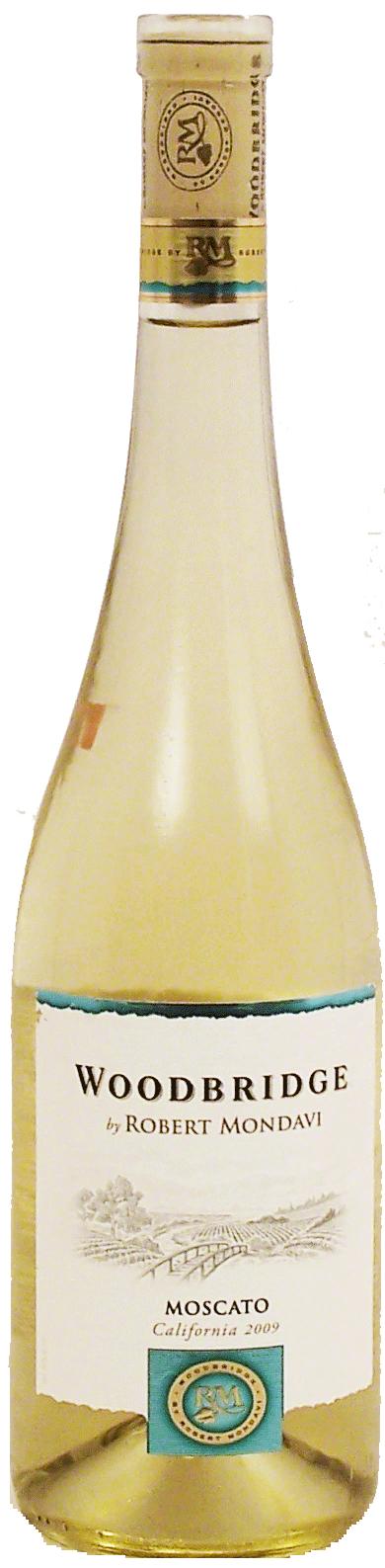
Naked Vine One-Hitter: Woodbridge by Robert Mondavi Moscato


Another offering from Robert Mondavi thanks to the folks at Folsom & Associates – this time their "Woodbridge by Robert Mondavi" series.

I’ve written a few times about Moscato d’Asti, for many years the most common version of the wine available. From the Piedmont region in Italy, this sweet, aromatic wine was a niche product for quite a while. Over the last couple of years, fans of sweeter wines have latched onto Moscato, making it the second most popular white varietal behind chardonnay. California production of Moscato has almost tripled, fueled by this demand and hip-hop shout-outs. (“I'm a’sip Moscato/And you 'gon lose them pants,” raps Wale.)  

While I can’t speak to its aphrodisiac qualities, Moscato is a marvelous brunch wine. Brunch is largely filled with mishmashes of strong flavors. Sausage next to salsa next to asparagus? Very possible. In my estimation, a sweet, relatively uncomplicated wine like Moscato works well. The food is the star of brunch. Wine just needs to taste good while staying out of the way. When I drink Moscato, what I’m looking for is the quality of the sweetness – is it more of a “honey” sweet or a “sugar” sweet. I prefer the former.

Woodbridge’s version does have the honey sweetness. Lots of peach and pear flavors ride on a full, slightly glycerine-thick body. The nose is peach-blossom floral. The finish is very peachy, with just a little bit of bitter right at the end. If you’re having this with food at all, you won’t notice that. Like all Moscato, it is an extremely flexible food wine. Everything from charcuterie to hash with egg on top go just fine alongside.

I always enjoy when wineries send along suggested pairings, recipes, and the like to go alongside the vino. On this occasion, The folks at Folsom & Associates sent a recipe using this wine as an ingredient for making peach preserves. The recipe sounded fabulous, but I don’t use a lot of jam and such. (I’ll still include the recipe below…)

However, one of the other included suggestions was to use it for pickling. I sliced some cucumbers into spears and pickled them with equal parts Moscato and champagne vinegar, with a hot pepper, salt, and dill thrown in. You know what? It turned out to be downright delicious. If you have some leftover Moscato, consider it!

For the price, $8, it’s a decent-enough wine. It’s not going to blow you away, but it doesn’t have to. I think I still prefer  the Italian version with its slight effervescence, but I wouldn’t turn down the Woodbridge if you poured it for me.


Sweet Peach and Moscato Preserves
Styling + Recipes by Candice Kumai
Photo by Emma Chao

Ingredients
8 Ripe peaches, sliced ½" thick
3 Cups sugar
2 Tablespoons fresh lemon juice
Rind of 1 lemon, peeled into large pieces using vegetable peeler
1 cup Woodbridge by Robert Mondavi Moscato
½ (3 oz.) packages liquid sure gel pectin
1 Tablespoon mint, sliced into thin ribbons
6-7 Sterile ½ pint mason jars with lids

Instructions
1. In a medium stockpot, combine peaches, sugar, lemon juice, lemon rind and Moscato, bringing to a boil. 
2. Stirring gently, reduce to a slow simmer over medium heat. Cook 45 minutes, stirring occasionally.
3. Some foam may appear at the top of the pot, using a spider or a slotted spoon skim off the foam and discard. Remove lemon rind with a fork.
4. Add mint and cook for an additional 2-3 minutes.
5. Remove from the heat and add the liquid pectin stirring constantly. Return to a full rolling boil and cook for 1 minute. Quickly and very carefully ladle the preserves into sterilized jars, leaving 1/2 in head space at the top.
6. Place the lids on top of the jam jars. Carefully twist on the tops.
7. To Seal: Gently, place the jars in a large stockpot full of boiling water. Make sure that the jars are fully submerged in the boiling water. Let it sit in the simmering water for 10-15 minutes to set. Jars should seal by then. If not, they will seal while cooling.
8. Remove jars after 10-15 minutes, set aside to cool and set. You will hear a “pop” noise when jars are sealed.
9. Allow jars to set for 24 hours before opening.

Monday, October 22, 2012

Österreichischer Rotwein (Red Wines of Austria)

Quick…”Austria” – what just popped to mind? The Hapsburg Dynasty? Any one of a list of composers longer than my arm? A certain ex-governor of Gully-fornee-uh? Probably. How about wine?

“Aha!” a couple of you might say, “I thought about wine! That groovy sounding grape Grüner Veltliner.” Well, bonus noogies for you. You’re absolutely right. Austria wasn’t exactly a major player in the world of wine until the last decade or so as more and more folks discovered that umlaut-speckled, mineral-slathered bottle of deliciousness. About half of the wine made in  Austria is white, with Grüner making up two-thirds of that. Austria is on a similar latitude as Alsace, and the mountainous terroir yields lean, minerally, acidic wine.

Austria actually has a long history of winemaking. There’s archeological evidence of wine production as far back as 700 BC in Austria. Through the Middle Ages, wine production waxed and waned, depending on various invasions, religious incursions, and various pestilence. In the 19th century, Austrian wine really hit its stride – only to be laid low by that little louse phylloxera. Austria bounced back quickly, though – and after World War I, Austria was the third-largest wine producer in the world, selling largely to other Central European countries.

In the 1980’s, though, everything came crashing down because of a scandal in the Austrian wine industry. Austrian wines are generally acidic, light-bodied, and minerally. Some enterprising winemakers discovered that the taste could be “fattened up” a bit by adding small amounts of diethylene glycol to the wine. The more common term for diethylene glycol is...well…antifreeze.

Needless to say, this did the Austrians no favors. Even though there were only a small number of producers following this creative production method, many countries out-and-out banned Austrian wine. In the 1990’s, Austria set up a control board for their winemakers to ensure quality. As a result, more care was taken in general in production of wine, and a higher-quality product resulted. Quality versions of Grüner reopened the gates for Austrian whites, and over the last five or six years, there has been an increased demand for Austrian red wine.

Austrian reds are largely autochthonal varietals (you may remember this term, meaning “native grapes,” from our profile of 20 Mondi). These grapes, alas, don’t roll trippingly off the American tongue. Asking for “Blaufränkisch,” “Zweigelt,” or “Sankt Laurent” is likely to cause an accidental spray of saliva in the face of your unfortunate local wine salesperson.

I’d encourage you to practice your Germanic pronunciation, however, as there are some tasty offerings out there. So you know, the pronunciation of Blaufränkisch is “Blau-FRONK-isch,” the pronunciation of Zweigelt is “ZVEI-gelt,” and the pronunciation of Sankt Laurent (St. Laurent, as it’s sometimes written) is “Zankt LAUER-ent.” All of these wines are in the weight class of pinot noir and Beaujolais, so if you’re looking for a red that’s a little different (perhaps for Thanksgiving dinner), these would be distinct possibilities.

Neckenmarkt 2009 Blaufränkisch and Neckenmarkt 2010 Zweigelt – I include these together because I found them to be very helpful wines, vocabulary-wise. Both have helpful phonetic spellings of the varietals on their labels. The Blaufränkisch a very light, pleasant red. I thought it had a surprising depth of flavor for a wine this light in body. Lots of cherry and blackberry flavors without a full mouth feeling, although thankfully not fading into watery. As the wine opens, I got a little more mineral and a little more spice. An excellent summer red alternative, had I found it a couple of months ago. We poured this wine with some roasted grouper and vegetables and it went splendidly. About $10.

As for the Zweigelt – I was hit initially with a whiff of cranberries and graphite. Its taste is light – almost a bitter cranberry flavor. The flavor feels like it should be a lighter bodied, but there’s almost a glycerine-y thickness. (Um…what was that about antifreeze again?) The finish is graphite and light tannin. Not my favorite. Around $13.

Sattler 2010 Burgenland Sankt Laurent  -- A very light, fruit forward, flexible red that I found exceptionally easy to drink. I found it full of smooth berry flavors with a firm, pleasantly smoky backbone. I found it quite pinot noir-ish in character, although not quite as complex. I recently rigged up my little kettle grill to double as a smoker. I sugar-and-salt cured some trout filets and put them over the applewood. We had a little smoked trout with the Sattler. My tasting note reads “Holy crap!” An unexpectedly wonderful pairing. You could conceivably have this for a brunchtime red, as it’s clearly a wine that’s not scared of a little oil and a little salt. Solid for around $15-16.


Heinrich 2008 “Red” – So, what happens when you start blending these autochthonal grapes? Oftentimes, these grapes take on entirely different characteristics when blended as when poured alone. (Case in point – just about any non-Burgundian French wine will be a blend.) This Austrian table wine is a blend of 60% Zweigelt, 30% Blaufränkisch, and 10% Sankt Laurent. The result? A much darker, deeper wine than any of those varietals singly. This one has a very fragrant nose of cherries and herbs. The mouthfeel is considerably heavier, and the flavors are fuller. Those flavors resemble pinot noir: cherry and smoke – with some pepper thrown in for good measure. The finish is long, firmly tannic, and peppery. For a fairly unique experience, give it a run for about $18.

Wednesday, October 10, 2012

Wine Fairies and the Unexpected Picnic – Robert Mondavi Wines


Vine HQ was a happy place last week. Not one, but two unexpected deliveries appeared from the wine fairy –samples from Robert Mondavi winery. I learned later that they were from our friends at Folsom & Associates, so thanks very much!

Robert Mondavi is a ubiquitous label. I’m trying to remember the last time I walked into a wine store and didn’t see at least a few selections from Mondavi. One reason we should all appreciate Mr. Mondavi -- back in the 1960’s, Mondavi was one of the first vintners in California to label wine by varietal instead of by vineyard – which is now, of course, the standard in the nomenclature wine bottled outside France, Italy, and a few other places.

Mondavi was known in the 60’s and 70’s for making high-end wines (and they still do – their 1997 reserve Chardonnay was rated #1 in the world). Over the years, the wild success of their more inexpensive labels like Mondavi Coastal and Woodbridge overshadowed their more premium bottlings (aside from some of the super high-end stuff like Opus One, done in partnership with Chateau Mouton Rothschild of Bordeaux). Mondavi has been trying to improve the marketing of its “inexpensive premium” wines, as well as giving a facelift to some of the less expensive lines. I had the opportunity to try a couple from each of these categories.

The first lot we received was from the “Napa Valley” series. This wines run $20-50 and are from selected sites within that appellation. This series includes a fumé blanc (aka sauvignon blanc, the wine that put Mondavi on the map), chardonnay, cabernet sauvignon, pinot noir, and merlot. We had one bottle each of the pinot noir and the chardonnay:

Robert Mondavi 2010 Carneros Pinot Noir – Carneros is a region that bridges Napa and Sonoma Counties. It includes some of the cooler climates found in either region – which makes Carneros a very good candidate to grow pinot noir. This bottle definitely needs a chance to breathe before you get down to it. Short of giving it a good solid spin or decanting it for a bit, I expect you’ll be a bit taken aback by the initial tannin level. Once it calms down, there’s lots of vanilla on the nose, followed by big flavors of plums, cherries, and smoke. The finish is firm, lasting, and smoky. We thought that it went well with a challenging pairing of stuffed green peppers. Quite nice with dark chocolate, too. If you like your pinot on the bolder side, it’s a pretty solid choice. Retails for $27.

Robert Mondavi 2010 Napa Valley Chardonnay – I imagine makers of California Chardonnay as engineers hovering over three dials labeled “Oak,” “Butter,” and “Fruit” -- manipulating dials to generate an algorithm of time in barrel, type of barrel, percentage of malolactic fermentation, residual sugar, etc. to create a consistent profile. This Chardonnay, sourced from all over Napa with a little Sonoma fruit thrown in, had a winemaker crank up the “Oak” and “Fruit” knobs. On the nose and palate, you’ll experience ample but reasonably well balanced oak. Flavorwise, I found pears, cantaloupe, and oak in a relatively friendly, stable environment, which follows through to the finish. Poured on its own, the Sweet Partner in Crime and I split on this wine. I liked it, but she didn’t. With a slow-cooked fall vegetable soup, the roasted veggies played off the oak nicely, making it a tasty meal wine. It retails for around $20.

The second lot was two bottles of the “Robert Mondavi Private Selection” series. Near as I can tell, this is the rebranding of the less-pricey Mondavi “Coastal” line. Most of these wines fit squarely into the Naked Vine wheelhouse, retailing in the $10-15 range.

This pair of wines, however, came with some bonus swag. The wines came in a very attractive soft-side picnic basket with a roll-up picnic blanket, a travel guide to California’s Central Coast, and some very spicy salami. The implication seems to be that these are good picnic wines. We received one bottle of Cabernet Sauvignon and one bottle of Chardonnay. The Private Selection catalog also contains all the other major varietals: Merlot, Pinot Noir, Zinfandel, Syrah, a Meritage red blend, Sauvignon Blanc, Riesling, and Pinot Grigio. How did this pair fare?
Look! Stuff!

Robert Mondavi 2010 Private Selection Central Coast Cabernet Sauvignon – We’d had a very long week at work and decided to grill some filets. What goes better with steak than California cabernet, right? Whew! On opening, this wine was tight. Tight enough to yield entendres galore on Match Game. My first impressions were tart flavors over graphite – not a particularly pleasant combination. Thankfully, after some air, the flavors mellowed. Some blackberry flavors started to emerge, and the tannin calmed down a bit. The finish was tart and a bit clipped. We sipped on it some more while waiting for the steaks to rest, and we each went through half a glass without thinking. When we had it with the steak, it was a decent accompaniment, but we didn’t notice that it did anything special. My note says, “Well, it’s there.” Simple, straightforward, and not unpleasant after decanting, it wasn’t exactly memorable. Retails for $11.

Robert Mondavi 2011 Private Selection Central Coast Chardonnay – Returning to our “Chardonnay engineering” friends and their hypothetical three dials, this time they’ve got the oak dialed way back. There’s a hint of it at the very end of the finish, and a few notes floating through the bouquet and flavor, but it’s largely background, which is a nice surprise for an $11 California bottle. The butter’s turned up a little, as it has a creamier vanilla flavor, but it doesn’t go all the way to full-on buttery. Fruitwise, it’s actually got quite a nice balance of mango, pear, and apple. I thought this was quite a pleasantly drinkable wine. We did another “breakfast for dinner” evening with this wine – and with an open faced omelet with sausage, a bunch of roasted veggies and mushrooms, it worked right well. With California Chardonnay, it’s a matter of finding a combination of the three dials that you like. I honestly enjoyed this one more than I did its doubly-priced cousin.

Monday, October 01, 2012

Naked Vine One-Hitter: A visit to the Chocolate Shop

Not long ago, the Sweet Partner in Crime and I hosted a dinner in celebration of the retirement of a good friend from her position in the professoriate at the University of Cincinnati. Our guest of honor brought along a bottle of Chocolate Shop, a dessert wine from Washington that she said she'd "always wanted to try." Who were we to say no?

Truth in advertising.
Available for around $15, it markets itself as "The Chocolate Lover's Wine." A "proprietary blend of red varietals" mixed with dark chocolate, it checks in at 12.5% alcohol. There are three varieties: Chocolate Red (the one we tried), Creme de Cocoa, and Chocolate Strawberry Red. There is also a 1.5 liter box version.

I'd never heard of this little confection before. I had a preconceived notion of port mixed with Quik. A bit dubious of the donation, we poured a round, had a sip...

...and, you know, for what it is, it ain't bad. It's not going to be for everyone, that's for sure. It is a sweet red wine with chocolate flavors. The nose is distinct: chocolate covered cherries. The flavor is very much along those lines, as well. While it's certainly got some sugar-weight, the overall feel is much more in the range of a merlot than a port. The finish is actually a bit cherry-tart, and there's a lingering flavor of cocoa powder, and I mean that quite literally. Something about the tannins and the flavors give me the sensation of actually having cocoa powder in my mouth.

Since I had pretty low expectations going in, I'll honestly say that I was pleasantly surprised by this wine. It just isn't the sort of dessert wine I generally prefer. I'd be interested to see how it would taste with some Mexican foods in mole sauce or some such. With dark chocolate, it gets a little overwhelming to my palate -- but if Death By Chocolate is your thing, it might be a good choice to wash it down.

Thursday, September 27, 2012

Naked Vine One-Hitter -- Ca' Momi Ca' Rosa

Tasty, Tasty...
Brunch is my favorite meal of the day, no matter what time it's served. And where's there's brunch in these parts, there's bubbly.

A week or so ago, Tara at Balzac sent me a sample of Ca' Momi winery's new "frizzante" offering: Ca' Rosa, a sparkling rosé. Despite the Italian trappings, Ca' Momi is a Napa winery. To bring a bit of the Old Country flavor to the West Coast, Ca' Momi developed a "prosecco-styled" sparkling white. Apparently that was enough of a success that they decided to venture into the world of pink bubbly with the Ca' Rosa.

Ca' Rosa is a blend of Chardonnay, Sauvignon Blanc, Pinot Noir, and Muscat. It retails for $17-18. The wine was described in the tasting notes as "off-dry." I translated that in my brain as "semi-sweet," so I wasn't thinking about it as a dinner offering. I thought it would be a better match for a lazy Sunday morning over an omelet and some fruit.

What I didn't count on was the sheer scrumptiousness of the salmon filets that I'd cured and cooked to perfection in my little jury-rigged grill/smoker one afternoon. That home-smoked salmon veritably screamed to be used in a main dish, so we decided to do "breakfast for dinner." A simple omelet, some home fries, a little sriracha on the side, and this bottle of bubbly.

Was I mistaken initially. The "off-dry" in the description was much more like "extra dry," which if you remember, is only one step from the bone-dry "brut." The nose was light with some yeast and a little strawberry. The flavor was light with easy pear and strawberry flavors. Nice mousse with a crisp level of acidity. The finish was crisp and fruity. We really enjoyed the bubbly -- and it was a superb pairing with the breakfast food. Brunches aweigh!

Tuesday, September 18, 2012

Naked and Peppy -- Pepi Winery

An apt description.

Another round of thanks to Stacey at Balzac for sending along a set of samples from Pepi Winery, one of the sub-labels of O’Neill Vintners – makers of Moscato Allegro, Camelot, and Tin Roof.

Pepi, taglined as “A True California Original,” makes whites only. They do a chardonnay, a pinot grigio, a sauvignon blanc, and a blend of chenin blanc & viognier. The grapes for these wines are sourced from all over California – largely from cool-climate areas in the state. According to their trade info, Pepi was one of the first wines in California to be bottled with a Stelvin closure, better known as a quality screwcap. (I am a long-time unabashed fan of Stelvined-up wines, as many of you know.)

Pepi wines are all in the $10 price range. I received a sample of each of their offerings from the 2011 vintage. How’d they work out?

Pepi 2011 Sauvignon Blanc – “Very pleasant” was underlined on my notes for this one. It kicks off with a light nose of peach blossoms. There’s a zippy acidity alongside some very friendly peach and pear flavors. The finish is quick and lemony. I’d put this in the fridge the night before and didn’t get to it when I thought I would. Make sure you let it warm up a bit if you’ve got it fridge-cold. Drunk too cold, it loses the fruit and becomes and acid ball. I found it to be nicely food-friendly as well. It held up to a honey-jalapeno glaze on some chicken breasts. Consensus was that this was a good “everything wine” – a bottle that’s stashable for almost any everyday meal or occasion.

Pepi 2011 Chardonnay –I don’t drink a lot of California chardonnay. I’m always a little nervous when I open one. California chards tend to be big oak/big butter, unless they’re marketed as “unoaked,” which means that the acidity has been cranked to the point where you might think you’ve opened lemon juice. Ol’ Pepi surprised me with its balance. The nose is straight-up honey and apples. My first impression was slightly tart apple with just a hint of oak in the background. There’s a wee bit of cream on the finish, but it’s largely more fruit with a good balance of soft oak and lemon peel. I liked this about as well as I have a California chardonnay at this price point. Went nicely with roasted chicken and sautéed veggies, as well. Solid and workable.

Pepi 2011 Pinot Grigio – A light sipper that was the least memorable of the four. It’s by far the lightest of the wines although, to its credit, it’s not as flimsy as many pinot grigios. There’s nothing overly fancy here. Mild acidity, very light nose, and basic citrus flavors. We opened this one next to some fish tacos and a mild salsa. Anything with a stronger flavor would probably run this one over. I figure it for a good picnic wine, too.

Pepi 2011 Chenin Blanc/Viognier – When my notes say a wine tastes like a fuzzy navel, ordinarily that wouldn’t be a good thing. Imagine those basic peach and citrus flavors with the sugar dialed way back, and you’ve got the basic idea of this very drinkable, surprisingly complex wine. The chenin cuts the “oily” texture often found in inexpensive viognier without killing the trademark floral fragrance, and the viognier takes the edge off what can be challenging chenin blanc acidity. All in all, I found this to be a harmonious, bold, fruity white that rattled nicely off a “hobo pack” of cod loin, a bunch of herbs, garlic, and garden tomatoes & peppers. I’d certainly pick this one up again – especially as the weather is cooling a bit.

All in all, I thought this was a solid set of nicely-priced whites well worth trying. Nice work.

Tuesday, September 11, 2012

Oregon

“If God made anything better, He kept it for Himself.”
-William S. Burroughs, Junky
The Sweet Partner in Crime and I talked for years about a vacation to Oregon. We’d always wanted to see Portland and we hoped to visit my cousin in Eugene. I wanted to return to Crater Lake to take the (spectacular!) boat ride that I’d adolescently skipped twenty years prior. And we wanted wine, of course.

Oregon, specifically the Willamette (rhymes with “Dammit!”) Valley, is known best for pinot noir. The area is nestled between the low Oregon Coastal Range mountains on the west and the tall Cascades on the east and stretches from the Columbia River on the north to just south of Eugene. The entire valley comprises about 3.3 million acres. The Willamette Valley’s temperate climate is quite friendly to those cool-weather loving grapes. (France’s Burgundy region is at the same north latitude, not surprisingly.)

The most common appellation you’ll see on a bottle of Oregon pinot is “Willamette Valley AVA.” AVA is WineSpeak for “American Viticultural Area” – the wine growing region. That designation means the grapes were grown within the valley. There are six sub-AVA’s within the larger Willamette Valley: Chehalem Mountains, Ribbon Ridge, Yamhill-Carlton, Eola-Amity Hills, Dundee Hills, and McMinnville. Each has distinct terroir.

Oregon’s fascinating topography, carved by glaciers, volcanic eruptions, wind, and water, contains wildly different soil types. The soils do fall into two major categories: marine sedimentary (which generally imparts an earthy complexity) and volcanic (which yields a fruity smokiness). Some vineyards have both soil types, often within a few hundred feet of each other.

The first pinot noir from Oregon was produced in the mid-1960’s, and Oregon became a major player in the market in the 1980’s.When Sideways kickstarted the California pinot boom in the mid-2000’s, Oregon pinot producers came along for the ride. Oregon pinot is very different from California pinot. In general, the terroir of Oregon produces a more subtle, lower-alcohol juice, which created a nice contrast for wine connoisseurs. Oregon pinot made a name for itself, and prices rose.

Alas, the mass market, fueled by our old friend Miles, demanded pinot. Inexpensive pinot from places like Chile and Australia, as well as some…shall we say…less-well-crafted-but-cheaper California offerings flooded the market. $10-15 pinot made in a big, fruit-forward style became common. Also, thanks to California’s maddeningly consistent (but beautiful) climate, a casual wine drinker usually can be fairly confident of what’s in the bottle. A 2010 wine from a particular producer in California will taste a lot like a 2009, which in turn will taste a lot like the 2008, and so on. Oregon’s climate has much more variation, so specific vintage plays a huge role in a wine’s flavor.

For a while, it was difficult to locate much Oregon pinot at local wine stores. California pinot ruled the roost of mid- to high-end domestic pinots, and Oregon’s low-key marketing approach (not to mention many fewer wineries) caused a pricing problem. A few major producers (Domaine Serene, Domaine Drouhin, Erath) were able to keep up – but a good number of the mid-sized and smaller producers had to make some major readjustments. As a result, very high quality Oregon pinot became available for about half what you’ll pay for a premier cru Burgundy.

Many Oregon wines really hit my palate’s sweet spot, particularly those from Eola-Amity, Yamhill-Carlton, and Ribbon Ridge. I thought many of these wines had similar flavor profiles as good Burgundy, but with an addition of the “brightness” that American wines tend to exhibit. The following were our faves for quality & price. Some of these may be difficult to find in your local wine stores, but they’re all well worth a few website clicks:

Witness Tree Vineyard (Eola-Amity) – The “witness tree” is an ancient white oak that marked the corner of the historical boundary of the property. A lovely location for our first stop -- with a couple of very solid choices. While the Willamette Valley is known best for pinot noir, there are a few whites spread around as well. Witness Tree produces a wonderful estate Viognier, which was the best bottle of that varietal I’ve ever tasted at $15. Their estate cuvee pinot noir, called “ChainSaw,” was a steal as well at $20. http://www.witnesstreevineyard.com
Witness Tree Vineyard's namesake

Cristom (Eola-Amity) – One can almost see the Cristom winery from the Witness Tree parking lot.They specialize in slightly higher-end pinot noir which was well-worth the extra few shekels. In honor of our beagle, Jessie Louise, we took home two bottles one each from their “Jessie” and “Louise” vineyards. More like $40 for these. I had a nice conversation with their winemaker, Steve Doerner, who said, “I’m the winemaker, but I have plenty of help – a few thousands of helpers in the vineyard and 10-to-the-sixth in the lees…” http://www.cristomwines.com/
Cristom Winery

Spindrift Cellars (Willamette Valley) – A cool, unpretentious little place we pulled into on the edge of an industrial section of Corvallis as we were on our way from Eugene to Dundee. We learned that “spindrift” is the name for the foam that rises from the top of a breaking wave. The star of the place for us was their rosé of pinot at $16 -- a perfect picnic wine with much more complexity and depth than you’ll see in many pinks. http://www.spindriftcellars.com/


Twelve Wine (Yamhill-Carlton). We first tasted this at a fantastic wine store in Eugene called Authentica. Twelve is run by a husband/wife duo – he an electrical engineer from Silicon Valley (who still works in high tech as a day job), she a high school counselor. We ran through their entire gamut at their tasting room in downtown McMinnville. (The vineyard is in Yamhill.) The quirky story of the wine’s name, their wicked cool labels, and their downright friendliness added to the experience. The estate pinot ($25) had a wonderful richness that played along especially nicely with the offerings from the gourmet chocolate shop with which they share a tasting room. Their currently-sold out reserve, called “144” (12-squared, get it?) was exceptional. http://twelvewine.com/
 

Patricia Green Cellars (Ribbon Ridge) – Patricia Green’s tastings are appointment only -- so we headed there semi-private late-morning tasting with eight other folks. We sampled 12 different wines from across three vintages, and two “futures” barrel tastings. The winemaker, Jim Anderson, sources grapes from many Willamette sub-AVAs, so we had an exceptionally educational experience. We experienced side-by-side the real differences between sedimentary and volcanic soil, as well as the wide variation that exists between vintages. We especially liked their “sedimentary” series, particularly the Etzel Block ($60), Ana Vineyard ($45), and their straight Estate ($30). They're also one of the few producers of sauvignon blanc ($20) in the Valley. Highly recommended on all counts. And we needed carbs for lunch immediately afterwards. http://www.patriciagreencellars.com/
Damage done at the Patricia Green Cellars tasting

Libra Wines (Yamhill-Carlton) – I’m writing a separate column on our experiences at Libra – a true vacation highlight. I’ll just say for now that Libra’s 2010 Willamette Valley Pinot Noir at $25 knocked the pants off almost anything else we tasted on the trip. Just try. It’s kickass. http://librawines.com/


If you decide to take a wine tasting tour around the Willamette Valley and you want to really pamper yourself, consider staying at the Le Puy Inn in Newberg. (http://lepuy-inn.com) Lea and Andy will take good care of you. Though there a number of top-notch restaurants in the area, make sure you have a meal at Tina’s (http://www.tinasdundee.com/), a favorite of Valley locals in Dundee. You’ll be glad you did.

Wednesday, August 29, 2012

Some local Labor Day tastings...

Our friends and Kinkead Ridge and La Vigna have announced their annual Labor Day wine tasting shindigs. Here's the skinny from each winery:

Kinkead Ridge
The winery at 904 Hamburg Street will be open on September 1 and 3 from 10-6 for the release of the 2010 red wines, Cabernet Sauvignon, Cabernet Franc, Syrah, and Petit Verdot and the Annual Vineyard Tour at 4288 Kinkead Road.

Kinkead Ridge will also be tasting their 2011 sweet Traminette, a white wine. Meet the winegrower in the vineyard and sample the grapes on the vine at our beautiful ridgetop vineyard. Maps are available at the winery. For more information see www.KinkeadRidge.com

La Vigna
Enjoy food, music and , of course, WINE throughout the afternoon from 12-5 on Saturday, September 1st and Monday, September 3rd.

We are happy to bring back Lee Ann O'Rourke, vocalist and acoustic guitarist from Northern Kentucky. Lee Ann has a passion for the music of Joni Mitchell, The Eagles, Sheryl Crow, as well as The Beatles.

Cara Bella Organic will be providing a delicious variety of appetizers paired with each of La Vigna's wines. Cara Bella Organic is a local company offering fresh, local food for any occasion.

A wine tasting of each of La Vigna's four wines with appetizers is offered for $10.00. More info here:
http://www.winegrown.com/2012/08/06/upcoming-labor-day-festivities/

Monday, August 27, 2012

Naked Vine Double Feature: A Blast from Banfi


Had the chance to attend the “yes, you really just got tenure” celebration for one Dr. Chris Sullivan not long ago. One of the partygoers was his neighbor John, who is affiliated with Banfi wine importing. Banfi, in addition to their own Italian wines, imports and/or manages a portfolio of 25+ new and old world wines. You’d probably recognize some of the wines: Bolla, Mont’Albano, Riunite, Little Black Dress, Trivento, and a number of others.

John and I got drawn into a fairly extensive conversation that started with wine and went considerably, and pleasantly, afield. As the Sweet Partner in Crime and I were starting to wind down, John graciously offered us a couple of bottles to sample. Here’s what he put into our hands:

Concha Y Toro 2009 Serie Riberas Gran Reserva Cabernet Sauvignon – Concha Y Toro is a Chilean winery known best for reasonably priced, solid wines. I’d not had a chance to try the Gran Reserva series. Cracked, poured, swirled, and was rewarded with a nose of smoke, cedar, dark fruit and a little alcohol. The flavors were quite soft for a young cabernet. Plenty of blackberry and cherry on the palate followed with some easy-access tannins. The finish is reasonably gentle and balanced, with tannins building after a few drinks. I could certainly see this as a quality porch wine you’d crack with some friends. With food alongside, we had it with some “mini meat loaves” and rosemary potatoes and it went along quite nicely. I think any kind of roasted meat would work here, especially if you go light on any sauces. At $15, quite a decent bottle.


Rainstorm 2009 Pinot Noir – Rainstorm is made by VinMotion, a “Pacific NW winery.” VinMotion used to be Washington’s Pacific Rim Wines, but has expanded its reach with Banfi’s assistance with Rainstorm, which focuses on Oregon pinot noir and pinot gris; and Sweet Bliss, a series of “sweet wines” that includes a red, a white, and a rosé.  Having just returned from Oregon, I had a reasonable idea of what an “Oregon pinot” would taste like (even though there’s an incredible amount of variation – but that’s for a future column). Oregon pinots tend to be a little pricier, and I was concerned with an $18 pricetag that I might be pouring a pinot that would be a little overly fruit-forward and high-alcohol for “Oregon style.” I was glad to see that the winemakers did their collective homework. Within this funky bottle lies a line with a slightly fruity, semi-smoky nose. Rather than being fruit-forward, the flavors are restrained but emerge quickly after a couple of sips. I wouldn’t call it “elegant,” but there’s much more subtle licorice and blackberry flavors than the cherry attack you’ll see in many inexpensive pinots. Finish is gentle and a little smoky. At this price point for a decent, relatively uncomplicated Oregon pinot, it’s surprisingly good. I’d give it a whirl again if I were in the mood for such.

Thursday, August 16, 2012

Flights of Fancy


I love doing flights of almost anything. A “flight” usually refers to a set of small samples of wine, but can be beer, whiskey, cola, orange juice, coffee…you get the idea. In general, I differentiate “doing a flight” from a “tasting” since there’s almost always a fun, social aspect involved.  Comparing notes with your slightly-buzzed nearest and dearest across a table strewn with glassware is good times, yo. 

I returned recently from a vacation in Oregon (And there will be future column inches devoted to the delicious wines of the Willamette Valley. Oh yes…). As a day in Portland drew to a close, I realized I’d downed four wildly different sets of liquid tapas:

Flight #1 – The Morning Meditation
After shaking off the previous evening’s revelry, the Sweet Partner in Crime and I left our hotel (the Monaco…a cool place!) for a day-long meander around the city. While Portland has a world-class public transportation system (in the eyes of practically everyone except dillweeds like Ohio’s Governor John Kasich and U.S. Rep. Steve Chabot), the city is eminently walkable. Our plan was to have a look around Old Town and buzz through Chinatown for some lunch before heading over to the Pearl District.
Lan Su Chinese Garden, Portland

After an intentionally aimless stroll, we turned a corner on the edge of Chinatown and came upon the Lan Su Chinese Garden. Portland is best known for the Rose Garden and the adjacent Japanese Garden – but we’d read (correctly) that the Chinese Garden was also not to be missed. From the outside, one wouldn’t know just how peaceful and beautiful this place plopped in the middle of a major city was. On one corner of the garden stands the tea house. Since lunchtime was still a bit away, we stopped in to discover that they offer flights of loose leaf teas. Since I had little notion of good tea beyond Celestial Seasonings, I was intrigued.
Ready for takeoff.

Careful now...careful...
Our server, Martin, was very patient and helpful as he explained to us the differences between the various offerings. We opted for a flight of three “old growth” teas – two green teas from different mountain regions in China and a black tea from Vietnam. I drink a fair amount of “normal” tea. I’d never thought much beyond a basic “tea” flavor – and I’d never really associated terroir with tea. But there it was. The flavors of the Chinese teas were quite different – one was earthier, the other a bit more tannic. And the black tea was another beast altogether.

More important was the preparation ritual, which I clumsily attempted to emulate. Quiet, contemplative, peaceful – looking out across lovely intricate patterns of water and stone – we lost ourselves in tea and serenity for over an hour. Marvelous.

(We ended up checking three small ziplocs of the leftover loose tea. We were half-expecting those aromatic little packets to be confiscated by the TSA, but they made it home.)

Flight #2 – Magnificent Midday Mold
Our walk resumed, our delicious Chinatown lunch was at a pan-Asian bistro called Ping. I had a fabulous kuaytiaw pet pha lo (a Thai-Chinese combo of a duck leg stewed in mushroom broth over fat fresh noodles). The SPinC enjoyed her yam yai (“big salad” in Thai). The food was delicious, but I was mesmerized by the discovery that Ping offered flights of shochu, which I’d always wanted to try.

Shochu is a Japanese alcoholic beverage. Like sake, it’s clear and can be served hot or cold. That’s where the similarities end. Sake is generally made from rice, is brewed in a similar process to beer, and is usually around 13-15% alcohol.

"I've smelled moldier in my sock drawer!"
Shochu can be made from basically any substance that contains convertible starch – rice (including leftover grain from sake production), buckwheat, sweet potatoes, molasses, potatoes, and so on. The raw material is steeped in water, steamed, and cooled. The resulting glop is treated with a mold called koji. The koji breaks the starches down into fermentable sugars. After several days of fermentation, the product is distilled, producing clear, 50-ish proof liquor with a distinct flavor.

I did a flight of three shochu: one made from rice, another from buckwheat, and a third from molasses. (I think the idea of a moldy drink scared the SPinC.) How were they? None of them will replace wine in my beverage rotation anytime soon. I did like the one from molasses, which maintained a bit of that blackstrap sweetness. Next time I’ll try the sweet potato shochu. It was still a little early in the day with the Pearl’s breweries still in front of us.

Flight #3 – Beer! At last, Beer!

We hoped to hit the Pearl’s “Brewery Blocks” for afternoon flights of local beers. As my beer drinkers know, there’s some good beer from Oregon. Alas, we discovered that, like the Manhattan’s Meatpacking District, “Brewery Blocks” now apparently refers to the former tenants of those buildings. The former brewery spaces are now largely retail spaces and upscale condos. We went looking for ales. We found Anthropologie.This gentrification was nicely done, mind you – but fantasies of little beer tasting rooms were dampened.

Slightly disheartened, we headed back towards the Monaco. Rounding a corner on our circuitous route, we saw a bar-front for “Tugboat Brewing Company,” but our bubbles burst as we discovered the door locked. Frustrated, we turned around and – to our joy and relief – saw a sign for “Bailey’s Taproom” directly across the street. With a giant flatscreen menu of 20 Oregonian beers on tap, we’d struck gold. We shared a flight – a couple of IPAs, a cask bitter, a hefeweizen, and a framboise. Since we’d been doing a limited-carb diet leading up to the vacation, these were the first beers we’d had in a month. I might have given thumbs up to an Old Style at this point. They just tasted GOOD.
Beer. Glorious Beer.

Flight #4 – The Plan of Attack Comes Into Focus
Before we headed off to dinner at a highly-recommended-but-ultimately-disappointing meal at a Peruvian place, we stopped at Oregon Wines on Broadway, a wine store and tasting. Wine tasting was heavily on the agenda for the remainder of the trip. We had names of a few places from friends and travel guides, but we weren’t as familiar with the geography, which winery specialized in what style of pinot noir, etc. Eager to learn, we bellied up to the tasting bar and our tastress Emily (who sported some of the most stylish body art you’ll ever see) lined up six Oregon pinots for us from producers large and small.

This sloth loves Oregon pinot. Really.
Emily explained (while cracking us up repeatedly) how Oregon wines were more terroir-driven than other domestics. Unlike California’s more consistent weather, Oregon’s changes markedly from year to year. A very warm year like 2009 leads to noticeably fuller and rounder wines than more subtle flavors of a cooler year like 2010 from the same vineyard. (How Euro!) Also, Oregon’s soil varies greatly – from clay to sediment to volcanic ash, all of which can sometimes be found in the same field of grapes. We picked out a couple of samples we particularly liked for flavor and structure -- “Patricia Green” and “Libra.” Emily gave us a map of the Willamette Valley and said, “If you like those – try these!” Within a few minutes, our itinerary was fleshed out. The adventure began…


Friday, August 10, 2012

Big House Wines


First, let me send another thank you to the good folks at Folsom who sent along a few of the whites from the Big House line of wines for sampling. Big House is a value-priced line of wines from Underdog Wine & Spirits. Underdog also makes Cupcake, Fish Eye, flipflop, and Octavin wines. Big House’s winery is basically across the street from the Soledad State Correctional Facility in Mendocino County, California – thus creating the obvious inspiration for both the name of the wine and the nicknames of many of the individual varietals.

I received three bottles for sampling – their “most popular summer sippers,” according to winemaker “Warden” Georgetta Dane. So, without further adieu:

Big House White 2011 – This white is a “field blend” of 10 primary varietals, plus whatever else they have around at the time. The largest chunk of the wine’s composition is Viognier (about 27%), followed by Malvasia and Gruner Veltliner. With a backbone of Viognier, I wasn’t surprised to find the nose rather perfumey. You can’t miss the floral characteristics unless your sinuses are acting up. Flavorwise, I got melon & tropical fruit flavors with a little bit of sweetness from a little bit of residual sugar. The finish is fruity and a little fat. I thought it tasted like an inexpensive Viognier without the oiliness common to many of those wines. A decent enough summer quaffer if you’re looking for something that’s aromatic.

Big House 2011 “Unchained” Naked (Unoaked) Chardonnay – I’m not a big fan of many California chardonnays because they’re usually heavily oaked and buttery. Some winemakers have tried producing unoaked chardonnay with mixed results. The big drawback to many of these unoaked specimens is a lack of acidity. When I tried the Unchained, I was pleasantly surprised to discover some tartness. (Now, it’s not super-acidic, mind you.) Lemon and green apple were major flavors. The body had a decent amount of weight and the finish was reasonably crisp. I thought it was OK, but I wouldn’t classify it as one of my favorite bottles to just slug on. Steak tacos were on the menu for the evening, and I hoped there’d be enough oomph within to handle them. With the beef, greens, avocado, and onion – everything was fine. As soon as I dolloped some spicy salsa on there, game over. The capsaicin just ran the flavors over. Lesson learned – it’s a flexible enough food wine, as long as you aren’t eating spicy.

Big House “The Birdman” 2011 Pinot Grigio – Again, this pinot grigio wasn’t exactly what I expected. Many pinot grigios are either highly acidic or downright watery. Neither was the case here. I found this to be quite full-bodied for a pinot grigio – and I certainly wasn’t expecting one which had lemon flavors that sat on my tongue for any length of time. That lemon is crossed with a strong dose of tropical fruit, especially pineapple. The finish is much more fruity than crisp. If I weren’t paying much attention and was looking for a wine to slug on, it was decent. However, I like more crispness in my pinot grigio. This one just wasn’t my speed.

Big House also offers Big House Red, “The Usual Suspect” Cabernet Sauvignon, “Cardinal Zin” Zinfandel, “The Slammer” sweet Shiraz, and “Grü-V” Grüner Veltliner. Big House’s wines generally retail for around $10. Three liter “wine casks” are usually around $22.  


Monday, July 23, 2012

Get Right Back Where We Started From


I have the good fortune to do a fair number of sample reviews in this space. After I finished my recent review of the wines from Biltmore Estates, Lisa at Folsom & Associates and I got into a discussion about grilling. She offered me the opportunity to sample a couple of Zinfandels from Ravenswood and I accepted. (Shocking, I know. I also received some Big House wines from them, but that’s for another column.)

Cracking these wines brought us a little reminiscence. Zinfandel was the grape that started us down the road towards the household’s oenological addiction. About seven years ago, the Sweet Partner in Crime and I took our first vacation to wine country -- Sonoma, specifically. We’d become wine drinkers at this point, but our house wines were generally Meridian Chardonnay and whatever Rosemount Garden Shiraz blend was on sale at the time.

This way lies madness...and tastiness!
We made our way towards our B&B in Healdsburg – a pretty cushy place called the Grape Leaf Inn. We got there in time for their “evening wine tasting” in the building’s cellar. The cellar was designed as a “speakeasy.” Seriously – the stairs down were hidden by a bookcase. (An architectural feature that I’ve always wanted for The Cave, but it just isn’t practical.) Anyway, we headed downstairs, bellied up to the bar, and our tastress Amy poured us a couple of glasses of Dark Horse Zinfandel. I was skeptical. All I knew about Zin at the time was the cotton-candy-in-a-glass. A little swirl, a little sip…Boom.

This huge, fruity monster of deliciousness changed me forever. I hadn’t encountered anything like it. Our normal Shiraz was a big, fruity creation – but there wasn’t a lot of structure. This was alcoholic, muscular, and in-your-face with dark fruit flavors, tannins, chocolate, and all sorts of other yummies. It practically screamed, “THIS is why you have a palate.”

The descent into oenological addiction.
Over the next couple of years, Zinfandel became a mild obsession for the SPinC and I. We loved the stuff. It went so well with anything grilled and was just dynamite with our evening chocolate. When we got back from California, we cast about for some Zins we could keep around as everyday wines. The one we settled on? Ravenswood.

As Zinfandel’s popularity rose across the country, the flavor profile of everyday Zins began to change, much as California Chardonnays did with “oaky & buttery” at the turn of the millennium. Zinfandels were big wines as it was – but it seemed like there was a race on between many of the major producers to make the biggest, baddest, highest-alcohol juice possible. I remember seeing Zins that were upwards of 17% alcohol. This change, coupled with our exploration of wines with a little more subtlety, caused us to drift away from Zin for a while. I was looking forward to sampling our old friend Ravenswood to see if things might have mellowed out a bit. Besides, everyone needs a big-ass wine from time to time, especially if that wine brings back happy memories.

Ravenswood makes several levels of Zin. Their “Vintner’s Blend” series comes from grapes from across California. They make “County” wines from some of the major Zin-growing regions of the state, as well as some single vineyard and limited release wines. We received two bottles – the Ravenswood 2010 Vintner’s Blend Old Vine Zinfandel and the Ravenswood 2009 Lodi Zinfandel. The Vintner’s blend retails for around $10. The Lodi around $13.

(One quick note about the term “Old Vine.” There's no real guideline for what constitutes an actual "old" grapevine. The general rule of thumb is "older than 45 years." Winemakers usually turn to Potter Stewart for direction -- they know it when they taste it. Since there's nothing cast in stone, the term can be applied somewhat loosely for marketing reasons.)

On tasting, I was relieved to discover the fruit bomb-iness that I’d come to associate with most California Zins had been dialed back a little bit, apparently. Don’t get me wrong, these are both pretty beefy wines, but the alcohol content is a much more manageable 13-15%. There’s a nice flavor contrast between those two. The Vintner’s Blend seems designed more of a crowd-pleaser. There are big cherry and blueberry scents and flavors, but the tannins are relatively mild and the finish is lingering and somewhat soft initially.

The Lodi had a little more character.” It needed some vigorous swirling, because straight from the bottle, it was very tannic and tight. Once it opened, there’s distinct vanilla on the nose. The flavor has the same backbone of dark fruit, but it’s spicier and adds plums. The tannins gripped firmly and lingered much longer than the Vintner’s. We split on these. I preferred the Lodi. The SPinC, the Vintner’s. In short, if more tannin is your thing, go with the “County” wines.

With food, Zinfandel cries out for MEAT, and the classic pairing is a slab of messy barbecue ribs. Alas, the SPinC and I are on a bit of a diet, so ribs weren’t an option. We settled for a couple of nice spice-rubbed steaks, some foil-pack beets from our garden, and some garlic-sauteed red potatoes. Alongside the meal, the Vintner’s was better as general all-around table wine. However, the Lodi was simply exceptional next to the beets and the potatoes. It seemed like it played along in a more friendly fashion with the beets’ sweetness. With chicken or ribs slathered in barbecue sauce or a sweet rub, the Lodi would probably be a solid bet.

Monday, July 09, 2012

Biltmore Estates


 “I never thought this would happen to me. I am an administrator at a small Midwestern college and I was on my way to a conference in Asheville, North Carolina…”

No, you’re not reading the start of my letter to Penthouse Forum. There are no scantily-clad medical students with heaving bosoms whose car overheated, stranded on the side of I-75. There were no offers for me to “accompany them on their Grand Rounds” once I got them into the college van and escorted them to safety.

The trip to and from was uneventful. When I returned home, however, there was a mysterious package waiting for me. I was expecting one set of wine samples (the ones from Pepperwood Grove, which I’ve posted about already) – but a second set of samples showed up unannounced. I long ago learned not to look a gift horse in the (bottle) mouth.

These wine samples turned out to be from the Biltmore Estate Winery. For those of you unfamiliar, the Biltmore Estate is an enormous chateau-style house built in the late 1800’s by George Washington Vanderbilt II. It’s still owned by the Vanderbilt family today. The Biltmore Estate Winery was a dairy farm until the early 1970’s. It is currently the most-visited winery in the United States with over a million visitors annually.

So, why is this of note? The Biltmore Estate and its associated winery are in…Asheville, NC. We just missed each other. I could have saved them some shipping charges, although I don’t think the Vanderbilts are hurting for cash these days.
Like ships passing in the night...

 Anyway, the Biltmore winery itself grows about 250 tons of grapes a year. On site, they grow Chardonnay, Riesling, Viognier, Cabernet Franc, Cabernet Sauvignon, and Merlot. They sell about 140,000 cases of wine per year. One ton of grapes yields about 60 cases of wine. Since the estate’s grapes can only provide a little over 10% of that yield, grapes get sourced from other growing regions – largely in northern California.

In the mysterious Biltmore box was one each of the red and white from the Biltmore’s “Century Collection.” These wines, which retail for $13-16, were first bottled in 1999 as tasting-room only offerings. The Biltmore’s winemaker, Bernard DeLille, said that he was trying to create a wine that would allow a wine drinker to “re-live their Biltmore experience at home by simply opening a bottle and pouring a glass. As the wines grew in popularily, they expanded production and began making them available through retail outlets.

Biltmore (NV) Century Century Red Wine – This red, sourced from three locations in California, is a blend of Sangiovese, Merlot, and Zindfandel. The Sweet Partner in Crime swirled this and exclaimed, “Vanilla!” For sure. The first whiff is powerful vanilla, followed by a bunch of dark fruit. Blackberries and cherries, predominantly. This is a wine that really improves with decanting as, straight from the bottle, the finish is clipped and the flavors don’t last long. With some air, the flavors brighten a bit. It’s a “firm” wine, but the finish stayed quick, even after decanting. The fruit flavors are quite nice while they’re there and the tannins are mellow. We had this alongside a grilled flank steak, some sautéed mushrooms, and a salad. The vinaigrette wasn’t the best match with the wine, but the crystallized ginger we’d thrown in the salad was wonderful with it. The steak and mushrooms were tasty enough matches. A decent enough bottle for an everyday quaffer.

Biltmore (NV) Century White Wine – Ninety-eight percent of the juice in this wine comes from Mendocino and Monterey. Two percent is actually from North Carolina. It’s a blend of some very aromatic grapes – Gewurztraminer, Muscat Canelli, Riesling, and Symphony (which is a cross between Muscat and White Grenache). The nose is peppery and peachy. I thought it smelled very much like a Gewürztraminer from the Pacific Northwest. The major flavors are ripe pineapple with some cloves and cinnamon underneath. It turned out lighter than I expected. I thought it would be a bit more palate-coating considering the residual sugar level. The finish is peppery with a good deal of sweetness, as the residual sugar finally shows up. Again, a very solid wine – flavors like a Gewurz, but milder and not quite as heavy. If you were trying to introduce the notion that “not all sweet wine is bad” to a friend, this wouldn’t be a bad start. Conversely, if you wanted to start moving an “I only like sweet wine” person towards the light, this would laos be a good starting point. Foodwise, we had this alongside a Thai-style chicken, shrimp and rice soup since gewürztraminer goes so well with those flavors. This one was no exception.

This was my first time with Biltmore wines. I can only hope I have the same good fortune after my upcoming trip to Oregon…aforementioned medical students optional.